Choosing a gas detector involves more than comparing sensor ranges and alarm settings. How the instrument gets the air sample to the sensor can have a major effect on how it performs in the field. This active-sampling gas detector buyer’s guide explains what to look for when evaluating systems that use an integrated pump to continuously draw air across the sensor, particularly when low-level detection, remote sampling, and fast identification of changing gas concentrations matter.
Unlike diffusion detectors, which depend on gas naturally reaching the sensing element, active-sampling systems control the movement of the sample. That distinction can be important when monitoring toxic gases at low concentrations or checking locations where the detector itself cannot be positioned.
For more detail on the underlying approach, see InterScan’s guide to active air sampling for gas detection.
1. Start With the Gas You Need to Detect
The first question should always be about the hazard, not the instrument.
Identify:
- The target gas or gases
- Expected concentration range
- Required detection limit
- Relevant exposure or alarm thresholds
- Potential interfering gases
- Environmental conditions at the sampling point
This is particularly important for toxic gases because measuring a known compound at low concentrations is a different task from broadly screening an atmosphere.
InterScan systems can be configured for gases including ammonia, chlorine, chlorine dioxide, carbon monoxide, ethylene oxide, formaldehyde, hydrogen sulfide, hydrogen cyanide, ozone, phosphine, sulfur dioxide, and others.
Subscribe to receive our monthly round-up of articles.
The required range also matters. A detector designed primarily to identify relatively high gas concentrations may not provide the low-level information needed for industrial hygiene, leak investigation, or process monitoring.
2. Evaluate the Sampling System, Not Just the Sensor
One of the most important lessons in an active-sampling gas detector buyer’s guide is that sensor specifications tell only part of the story.
An active-sampling detector uses a pump to actively move the air sample to the sensing element. This provides controlled sample movement instead of waiting for ambient air circulation to carry gas to a passive sensor.
That can provide practical advantages when users need to:
- Monitor low gas concentrations
- Check a specific leak source
- Draw a sample through tubing
- Test confined or difficult-to-access areas
- Compare concentrations at several locations
- Follow concentration changes during a process
Sampling tubing needs consideration as well. Longer sample lines add transport time before the sample reaches the detector. Tubing material and the chemical properties of the target gas can also affect sampling performance.
When comparing instruments, ask the manufacturer how pump performance, tubing length, target gas chemistry, and the complete sample path affect response.
3. Decide Between Portable and Fixed Monitoring
Active sampling does not automatically mean portable monitoring. Both portable and fixed systems can actively draw samples.
The right architecture depends on where the risk occurs.
A portable analyzer such as the InterScan GASD 8000 works well when measurements need to move with technicians. It combines an integral sample pump with real-time concentration readings, graphical displays, data logging, audible and visual alarms, and up to eight hours of continuous service.
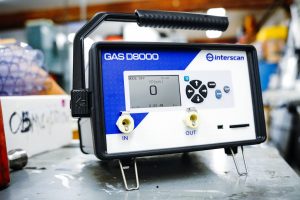
GASD 8000
Typical applications include:
- Industrial hygiene surveys
- Leak investigations
- Maintenance activities
- Process troubleshooting
- Temporary monitoring
- Repeated measurements across a facility
Fixed monitoring makes more sense when hazards exist continuously at known locations.
The InterScan AccuSafe system is designed for fixed-point monitoring with active and continuous sampling. It can support single-point or multipoint configurations and up to 10 unique gases simultaneously, depending on the system configuration.
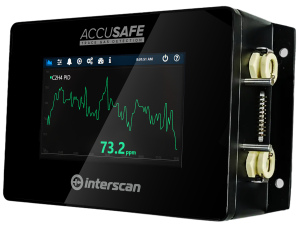
Accusafe
For facilities with both permanent hazards and mobile work, using fixed and portable equipment together may provide the most complete coverage.
4. Consider Low-Level Sensitivity
Sensitivity becomes particularly important when a gas can create health concerns well before it reaches concentrations associated with an immediately obvious incident.
Active sampling can help by continuously bringing a controlled air sample to the sensor rather than relying exclusively on natural diffusion.
InterScan specifically designs its gas detection platforms around trace-level gas sensing, with the actual detection range depending on the gas and selected sensor.
When comparing products, look beyond a manufacturer’s general claim of “high sensitivity.” Ask for the measurement range for your specific gas and application.
The useful question is not whether the detector is sensitive. It is whether it is sensitive enough at the concentrations your team actually needs to measure.
5. Look at Data Logging and Trend Information
A detector that only provides a current reading answers one question: What is the concentration right now?
A detector with continuous data logging can answer much more.
Logged measurements can help teams determine:
- When concentrations began increasing
- Whether exposure peaks repeatedly occur
- Which process conditions correspond with higher readings
- Whether corrective measures reduced concentrations
- How conditions changed during maintenance or production
- What gas levels were present during an event
The GASD 8000, for example, includes an integral 32 GB SD card for data logging along with real-time graphical concentration information.
This becomes valuable when gas detection is part of an industrial hygiene program, process investigation, or long-term exposure assessment rather than a simple presence or absence check.
For another look at the difference between ongoing readings and one-time measurements, see InterScan’s comparison of gas detectors and colorimetric tubes.
6. Account for the Operating Environment
A strong active-sampling gas detector buyer’s guide also needs to address where the instrument will actually be used.
Check temperature and humidity ratings, enclosure construction, expected contamination, power requirements, battery runtime, and hazardous-location requirements before selecting equipment.
This last point is particularly important around combustible gases, vapors, and other potentially explosive atmospheres.
A general-purpose portable detector should never be assumed to be appropriate for a classified area simply because it is rugged or portable. Intrinsically safe equipment must meet specific design and certification requirements.
InterScan offers the GASD IS for applications where intrinsically safe portable gas detection is required. Facilities comparing portable platforms can also review the GASD IS versus GASD 8000 comparison.
7. Consider Maintenance and Sensor Replacement
Gas detector ownership does not end after installation.
Ask how frequently sensors require replacement, how calibration is performed, whether the detector must be returned to the manufacturer for routine sensor changes, and how much downtime maintenance creates.
These questions become increasingly important when a facility operates multiple detectors.
InterScan addresses this through its Interchange Sensor System and SensorExpress program. The goal is to make sensor replacement and calibration management more straightforward while limiting interruptions to monitoring.
Total cost of ownership should therefore include more than the initial instrument price. Consider sensors, calibration, labor, downtime, training, and data-management requirements over the expected service life of the detector.
Making the Final Selection
The best active-sampling system is the one that matches the actual monitoring objective.
Start with the target gas and required concentration range. Then evaluate sampling configuration, response needs, portability, fixed monitoring requirements, data logging, environmental conditions, and maintenance.
Active sampling is particularly useful when you need controlled sample delivery, continuous measurements, trace-level detection, or the ability to pull samples from locations away from the instrument.
InterScan offers portable and fixed active-sampling options for a wide range of toxic gas monitoring applications. If you are comparing systems, explore InterScan’s active-sampling gas detection platforms and talk with the InterScan team about the sensor, range, and sampling configuration that fits your facility.
Frequently Asked Questions
What is an active-sampling gas detector?
An active-sampling gas detector uses a pump to draw air into the instrument and across the sensor. This differs from a passive diffusion detector, which relies on natural air movement to bring gas into contact with the sensing element.
When should I choose active sampling instead of diffusion?
Active sampling is useful when an application requires controlled sample movement, low-level measurement, remote sampling through tubing, leak investigation, or continuous monitoring of changing gas concentrations. The best approach still depends on the gas, environment, and monitoring objective.
Can active-sampling gas detectors be used for both fixed and portable monitoring?
Yes. Active sampling is a sampling method rather than a specific detector format. Portable systems such as the InterScan GASD 8000 can actively sample while technicians move between measurement points, while fixed systems such as AccuSafe provide continuous active sampling at designated facility locations.