Selecting a gas detector is not only about choosing the right sensor or measurement range. In facilities where flammable gases or vapors may be present, the area classification can determine which instruments are appropriate before measurement performance even enters the discussion. Gas detection for classified areas requires equipment designed to operate without becoming a potential ignition source, while still providing the sensitivity, sampling performance, alarms, and data needed by industrial hygiene and safety teams.
For refineries, chemical plants, fuel handling operations, tank farms, and certain confined spaces, this distinction is central to detector selection. A portable instrument may offer excellent analytical performance, but that alone does not make it suitable for use in a hazardous location.
Start With the Area Classification
The first question should be simple: where will the detector actually be used?
Classified locations are environments where flammable gases or vapors may exist at concentrations that create an ignition risk. Equipment used in these locations must be evaluated according to the hazard classification that applies to the area.
This is why intrinsic safety matters. An intrinsically safe instrument is designed so its electrical and thermal energy remain below levels capable of igniting a hazardous atmosphere under the conditions covered by its certification.
For gas detection for classified areas, the certification should be treated as a core specification, not an optional feature.
InterScan’s GASD IS is UL certified for Class I, Division 1, Groups A, B, C, and D locations. It is also certified for Class I, Zone 0, AEx ia IIC T4 Ga in the United States and Ex ia IIC T4 Ga in Canada. These classifications allow the analyzer to be used directly in hazardous areas where flammable gases or vapors may be present.
Subscribe to receive our monthly round-up of articles.
Teams comparing portable options can also review InterScan’s detailed comparison of GASD IS vs GASD 8000 for classified-area applications.
Do Not Confuse Ruggedness With Intrinsic Safety
Industrial instruments are often described as rugged, portable, or suitable for harsh environments. Those characteristics matter, but none automatically indicate that an instrument is appropriate for a classified location.
A rugged enclosure may resist physical damage. A portable analyzer may work well during maintenance inspections. A detector may also provide excellent trace-level sensitivity. Unless the instrument carries the hazardous-location certification required by the facility, however, those advantages do not establish suitability for a combustible environment.
This is an important distinction when comparing the GASD IS with the GASD 8000 portable gas detector. Both platforms support active sampling, low-level toxic gas measurement, real-time readings, alarms, data logging, and portable operation. The difference is that GASD IS is specifically certified around intrinsic safety requirements for hazardous classified locations.
Consider How the Sample Reaches the Sensor
Certification answers whether an instrument can be brought into a classified area. The next issue is how effectively it measures the atmosphere.
Active sampling can be particularly useful when technicians need to investigate specific equipment, monitor near a suspected leak source, sample through tubing, or observe changing gas concentrations during a task.
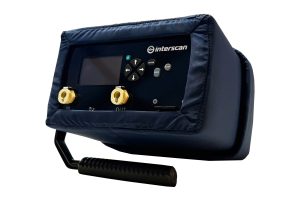
The GASD IS uses continuous active air sampling with an integral pump rather than relying solely on passive diffusion. InterScan’s current product information describes the system as providing active and continuous sampling while delivering extremely low-level sensitivity, depending on the gas and sensor configuration.
GASD IS
Taking the detector into the classified location can also shorten the sample path compared with positioning a non-certified analyzer outside the area and using long sampling lines. That can provide measurements closer to the actual point of concern and reduce complications associated with remote sampling.
Match the Detector to the Target Gas
Gas detection for classified areas still needs to begin with a clear understanding of the chemical hazard.
Ask:
- Which gas or gases need to be measured?
- What concentration range matters for the application?
- How low does the detection limit need to be?
- Is the concern occupational exposure, process leakage, or both?
- Does the atmosphere contain other compounds that could affect the measurement?
- How quickly does the team need to see changes in concentration?
This is especially important because toxicity and flammability are separate issues. Some gases can create serious health concerns at concentrations far below levels associated with combustion.
The GASD IS is designed for trace-level toxic gas detection and supports a range of target gases, including ammonia, ethylene, ethylene oxide, formaldehyde, hydrazine, hydrogen sulfide, nitrogen dioxide, and sulfur dioxide.
That targeted approach gives industrial hygienists a way to select detection around a known chemical hazard instead of relying only on a broad indication that an atmospheric change has occurred.
Look Beyond the Instantaneous Reading
A useful field detector should provide more than a concentration value at a single moment.
For routine industrial work, teams may need to understand how concentrations change during a maintenance procedure, determine whether an intermittent release occurred, document exposure conditions, or review measurements after an event.
Useful capabilities therefore include:
- Real-time concentration readings
- Trend visualization
- Audible and visual alarms
- Data logging
- Adjustable alarm thresholds
- A display that remains readable in field conditions
- Outputs that can support larger monitoring or data systems
The GASD IS includes a sunlight-visible transflective LCD, integral 32 GB SD-card data logging, audible and visual alarms, and analog outputs. Its enclosure is anodized aluminum and the current brochure lists an operating environment of 32°F to 113°F, or 0°C to 45°C.
For work involving restricted-entry environments, InterScan’s guide to gas detection in confined spaces provides additional context on atmospheric monitoring strategy.
Maintenance Should Be Part of the Selection Process
Measurement performance on the first day is only one part of detector ownership. Sensor replacement, calibration, routine checks, and equipment downtime affect the long-term usefulness of a gas detection program.
InterScan uses its Interchange Sensor System to simplify sensor replacement without requiring the entire instrument to be returned for routine sensor changes. Its SensorExpress program also provides replacement sensors to support ongoing calibration and maintenance requirements.
For facilities operating multiple detectors, this can make maintenance easier to standardize and reduce the amount of time equipment is unavailable.
When GASD IS Becomes the Logical Choice
For a general industrial area that does not require intrinsically safe equipment, factors such as target gas, sensitivity, portability, sampling method, and data requirements may lead to several viable detector options.
Once the work moves into a classified area, the decision becomes narrower.
Facilities should prioritize:
- Certification for the specific hazardous-location classification
- Detection capability for the target gas and concentration range
- Active sampling performance
- Alarm and data-logging requirements
- Field portability and usability
- Maintenance and sensor replacement procedures
- Compatibility with the facility’s broader safety program
This is where a purpose-built system has an advantage over trying to adapt a general portable detector to a hazardous-location application.
For operations that need gas detection for classified areas, InterScan’s GASD IS combines UL-certified intrinsic safety with active sampling, trace-level gas detection, real-time data, alarms, and portable field operation. Review the GASD IS intrinsically safe gas detector and contact InterScan to discuss the target gas, measurement range, classified-area requirements, and sampling configuration for your application.
Frequently Asked Questions
What does intrinsically safe mean for a gas detector?
An intrinsically safe gas detector is designed and certified so that its electrical or thermal energy does not create an ignition source under the hazardous-location conditions covered by its certification. This allows appropriately certified equipment to operate in locations where combustible gases or vapors may be present.
Can any portable gas detector be used in a classified area?
No. Portability, rugged construction, or good measurement performance does not automatically make an instrument suitable for a hazardous classified location. The detector should carry the certification required for the specific area in which it will operate.
What makes the GASD IS suitable for classified environments?
The GASD IS is UL certified as intrinsically safe for Class I, Division 1, Groups A, B, C, and D and for Class I, Zone 0 applications under its listed U.S. and Canadian protection classifications. It also combines active sampling, trace-level detection, data logging, alarms, and portable operation for field measurements in combustible environments.