For many facilities, a standard gas detector does exactly what is required. The target gas is known, the monitoring points are straightforward, and an established portable or fixed system fits the application. But some projects do not fit neatly into a standard configuration. Comparing off-the-shelf gas detectors vs custom Interscan systems becomes important when the facility has unusual monitoring requirements, multiple hazards, specific control requirements, or an existing infrastructure that the gas detection system must work with.
The question is not whether custom engineering is always better. It is whether the added engineering solves a real operational problem that a standard detector cannot solve efficiently.
When Off-the-Shelf Gas Detection Makes Sense
Standard gas detectors are usually the logical starting point.
If the facility needs to monitor a known gas within the operating capabilities of an existing detector, there is little reason to complicate the project. Interscan already provides platforms designed around common portable and fixed gas monitoring requirements.
For portable applications, the GASD 8000 provides active continuous sampling, data logging, audible and visual alarms, analog outputs, real-time graphics, and low-level detection for a range of toxic gases. It can operate as a standalone analyzer or become part of a broader connected monitoring environment.
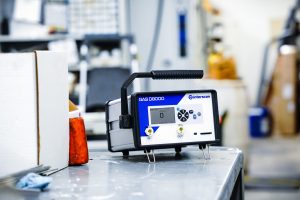
GASD 8000
For continuous fixed monitoring, AccuSafe supports distributed sensor modules connected to a central controller. The system supports configurations with up to 10 smart sensor modules and can monitor multiple gases across a facility.
Subscribe to receive our monthly round-up of articles.
Standard systems generally make sense when:
- Monitoring requirements are clearly defined
- Existing sensor ranges cover the target gas
- Standard alarm functions meet the application
- Conventional data logging is sufficient
- Existing communications interfaces match the facility
- Monitoring locations and environmental conditions are relatively straightforward
In these situations, using an established platform can simplify specification, installation, training, and maintenance.
Facilities deciding between monitoring architectures may also find Interscan’s discussion of fixed and portable gas detectors useful. Fixed or Portable Gas Detectors: What Does Your Facility Need?
Where Standard Systems Start Reaching Their Limits
The off-the-shelf gas detectors vs custom Interscan systems decision changes when the monitoring requirement is driven by the process rather than by a standard instrument specification.
Consider an engineering firm designing a safety system for a chemical process. The facility might need sensors at several process points, a particular alarm sequence, communication with existing controls, and monitoring for gases that require different detection ranges.
At that point, simply choosing detectors from a catalog may leave the engineering team responsible for making several unrelated components work together.
Gas detection is also influenced by more than the target gas. Sensor placement depends on the process, possible release locations, airflow, equipment layout, environmental conditions, and how a gas disperses after release.
Interscan’s guide to gas detector placement discusses why these variables matter when designing fixed monitoring systems. How to Place Gas Detectors for Optimal Safety and Accuracy
When those variables produce unusual requirements, custom engineering starts to become more valuable.
What a Custom Interscan System Can Address
Interscan develops customized gas detection solutions for companies that already understand their client’s application, specifications, and regulatory requirements.
That model is particularly relevant for EHS consultants, safety and engineering firms, regulatory specialists, and environmental solution providers. Rather than replacing the engineering work already completed by those organizations, Interscan can serve as the technical partner responsible for turning their specifications into a purpose-built detection system.
Custom projects can include:
- Multi-gas monitoring systems configured around specific processes
- Sensors and monitoring systems for hazardous-material handling
- Monitoring solutions for unusual environmental conditions
- Application-specific combinations of detection technologies
- Systems designed around defined client or regulatory specifications
This approach matters because a custom gas detection system does not necessarily mean designing every component from scratch. Existing Interscan technologies can provide the foundation while the overall architecture is configured around the application.
Integration Can Be the Point Where Custom Engineering Pays Off
One of the strongest reasons to consider a custom solution is system integration.
Modern gas detection rarely operates completely independently. Monitoring data may need to reach a control room, plant network, alarm system, supervisory platform, or automated process control.
AccuSafe illustrates what this connected architecture can look like. Its controller supports Modbus TCP and RTU communications, remote browser access, a desktop interface, MQTT API connectivity, configurable I/O, and control approaches including PID, ON/OFF, and open-loop operation.
Those capabilities create considerably more flexibility than a detector that simply produces a local alarm.
In a larger installation, the real engineering question may therefore be less about detecting the gas and more about determining what should happen after the gas is detected.
For example, the system may need to:
- Activate a local alarm
- Notify personnel remotely
- Send readings to another control system
- Initiate ventilation
- Trigger an actuator
- Log information for later analysis
- Coordinate several sensing locations
Interscan also discusses this scalability issue in its comparison of connected and standalone monitoring architectures. Modbus-Connected Gas Detection vs Standalone Monitors
Custom Engineering Should Solve a Specific Problem
Custom equipment naturally requires more application definition than selecting a standard product. That additional effort makes sense when it removes another source of engineering complexity.
A useful way to evaluate off-the-shelf gas detectors vs custom Interscan systems is to ask what would have to be added around the standard detector.
Would the project require separate pumps, controllers, data acquisition equipment, custom software, communication converters, or external alarm logic? Would several vendors need to supply components? Would the engineering team then have to validate how all of those pieces interact?
If the answer is yes, a customized system can become attractive because the engineering effort is concentrated into a coordinated monitoring solution.
The same principle applies when a client has already established detailed safety or compliance specifications. Instead of adapting the process to the limitations of a standard product, the detection system can be developed around those requirements.
Do Not Customize What Already Works
Custom engineering should not be treated as the default choice.
Interscan’s standard platforms already provide capabilities that would have required considerably more external equipment in older monitoring architectures. GASD 8000 includes onboard processing and data logging in a portable platform. AccuSafe distributes pumps, processing, and data acquisition across smart sensor modules while providing centralized visibility.
That means many sophisticated applications can still be handled with standard equipment.
The point where customization pays off is when the application introduces requirements that cannot be addressed cleanly by the existing architecture.
FAQs
What is the main difference between an off-the-shelf detector and a custom Interscan system?
An off-the-shelf detector uses an established product configuration designed to cover common monitoring applications. A custom Interscan system is developed around defined client requirements, such as unusual environmental conditions, specific multi-gas configurations, hazardous-material processes, or specialized system requirements.
When should an engineering firm consider a custom gas detection system?
Custom engineering is worth considering when the firm has already defined detailed process, safety, or regulatory requirements that cannot be addressed efficiently with a standard detector. It can also make sense when multiple components would otherwise need to be integrated separately.
Can standard Interscan equipment still support connected gas detection?
Yes. AccuSafe provides Modbus communications, remote interfaces, configurable I/O, data storage, and other integration capabilities, while GASD 8000 supports analog outputs and integration with connected operations. A fully custom system is not necessary simply because connectivity is required.
Choosing between off-the-shelf gas detectors vs custom Interscan systems ultimately comes down to how closely an existing product matches the application. When a standard GASD 8000 or AccuSafe configuration meets the requirement, keeping the architecture simple usually makes sense. When the monitoring system has to conform to a specialized process, environmental condition, control strategy, or detailed client specification, custom engineering can remove compromises from the project.
For applications that have moved beyond a standard configuration, explore Interscan’s customized gas detection solutions and talk with the Interscan team about building a system around your project requirements. Explore Interscan Customized Gas Detection Solutions