When safety teams compare Interscan gas detectors vs Colorimetric Tubes, the biggest difference is not simply electronic versus chemical detection. It is the type of information each method provides. A colorimetric detector tube usually gives a concentration reading for a specific sample taken at a specific moment. Interscan gas detectors can actively sample air and provide real-time readings over a longer monitoring period. For facilities where gas concentrations can change during a process, shift, leak, or maintenance activity, that difference can affect how quickly personnel recognize changing conditions.
Colorimetric tubes still have legitimate uses. They are simple, familiar, and useful for certain screening applications. The question is whether a snapshot is enough for the job or whether the application requires continuous visibility.
How colorimetric detector tubes work
A colorimetric detector tube is a sealed glass tube containing a chemical reagent. The ends are opened before use, and a compatible hand pump draws a known volume of air through the tube. If the target gas is present, the reagent changes color. The user determines the concentration by comparing the resulting stain length or color change with markings on the tube.
This approach has several practical advantages. Detector tubes are relatively inexpensive, easy to transport, and available for a large number of gases and vapors. Interscan also notes that the basic detector tube method is intrinsically safe, which can be useful in environments where electrical equipment requires additional consideration.
For a technician who suspects a known gas is leaking from a particular component and needs a quick indication, a tube may be completely reasonable.
That is why the better comparison of Interscan gas detectors vs Colorimetric Tubes is not whether tubes work. They do. It is whether a single measurement provides enough information for the monitoring objective.
A spot check only captures one part of the story
OSHA describes detector tubes as especially useful for screening to determine whether contaminant levels warrant additional sampling. OSHA also notes that most detector tubes provide near-instantaneous measurements and therefore do not represent changing concentrations over longer periods, although specialized long-duration tubes are available for some applications.
Subscribe to receive our monthly round-up of articles.
This matters whenever gas concentrations fluctuate.
Consider a process where emissions rise during startup, fall during normal operation, and rise again during cleaning. A detector tube used at 10:00 a.m. may accurately characterize the sampled air at 10:00 a.m., but it does not tell you what happened several minutes before or what will happen later.
Continuous gas detection fills those gaps.
Interscan discusses this difference in more detail in its article Detector Tubes and When to Use Them, noting that conventional detector tubes are best suited to one-shot evaluations rather than routine or prolonged monitoring.
What continuous Interscan gas detection adds
The Interscan gas detector product line includes portable and fixed monitoring options, allowing safety teams to choose continuous detection based on where and how gases need to be measured. The current product lineup includes the portable GASD 8000, the GASD IS for classified-area applications, and the fixed-point AccuSafe system.
The GASD 8000 illustrates the difference clearly. It uses active and continuous sampling through an integral pump and displays gas concentration digitally along with real-time graphics. It also includes integral data logging plus audible and visual alarms. Interscan specifies up to eight hours of continuous battery-powered service and detection configurations across 21 gases.
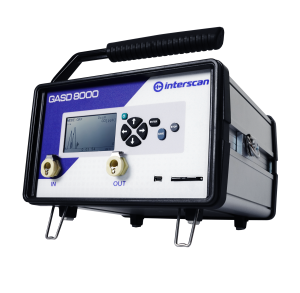
The Interscan GASD 8000 provides portable, continuous gas monitoring for field surveys, maintenance, and task-based applications.
Instead of taking one reading and removing the sampling device, the operator can watch concentration changes as they happen.
That makes portable electronic detection useful for:
- Leak investigations
- Industrial hygiene surveys
- Maintenance activities
- Process troubleshooting
- Repeated measurements
- Monitoring changing work areas
- Applications where an immediate alarm is important
Interscan also uses active sampling in its AccuSafe fixed gas detection system. AccuSafe provides continuous sampling, real-time concentration information, data logging, audible and visual alarms, and network connectivity. It can support multiple sensor modules for facility-level monitoring.
For more on this sampling approach, see Interscan’s guide to active vs passive sampling of gaseous pollutants.
Continuous readings make trends visible
A major advantage in the Interscan gas detectors vs Colorimetric Tubes comparison is the ability to see concentration over time.
A tube produces a measurement that personnel can document manually. A gas detector with data logging can produce a sequence of readings. That gives safety managers much more context.
Logged measurements can help teams:
- Identify recurring concentration peaks
- Compare gas levels during different operating conditions
- Determine when a concentration began rising
- Review exposure conditions after an event
- Identify locations or activities associated with repeated readings
- Build a more complete history of monitored conditions
Interscan has discussed this value specifically for hydrogen sulfide monitoring. Regularly logged GASD 8000 measurements can help safety managers track patterns, document exposure history, and develop work plans around known gas conditions.
That information simply cannot be reconstructed from a few isolated measurements unless the sampling frequency happens to capture the important events.
Detector tube readings also require careful interpretation
Colorimetric tubes may look simple, but several factors affect their use.
OSHA identifies measurement accuracy, detection limits, interferences, temperature, humidity, shelf life, and stain stability as important considerations. OSHA states that detector tube measurement precision is typically about ±25 to 35 percent and notes that some chemical indicators can cross-react with other gases or vapors. Temperature, humidity, and pressure can also affect readings.
Interscan similarly notes that errors can occur when users must complete multiple pump strokes, follow timing requirements, apply environmental corrections, or interpret color changes.
Electronic detectors require their own maintenance. OSHA emphasizes that direct-reading monitors need proper testing and calibration to verify sensor response and alarm performance.
So this is not a comparison between a maintenance-free method and a maintenance-heavy one. Both require correct procedures. The difference is what the user gets in return.
With an Interscan detector, that can include continuous measurements, digital concentration readings, alarms, and stored data.
When colorimetric tubes still make sense
There are applications where investing in an electronic monitoring instrument may not be necessary.
A colorimetric tube can make sense when:
- Testing is infrequent
- The suspected gas is already known
- Only a rough screening measurement is needed
- The objective is a one-time investigation
- Continuous alarms are not required
- A suitable electronic detector is not available
Interscan itself identifies suspected plumbing leaks, preliminary hazardous material evaluations, and nuisance odor investigations as examples where tubes can provide useful quick checks.
The economics change when sampling becomes routine. Continually purchasing and using single-use tubes also adds recurring consumable costs and manual work. For repeated measurements, continuous or reusable electronic detection can become the more practical approach.
Choosing based on the monitoring objective
The simplest way to evaluate Interscan gas detectors vs Colorimetric Tubes is to ask what happens after the first reading.
If you only need to know whether a known gas appears to be present during a one-time check, a detector tube may provide enough information.
If you need to know whether concentration is rising, falling, recurring, or exceeding an alarm threshold while work continues, an electronic gas detector provides much more useful information.
If the hazard exists continuously in a known area, fixed monitoring may be the better approach. If the monitoring point moves with workers, maintenance activities, or inspections, a portable detector such as the GASD 8000 may fit better.
There is also no requirement to treat the two technologies as mutually exclusive. Facilities can keep detector tubes for occasional screening while using electronic instruments for routine safety monitoring and higher-risk applications.
The important distinction is that a spot check answers, “What is the concentration in this sample?” Continuous monitoring can answer, “What is happening to the concentration right now, and how has it been changing?”
For operations where that second question matters, explore the full range of Interscan gas detection products. Portable and fixed options provide real-time gas measurements for applications where a one-time snapshot is no longer enough.
Frequently Asked Questions
Are colorimetric tubes accurate enough for gas detection?
They can be useful for screening and certain defined sampling applications, but their precision varies by tube and manufacturer. OSHA states that detector tube precision is typically around ±25 to 35 percent and recommends considering environmental conditions, interferences, and manufacturer instructions when interpreting results.
Can Interscan gas detectors be used for spot checks?
Yes. Portable instruments such as the GASD 8000 can be taken to specific locations for targeted measurements while also providing active continuous sampling, real-time readings, alarms, and data logging. Interscan also offers a sampling wand for accessing specific or difficult-to-reach sampling locations.
When should I choose continuous monitoring instead of detector tubes?
Continuous monitoring is generally the stronger option when gas concentrations may fluctuate, measurements must be repeated frequently, alarms are required, or safety teams need data over time rather than an isolated reading. Fixed continuous monitoring is especially useful for persistent hazards in known areas, while portable electronic monitoring supports changing locations and tasks.