Formaldehyde Exposure Monitoring in Pathology Labs and Anatomy Facilities is a practical occupational safety requirement because formaldehyde and formalin remain common in specimen preservation, tissue fixation, gross anatomy work, and related laboratory procedures. These environments can produce both routine low-level exposure and short-duration concentration spikes, particularly when containers are opened, specimens are transferred, or preserved tissue is handled. A monitoring strategy needs to account for both types of exposure rather than treating formaldehyde as a hazard that can be assessed through occasional sampling alone.
Formaldehyde is especially relevant in healthcare gas detection because workers may handle it repeatedly throughout a shift. Unlike a single accidental release, exposure can result from a series of small tasks performed at benches, grossing stations, storage locations, dissection areas, and specimen-handling points.
Why Formaldehyde Exposure Requires Close Attention
Formaldehyde can irritate the eyes, skin, nose, throat, and respiratory system. OSHA also regulates it as a carcinogenic occupational hazard.
For pathology, histology, and human or animal anatomy laboratories in the United States, the regulatory distinction is particularly important. OSHA has clarified that these production laboratories are generally not covered by the Laboratory Standard’s usual framework for formaldehyde. Instead, OSHA’s formaldehyde standard applies directly to their occupational formaldehyde exposures.
OSHA establishes several concentration benchmarks:
- 0.75 ppm as the permissible exposure limit, measured as an 8-hour time-weighted average
- 2 ppm as the 15-minute short-term exposure limit
- 0.5 ppm as the 8-hour action level that triggers specific monitoring requirements under the formaldehyde standard
OSHA requires initial exposure monitoring when employees may be exposed at or above the action level or STEL. Monitoring may also need to be repeated when processes, equipment, personnel, or controls change in a way that could increase exposure.
These limits make one point clear: a monitoring program needs to understand both longer-term exposure and short-term peaks.
Subscribe to receive our monthly round-up of articles.
Where Formaldehyde Exposure Can Occur
In a pathology or anatomy facility, exposure conditions can change considerably from one task to another.
A room may have acceptable background concentrations while a worker experiences a substantially higher concentration during a specific procedure. Opening specimen containers, pouring formalin, transferring specimens, handling saturated materials, working over preserved cadavers, or responding to spills can all create localized exposure conditions.
Ventilation also plays an important role. Grossing stations and local exhaust systems are intended to control contaminants near their source, but changes in airflow, equipment condition, room configuration, or work practices may affect their performance.
This is where real-time gas detection becomes useful. Instead of receiving only a final result after a sampling period, safety teams can observe how concentrations change as work is performed.
Why Real-Time Monitoring Adds Useful Context
Traditional personal exposure sampling remains important, particularly when conducting compliance assessments. OSHA notes that representative employees may use passive badges, sorbent tubes with pumps, or other sampling methods to characterize formaldehyde exposure. Full-shift measurements are appropriate when evaluating time-weighted average exposure, while short-duration measurements are needed for tasks that may produce intense exposure.
Direct-reading instruments address a different operational need.
A real-time instrument can help a facility determine when concentrations rise, where a problem is occurring, and which activity may be responsible. That makes Formaldehyde Exposure Monitoring in Pathology Labs and Anatomy Facilities more useful for troubleshooting engineering controls and work practices.
For example, a safety professional can observe formaldehyde levels before, during, and after a specimen-handling procedure. If concentrations rise sharply during one part of the process, the team has information it can use to evaluate ventilation, handling techniques, containment, or procedure design.
Real-time monitoring can also help verify conditions after corrective actions have been implemented.
Portable Formaldehyde Monitoring With the GASD 8000
Portability is valuable when formaldehyde must be assessed at multiple locations rather than at one permanent monitoring point.
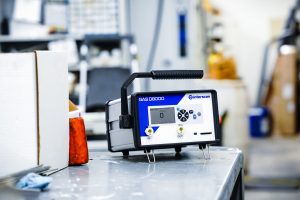
The InterScan GASD 8000 is a portable gas analyzer designed for active, continuous sampling. Formaldehyde is among the gases supported by the GASD 8000 platform. The instrument combines an integral sample pump with a digital concentration display, real-time graphics, onboard data logging, and audible and visual alarms.
GASD 8000
Those capabilities are particularly relevant to pathology and anatomy facilities because the same analyzer can be moved between potential exposure points.
A safety team could use a portable analyzer to investigate a grossing station, specimen receiving area, chemical storage location, dissection table, or another point where formalin is handled. Logged measurements also provide a record that can help teams compare conditions between activities or evaluate changes after ventilation or work-practice improvements.
The GASD 8000 provides up to eight hours of continuous battery-powered operation and stores logged data on an integral SD card. It can therefore serve as more than a spot-check instrument when facilities need to observe concentration patterns across an extended procedure or work period.
When Fixed Monitoring Makes Sense
Portable instruments provide flexibility, but some locations require continuous observation regardless of whether a safety professional is present.
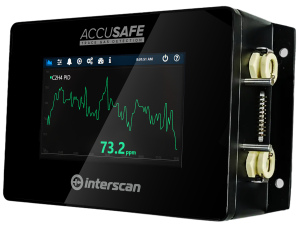
For these applications, the InterScan AccuSafe fixed gas detection system provides an always-on approach. AccuSafe uses smart sensor modules with integrated sample-draw pumps and onboard processing. A system can support multiple sensor modules connected to a controller, allowing facilities to expand monitoring across several areas.
Accusafe
AccuSafe also supports digital concentration readouts, real-time graphical information, data logging, and audible and visual alarms. Network access and notification capabilities can help responsible personnel maintain visibility without continuously standing at the monitoring location.
This type of configuration can be useful where formaldehyde is handled routinely and the potential exposure point is predictable.
Building a More Useful Formaldehyde Monitoring Program
No single measurement tells a facility everything it needs to know about formaldehyde exposure.
Personal exposure sampling answers questions about an individual worker’s occupational exposure. Portable direct-reading instruments help locate sources and identify concentration changes associated with specific activities. Fixed detection provides continuous awareness in areas where the hazard is consistently present.
Used together with ventilation controls, written procedures, employee training, PPE, and appropriate exposure assessment methods, gas detection gives safety teams another source of actionable information.
That approach is particularly useful because work environments change. Procedures are modified, equipment ages, room layouts change, and ventilation systems can perform differently over time. Formaldehyde Exposure Monitoring in Pathology Labs and Anatomy Facilities should therefore be treated as an ongoing process rather than a one-time assessment.
Frequently Asked Questions
What is OSHA’s formaldehyde exposure limit for laboratory workers?
OSHA’s permissible exposure limit is 0.75 ppm as an 8-hour time-weighted average. The short-term exposure limit is 2 ppm over 15 minutes, and the formaldehyde action level is 0.5 ppm as an 8-hour average. Specific monitoring requirements depend on exposure conditions and the applicable OSHA provisions.
Can a real-time formaldehyde monitor replace personal exposure sampling?
Not automatically. Direct-reading monitors are valuable for identifying concentration changes, locating sources, evaluating controls, and providing immediate warnings. Compliance exposure assessments may require specific sampling strategies and methods. Facilities should use monitoring equipment as part of a broader exposure-control and industrial hygiene program.
Should a pathology laboratory use portable or fixed formaldehyde detection?
It depends on how formaldehyde is used. Portable monitoring is useful when concentrations need to be investigated at different workstations or during particular tasks. Fixed monitoring makes sense where continuous awareness is needed at predictable formaldehyde-handling locations. Some facilities can benefit from using both approaches.
Pathology and anatomy facilities need formaldehyde data they can act on, not simply confirmation that the chemical is present. InterScan provides portable and fixed gas detection options designed for active, continuous monitoring of toxic gases in healthcare and laboratory environments. Explore InterScan’s healthcare gas detection solutions to see how the GASD 8000, AccuSafe, and other monitoring technologies can support a more responsive formaldehyde safety program.