- The emission levels of individual gases can differ by animal.
- However, stocking density, housing type, feed composition, bedding and floor type, and ventilation also influence concentrations, so generalizing gas risks is difficult.
- Ammonia and carbon dioxide are problems on all animal farms in housing and manure.
- Hydrogen sulfide is the most dangerous gas, followed by methane, ammonia, and carbon dioxide, in manure pits, tanks, and lagoons, especially in pig farms.
Demand for animal proteins is expected to grow by 20% by 2050. As a result, the potential risks workers and animals face from hazardous gases produced on animal farms are receiving more attention. Agricultural workers face high occupational risks of toxic exposure, fire, and explosions, with few or no government regulations on chemical hazards. This article explores the major gases produced to see whether gas risks differ by animal farmed and by gas source.
Common gases associated with animal farms
The common gases produced on animal farms that should be monitored are carbon dioxide (CO2), methane (CH4), carbon monoxide (CO), ammonia (NH3), nitrogen oxides (NO, NO2, and N2O), hydrogen sulfide (H2S), sulfur dioxide (SO2), and volatile organic compounds (VOCs). Secondary particulate matter (PM) forms from pollutants (ammonia, sulfur oxides, and nitrogen oxides), dust, and water droplets, and it also irritates the respiratory system in animals and farm workers. These gases and PM can affect human and animal health and well-being through direct health effects or by causing fires.
- Asphyxiants: Methane, CO2, and CO are asphyxiants whose accumulation reduces oxygen levels, harming or even killing people.
- Toxic: Poisonous gases include H2S, ammonia, nitrogen oxides, SO2, and VOCs.
- Fire and explosion: Gases that are explosion risks are H2S, methane, CO, and ammonia. Nitrogen oxides do not burn but act as oxidizers and can react with flammable compounds.
Common sources of these gases, as shown in Figure 1, include animals, animal waste, animal feed, and the use of machinery and other technology.
- Animals: Gases produced by internal physiology include CO2 during breathing in all animals. Methane and H2S are produced as flatulence and burps.
- Animal waste: Feces and urine are sources of manure gases: ammonia, CO2, H2S, and methane in animal stalls, waste storage pits, flushing lanes, and manure pits. These places also produce nitrogen oxides and VOCs.
- Feed: Animal feed composition in feed lanes can affect VOC gases and the amounts produced by individual animals.
- Technology: Equipment such as fossil fuel heaters and vehicles can release CO and CO2.
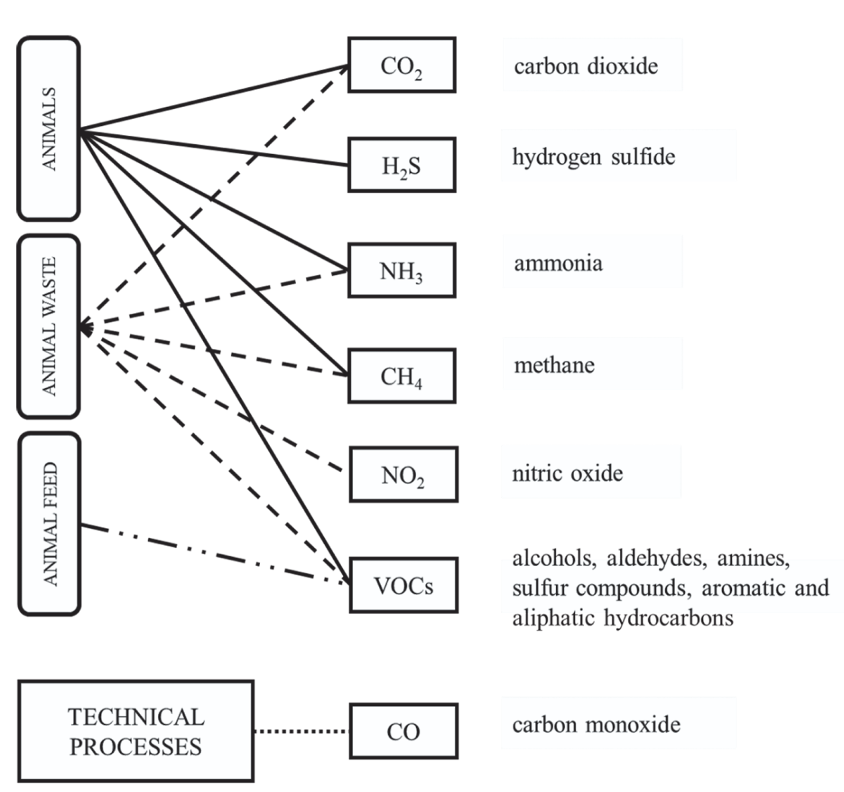
Figure 1: “The sources of released gaseous pollutants include the animals themselves, feces (whether freshly excreted, remaining in channels, or stored in slurry tanks), urine, breathing, feed, and technological equipment,” Chmielowiec-Korzeniowska et al. (2022). (Image credits: https://doi.org/10.2478/aoas-2021-0015
However, within these common processes and systems, hazardous gases, their amounts, and where they occur can vary depending on the animal reared.
Ammonia
Among gases, ammonia causes the most frequent and serious health problems for workers and animals.
Subscribe to receive our monthly round-up of articles.
The main source of NH3 is animal waste-feces and urine. The gas is produced in stalls where animals are kept, or where the waste is collected and stored, and in manure pits, tanks, and lagoons.
Table 1: “Ammonia emissions factor for assessment in Poland,” Chmielowiec-Korzeniowska (2022). (Image credits: DOI: https://doi.org/10.2478/aoas-2021-0015).

Gas production depends mainly on species; see Table 1. However, the number of animals in a building, the age and weight of animals, and the type of building determine how much gas is produced and accumulates in a building. As the number of animals increases, ammonia production increases. Ammonia is a heavy gas and tends to settle closer to the floor. The gas is colorless and invisible, but its distinct, pungent odor can alert people to its buildup.
The amount of NH3 produced also depends on the nitrogenous compounds in the animal waste and microbial activity that ferments it. Environmental factors such as temperature and pH are also important.
For all animals, ammonia is a toxic gas that must be monitored and controlled.
Cattle: NH3 is produced in manure from cows. Cows that are kept for dairy production produce more NH3 from their waste than cattle for beef. Differences in nutrient composition drive these differences. Dairy cow feed has high nitrogen, but only 33% ends up in milk or is retained to grow a fetus; the remaining 67% is excreted in feces (36%) and urine (32%). Around 65-75% of the nitrogen in urine is in the form of urea, which is broken down to give ammonia. Higher temperatures and more mixing of liquid and solid animal wastes produce more ammonia in manures when the pH is over 9.4. At lower pH, ammonia is not volatile but exists as ammonium. NH3 can also be found in cow housing and hard standings. Naturally ventilated cow sheds have low NH3 levels.
Horses: Decomposing urine in bedding releases NH3 and is the main source of the gas in horse barns and stalls. Bedding collects and absorbs it. Ammonia levels vary by bedding material, which includes straw, paper cuttings, straw pellets, hemp, and wood shavings. Straw pellets absorb the most, bind ammonia, and prevent it from converting to gas. By choosing bedding materials, cleaning daily, and designing buildings for proper ventilation, you can reduce NH3 levels. Animals are more exposed to NH3 when they lie down or when they are young and smaller. Concentrations of 20–25 mg/m3 are very high and can irritate animals’ respiratory systems. Horses are likely to be more affected by NH3 accumulation than workers because they spend more time in stalls.
Pigs: NH3 gas is formed in manure, urine in storage pits, and on stall floor surfaces. In ventilated buildings, levels are around 5-20 ppm but can rise to 10-50 ppm when manure and urine are on solid floors. During winter, poor ventilation can raise NH3 levels to 100 ppm. NH3 values fall in pig farms when manure is cleaned daily instead of weekly.
Poultry: In chicken houses, the gas comes from the chemical decomposition of uric acid in bird droppings. Poultry farms have some of the highest NH3 levels despite a low emission factor because of stocking densities and high manure moisture. However, in many places, a manure belt catches and transports excreta out of the house, helping keep levels below harmful concentrations. Poor ventilation, however, can be a problem, especially in winter, and can raise NH3 levels. For poultry, the permissible level is 15 ppm. In Spain, Barrasa et al. (2012) found that short-term NH3 levels are highest in poultry farms, followed by pigs, and then cattle farms, where animals were housed, which they attribute to stocking densities.
For workers, OSHA advocates a permissible exposure limit (PEL) for ammonia of an average of 50 ppm over an 8-hour period.
Carbon Dioxide
Carbon dioxide is produced on animal farms through animal respiration. The number of animals, their size, ventilation, and manure handling will influence CO2 levels in the animal stalls.
Poultry: On poultry farms, it is also produced during the degradation of uric acid in bird droppings. Flame heaters also produce some CO2 during the brooding season. Other factors that influence CO2 production in birds include diet composition, feeding rates, activity, and age. According to Al-Kerwi et al. (2022), even young chicks can tolerate 4000 ppm of CO2 without any ill effects. Very high CO2 levels can change behavior, activity, and production. At 118000 ppm, birds develop gasping and shortness of breath, with death occurring at 174000 ppm.
Pig farms: Small amounts of CO2 are formed and released from manure due to the breakdown of urea and degradation (aerobic and anaerobic) of organic matter. Exposure to CO2 levels above 40,000 ppm seriously affects pig health.
CO2 production is a concern for livestock in barns and manure pits. Daily CO2 levels vary across different animal farms. Dangerous CO2 levels can build up in poorly ventilated barns or manure pits, and workers must enter them with extreme caution. OSHA sets the safe occupational CO2 level for people at 5000 ppm.
Barrasa et al. (2012) found that human exposure to CO2 levels on livestock farms varies day to day and depends on temperature and activity in animal houses.
Methane
Methane is a major gas produced in manure storage sites through anaerobic breakdown. It is also produced through enteric fermentation, where microbes digest fibers resistant to enzymes. Livestock species determine how much methane is produced from these two sources. Other factors that influence gas production include the animals’ life stage, weight, feed composition, and intake.
Cattle farms produce around 86% of intestinal methane in their ruminant guts, while pig farms release only 10%. Large cattle farms are a major source of the gas, with 95% released through burps. Enteric fermentation accounts for 40-50% of total farm methane production for cattle and only 3-4% for pigs.
However, methane production rates per animal from manure can be higher. Whereas pig digestion produces only 1.5 kg/pig, manure pits produce 9-12 kg/pig. Most of the methane on pig and poultry farms comes from manure.
Hence, manure pits are the main areas of methane risk, where it is formed naturally. However, foaming manure traps very high concentrations of 50–70% methane, which is not a fire risk. Stirring the foam can release the gas, which, when diluted with air, reduces methane levels to 5-15% (or 50,000 to 150,000 ppm), when it is a fire risk. Also, every 4% of methane can displace 1% of oxygen and cause asphyxiation. Therefore, stir manure foams only with adequate personal protective gear.
Methane is also produced in areas that are pressure-washed, have feed systems, have manure pumped, and where welding and grinding are done close to manure. Methane is lighter and rises through and from floors to accumulate in higher areas of a room. People and animals must be removed from a room before disturbing manure foam.
OSHA advocates a methane permissible exposure limit (PEL) of 1000 ppm over an 8-hour period. For methane, its LEL (Lower Explosive Limit) should also be monitored near manure
Hydrogen Sulfide
H2S is the most toxic gas found on farms, as it can be immediately lethal at high doses. It is responsible for the accidental deaths reported on farms. It is found in all manure pits because anaerobic breakdown of organic matter produces it. It can also be found in animal housing where solid animal waste is not regularly cleared. H2S is a risk outdoors in manure lagoons and tanks and indoors in barns.
Poultry farms have higher H2S levels in housing than dairy and swine farms. Like people, animals can suffer respiratory problems from H2S. Poultry farms with high ammonia levels also report high H2S levels. Composting pits can have higher H2S levels than manure pits on poultry farms.
Cattle farms have less H2S in the manure than pig farms.
H2S production is highest in pig manure compared to other livestock farms because of the high sulfur content in dried distiller’s grain in feed and cleaning water, which increases sulfur levels in manure. Moreover, pigs’ monogastric stomachs do not break down all organic matter, unlike ruminant digestion in cattle. Pig waste is also a slurry of liquids and solids that settles in layers in pits, making it more conducive to anaerobic breakdown by sulfate-reducing bacteria. Lack of ventilation also increases the risk of H2S accumulation. Pig farms with deep pit manure systems, slats, and mechanical ventilation have higher NH3 and H2S levels than other systems.
The background level of H2S in pig stalls is 2 ppm, but it can rise to dangerous levels of 200 to 1500 ppm within seconds if foam on manure on the floor is stirred. Levels above 500 ppm can cause unconsciousness and death.
H2S is “Immediately Dangerous to Life or Health” (IDLH) at 100 ppm for people.
VOCs
VOCs produced by each farm type can differ by animal species because feed, digestive systems, manure management, and housing systems vary. The VOCs found can be classified as phenols, alcohols, carbonyls, carboxylic acids, and nitrogen- and sulfur-containing compounds.
VOC levels can differ even within a species. More VOCs are produced in dairy farms than beef cattle farms. Animals release acetone, a VOC, while breathing, and it is found in animal stalls. Waste removal and feeding release the most VOCs on cattle, pig, and sheep farms. Feed storage and handling account for a significant proportion of VOCs produced. This ranges from 35-41% in dairy farms, 23.30% in beef cattle farms, 13% in sheep yards, and 41% in poultry farms.
In dairy farms, silages and feed piles produced the most VOCs, especially ethanol, more than waste.
Monitoring Hazardous Gases
All animal farms produce H2S, NH3, methane, CO2, and VOCs, as well as CO, nitrogen oxides, and sulfur oxides. The VOCs produced can vary based on several factors. For the other four major gases, proportions and quantities vary by species, and emission factors have been developed to calculate releases. However, gas emission trends cannot be generalized by species because other environmental and management factors influence gas production rates.
So, all animal farms should at least monitor NH3, H2S, methane, and CO2, as these cause the most loss of life and damage to facilities. Additionally, consider risks from other hazardous gases produced on animal farms.
Interscan provides fixed and portable gas detectors for many of the gases found on animal farms. Fixed detectors are suitable for around-the-clock gas monitoring to maintain animal health and productivity. Workers can use portable sensors when working near manure and when entering poorly ventilated areas.
Contact us for more information or demos of the gas detectors for your farm.
Sources
Al-Kerwi, M. S. M, Mardenli, O., Mahdi Jasim, M. R., & Al-Majeed, M. A. (2022, July). Effects of harmful gases emitted from poultry houses on productive and health performance. In IOP Conference Series: Earth and Environmental Science (Vol. 1060, No. 1, p. 012082). IOP Publishing.
Bazay, C. (2026, July 22). Air Quality in Horse Barns: Respiratory Health, Dust & Ventilation. Retrieved from https://madbarn.ca/air-quality-in-horse-barns/
Chmielowiec-Korzeniowska, A., Tymczyna, L., Wlazło, Ł., Trawińska, B. & Ossowski, M. (2022). Emissions of Gaseous Pollutants from Pig Farms and Methods for their Reduction – A Review. Annals of Animal Science, 22(1), 89-107. https://doi.org/10.2478/aoas-2021-0015
Donham, K., Aherin, R., Baker, D., & Hetzel, G. (2006, June 3). Safety in Swine Production Systems. Retrieved from https://porkgateway.org/resource/safety-in-swine-production-systems/
Grout, L., Baker, M. G., French, N., & Hales, S. (2020). A Review of Potential Public Health Impacts Associated With the Global Dairy Sector. GeoHealth, 4(2), e2019GH000213. https://doi.org/10.1029/2019GH000213
Guelph, E. (2025, Nov 12). The Importance of Quality Air in the Horse Stable. Retrieved from https://www.horsejournals.com/horse-care/illness-injury/prevention/importance-quality-air-horse-stable
Wålinder, R., Riihimäki, M., Bohlin, S., Hogstedt, C., Nordquist, T., Raine, A., Pringle, J., & Elfman, L. (2011). Installation of mechanical ventilation in a horse stable: effects on air quality and human and equine airways. Environmental health and preventive medicine, 16(4), 264–272. https://doi.org/10.1007/s12199-010-0195-5
Yuan, B., M.M. Coggon, A.R. Koss, C. Warneke, S. Eilerman, J. Peischl, K.C. Aikin, T.B. Ryerson, and J.A. de Gouw, Emissions of volatile organic compounds (VOCs) from concentrated animal feeding operations (CAFOs): chemical compositions and separation of sources, Atmospheric Chemistry and Physics, doi:10.5194/acp-17