Hydrazine monitoring for aerospace fueling, test cells, and propellant handling requires more than simply confirming that a leak has occurred. Aerospace teams need to identify low-level releases quickly, understand how concentrations change during an operation, and maintain monitoring coverage wherever hydrazine may be transferred, connected, disconnected, stored, or tested. Because hydrazine is toxic at very low concentrations, the quality and placement of gas detection equipment directly affect how effectively personnel can respond.
Hydrazine remains relevant to aerospace operations because of its use in rocket propellants and spacecraft systems. NIOSH identifies hydrazine as a potential occupational carcinogen and lists a recommended exposure limit of 0.03 ppm as a two-hour ceiling. That low concentration illustrates why aerospace facilities need detection equipment designed specifically for trace-level toxic gas measurement rather than relying only on systems intended to identify much higher gas concentrations.
Why Hydrazine Requires Dedicated Monitoring
Hydrazine is a colorless, fuming liquid with an ammonia-like odor. It can present inhalation and skin exposure hazards, and it is also highly reactive. NIOSH specifically identifies workers involved in rocket propellant and spacecraft fuel applications as potential exposure groups.
In practical aerospace operations, exposure risk is not limited to a major release. Smaller leaks can develop around:
- Transfer connections and fittings
- Fueling and servicing equipment
- Pumps, valves, and flexible lines
- Propellant storage areas
- Test equipment and test cells
- Maintenance activities
- Purge and ventilation systems
- Disconnection points following fueling
That makes early detection particularly important. A monitor that continuously samples the atmosphere can show whether hydrazine is present, whether concentrations are increasing, and whether conditions return toward baseline after work is completed.
For organizations evaluating gas detection for aerospace applications, monitoring strategy should therefore address both permanent risk areas and temporary work zones.
Monitoring Aerospace Fueling Operations
Propellant transfer and spacecraft fueling can place technicians close to hoses, valves, couplings, and other potential release points. Procedures may be carefully controlled, but the monitoring system still needs to provide useful information throughout the operation.
Subscribe to receive our monthly round-up of articles.
Portable detection has an important role here because the location requiring monitoring can change as work progresses.
The GASD 8000 is a portable gas analyzer that supports hydrazine detection and uses active sampling through an integral pump. It provides a digital concentration readout, real-time graphical information, onboard data logging, and audible and visual alarms. The system can operate for up to eight hours using its rechargeable lithium-ion battery.
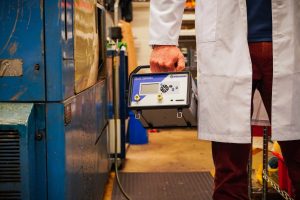
GASD 8000
For fueling teams, those capabilities allow a monitor to be positioned where the work is actually happening rather than relying entirely on a permanently mounted detector some distance away.
Active sampling is also useful when teams need to monitor a defined location, connection point, enclosure, or area where air must be deliberately drawn through the sensing system.
Hydrazine Monitoring in Test Cells
Test cells present a different monitoring problem. Equipment generally stays in a known location, which makes continuous fixed detection practical.
A test cell may also experience changing airflow, ventilation cycles, equipment configurations, and operating conditions. Monitoring only during a specific procedure can leave gaps between tests or during maintenance.
The AccuSafe fixed gas detection system provides continuous active sampling and supports hydrazine among its available target gases. A system can operate in single-point or multi-point configurations, with up to ten sensor modules connected to a controller. Individual sensor modules include integrated sample-draw pumps and local data processing.
This architecture gives aerospace facilities a way to monitor several identified risk points rather than assuming that one detector represents conditions throughout an entire room.
Potential locations could include areas near test equipment, propellant connections, ventilation pathways, storage locations, or other points identified through the facility’s hazard assessment.
AccuSafe also provides data logging and network connectivity. That can be useful when teams need more than an alarm. Historical concentration information can help safety personnel review an event, examine recurring patterns, and determine whether particular procedures regularly produce detectable releases.
Fixed and Portable Detection Work Better Together
Hydrazine monitoring for aerospace fueling, test cells, and propellant handling rarely fits neatly into either a fixed or portable category.
Fixed monitors make sense where a hazard remains associated with a predictable location. Portable instruments are useful when the task, equipment, or personnel move.
An aerospace facility may therefore use AccuSafe for continuous monitoring of permanent work areas while deploying GASD 8000 instruments during activities such as:
- Fuel transfer
- System servicing
- Pre-test inspections
- Maintenance
- Leak investigations
- Post-operation verification
- Temporary propellant handling
This layered approach helps maintain continuous coverage while giving personnel additional measurement capability directly at the point of work.
Why Trace-Level Measurement Matters
Hydrazine presents an important distinction between toxic gas monitoring and general combustible-gas detection.
A detector designed primarily to warn about a percentage of the lower explosive limit addresses a different hazard. Hydrazine exposure limits are measured at much lower concentrations. NIOSH’s recommended two-hour ceiling is 0.03 ppm, while the published lower explosive limit is approximately 2.9 percent by volume.
Those numbers are separated by several orders of magnitude.
For personnel protection, waiting until a concentration approaches a meaningful percentage of the LEL would therefore not provide the same information as a trace-level toxic gas analyzer.
This is where target-gas instrumentation becomes valuable. InterScan systems are designed around low-level toxic gas measurement and active sampling, giving aerospace safety teams information that is directly related to the contaminant they need to control.
Data Logging Supports More Than Immediate Alarms
An alarm tells personnel that a threshold has been reached. Logged concentration data provides additional context.
For aerospace teams, recorded measurements can help answer questions such as:
- When did the concentration begin increasing?
- How high did it rise?
- How long was hydrazine detectable?
- Did ventilation reduce the concentration as expected?
- Are similar readings appearing during repeated procedures?
- Was the atmosphere clear before personnel returned to the area?
Both GASD 8000 and AccuSafe provide data logging capabilities. This makes them useful not only for immediate warning but also for reviewing operations and improving monitoring procedures over time.
Building a Practical Hydrazine Monitoring Strategy
Effective hydrazine monitoring for aerospace fueling, test cells, and propellant handling starts by identifying where releases can occur and matching the monitoring method to the task.
Permanent test or storage areas may benefit from fixed continuous detection. Fueling operations and maintenance tasks may require portable monitoring that follows the work. Facilities with both types of hazards can combine the two approaches.
Sensor maintenance also matters. InterScan’s Interchange Sensor System is designed to allow sensor replacement without tools and without returning the instrument for routine sensor calibration, helping reduce monitoring downtime. Both portable and fixed InterScan platforms are built around active sampling and low-level toxic gas detection for applications where early awareness matters.
For aerospace organizations working with hydrazine, the objective is straightforward: detect a release early enough to make a useful safety decision.
InterScan provides portable and fixed monitoring options designed for low-level toxic gas measurement in demanding applications. Explore InterScan gas detection solutions for aerospace to determine how GASD 8000, AccuSafe, or a combination of both can support your hydrazine monitoring program.
Frequently Asked Questions
What type of detector is used for hydrazine monitoring in aerospace facilities?
Aerospace facilities can use fixed or portable target-gas detectors depending on the application. Fixed systems are suited to continuously monitoring known risk areas, while portable analyzers can follow fueling, maintenance, servicing, and leak investigation activities.
Why is low-level hydrazine detection important?
Hydrazine has occupational exposure guidance at concentrations far below its lower explosive limit. A trace-level toxic gas detector is therefore needed when the objective is personnel exposure monitoring rather than only combustible-gas protection. NIOSH lists a recommended hydrazine exposure limit of 0.03 ppm as a two-hour ceiling.
Can fixed and portable hydrazine monitors be used together?
Yes. A fixed system such as AccuSafe can provide continuous monitoring at permanent risk points, while a portable instrument such as GASD 8000 can provide additional coverage during fueling, maintenance, testing, or other temporary operations. Using both can provide broader coverage across changing aerospace work environments.