Chlorine Dioxide Monitoring in Pulp Bleaching and Water Treatment is an important part of maintaining worker safety and reliable plant operations wherever chlorine dioxide is generated, handled, or applied. Chlorine dioxide, or ClO2, is a strong oxidizer used extensively in pulp bleaching and as a disinfectant in water treatment. Its effectiveness is exactly why facilities rely on it, but the same chemical properties also make uncontrolled airborne releases a serious concern. Continuous or targeted gas monitoring gives operators an early indication of changing conditions before a small release becomes a larger exposure problem.
Why Chlorine Dioxide Requires Close Monitoring
Chlorine dioxide is commonly encountered as a yellow to reddish-yellow gas with a strong odor. It is highly reactive and can irritate the respiratory system at relatively low airborne concentrations. OSHA lists an 8-hour permissible exposure limit of 0.1 ppm for chlorine dioxide. NIOSH likewise lists a recommended 10-hour time-weighted average of 0.1 ppm and a 15-minute short-term exposure limit of 0.3 ppm.
Those numbers leave little margin for relying on odor or visual indicators. By the time personnel recognize a leak without instrumentation, concentrations may already warrant attention.
Effective Chlorine Dioxide Monitoring in Pulp Bleaching and Water Treatment therefore focuses on identifying low concentrations early and tracking conditions around equipment where ClO2 may escape.
Typical monitoring locations can include:
- Chlorine dioxide generators
- Chemical storage and transfer areas
- Bleach plants and bleaching towers
- Pumps, valves, seals, and piping connections
- Chemical feed rooms
- Water disinfection systems
- Enclosed process areas
- Maintenance and sampling locations
The objective is not simply to detect a major release. Good monitoring should also help identify smaller abnormal conditions that maintenance and safety teams can address before they develop further.
Chlorine Dioxide Monitoring in Pulp Bleaching
Chlorine dioxide has become an important bleaching chemical in modern pulp production. It reacts selectively with lignin, helping mills achieve the required pulp brightness while limiting damage to cellulose fibers. EPA guidance on pulp and paper production has documented the industry’s use of chlorine dioxide substitution as part of elemental chlorine-free bleaching processes.
Subscribe to receive our monthly round-up of articles.
The Interscan article on chlorine dioxide detection in the pulp industry also discusses its use for bleaching and slime control.
The challenge is that chlorine dioxide can escape when process containment is compromised. OSHA has specifically addressed pulp and paper processes containing aqueous chlorine dioxide, noting that a containment breach can expose workers to gaseous ClO2 as it leaves solution.
Bleach plants therefore benefit from monitoring at several levels.
Fixed monitors can watch areas where ClO2 is routinely generated or handled. Portable instruments can then support troubleshooting, maintenance, leak investigation, and entry into locations where changing conditions require a direct measurement.
This combination provides more useful information than relying on a single monitoring method across an entire mill.
Chlorine Dioxide in Water and Wastewater Treatment
Chlorine dioxide is also used as a disinfectant and sanitizer in water treatment. It can be applied for microbial control while offering process advantages in applications where facilities want an alternative to conventional chlorination. Interscan identifies chlorine dioxide among the gases commonly encountered in water and wastewater treatment facilities.
Water treatment plants have many of the same monitoring challenges as pulp mills. Gas can potentially be released around generation equipment, chemical feed systems, piping connections, pumps, or enclosed rooms.
That makes detector placement important. A monitor should be located based on how the gas could move after a release, where the release is most likely to occur, ventilation patterns, and where employees routinely work.
Facilities using multiple oxidants or treatment chemicals may also need detection for gases such as chlorine, ozone, hydrogen peroxide, hydrogen sulfide, or sulfur dioxide. A monitoring platform that supports different gas sensors can simplify expansion as process requirements change.
For related information, see Interscan’s discussion of chlorine detection in water treatment facilities.
Fixed and Portable Monitoring Serve Different Jobs
One of the most practical approaches to Chlorine Dioxide Monitoring in Pulp Bleaching and Water Treatment is to combine fixed-point monitoring with portable measurements.
Fixed monitoring
Fixed detectors are suited to locations where chlorine dioxide is continuously present as a process chemical or where a release could occur without an operator standing nearby.
The AccuSafe fixed gas detection system uses electrochemical sensing and provides continuous measurement. The system supports Modbus TCP and RTU communications, while the AccuSafe Connect platform can provide browser and desktop access along with configurable alarms and integration capabilities.
That connectivity can be useful in facilities where gas detection information needs to become part of a broader plant safety or control strategy rather than remain isolated at the detector.
Portable monitoring
Portable analyzers fill a different role. Maintenance teams may need to investigate a suspected leak, evaluate an area before work begins, verify conditions after repairs, or take measurements in locations where permanent sensors are impractical.
The GASD 8000 supports chlorine dioxide among its available target gases. It also provides onboard data logging through an SD card, giving users a record that can be reviewed after measurements are completed.
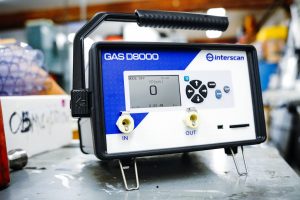
GASD 8000
For ClO2 applications, the GASD 8000 manual notes that the chlorine dioxide sensor is suited to continuous exposure at low concentrations or occasional measurements across its full measurement range. Prolonged exposure to high concentrations can shorten sensor cartridge life, so sensor condition and calibration should remain part of the monitoring program.
What to Look for in a Chlorine Dioxide Monitoring System
Selecting a detector is only part of building a reliable program. Facilities should consider how the entire monitoring system will operate over time.
Important factors include:
- Sensitivity at concentrations relevant to occupational limits
- Continuous versus portable monitoring requirements
- Sensor response and recovery characteristics
- Alarm configuration
- Data logging and historical records
- Calibration procedures
- Sensor replacement requirements
- Integration with plant controls or notification systems
- Detector placement and sampling strategy
- Access to technical support and replacement sensors
A detector that fits the actual process is more useful than one selected only from a specification table. Pulp mills, municipal water plants, and industrial wastewater facilities can have very different layouts, airflow conditions, maintenance practices, and risk profiles.
Building Monitoring Into Everyday Operations
Chlorine dioxide detection works best when it is treated as part of normal plant operation rather than equipment reserved only for emergencies.
Routine testing and calibration should be documented. Alarm responses should be clearly defined. Employees should understand what an alarm means, where to evacuate, and when trained personnel can investigate with portable instrumentation.
Historical gas readings can also provide operational value. Repeated low-level readings around the same pump, valve, or process area may reveal a maintenance issue before it develops into a significant leak.
This is where modern gas detection systems offer an advantage. Monitoring can become a source of actionable operating information, not simply an alarm on the wall.
FAQs
Why is chlorine dioxide monitoring important in pulp bleaching?
Chlorine dioxide is widely used to remove lignin and increase pulp brightness, but an equipment or containment failure can release ClO2 into the surrounding work area. Monitoring helps identify airborne gas before concentrations create a greater exposure risk for employees.
Where should chlorine dioxide detectors be installed?
Potential locations include chlorine dioxide generators, chemical feed and storage areas, pumps, valves, piping connections, bleaching equipment, and enclosed spaces where a release could accumulate. Final detector placement should account for the specific facility layout, ventilation, release points, and work practices.
Should a facility use fixed or portable chlorine dioxide detectors?
Many facilities benefit from both. Fixed systems provide ongoing surveillance of known risk areas, while portable analyzers allow personnel to investigate leaks, perform maintenance checks, verify an area before entry, and measure locations that do not justify permanent instrumentation.
Reliable Chlorine Dioxide Monitoring in Pulp Bleaching and Water Treatment depends on measuring the right gas at the right locations and making the resulting information available to the people who need it. InterScan offers both fixed and portable solutions for this purpose. Explore the AccuSafe fixed gas detection system and GASD 8000 portable gas detector to build a chlorine dioxide monitoring approach around the way your facility actually operates.