Hydrogen Peroxide Vapor Monitoring During Vaporized Sterilization Cycles is an important part of protecting personnel who work around low-temperature sterilization equipment. Vaporized hydrogen peroxide, commonly referred to as VHP, is effective for sterilizing and decontaminating heat-sensitive medical equipment, enclosed spaces, and other healthcare environments. The same properties that make hydrogen peroxide useful for sterilization also make uncontrolled vapor exposure a concern.
Sterile processing departments need to know what is happening outside the sterilization chamber as well as when an area is safe to re-enter after treatment. Reliable hydrogen peroxide monitoring gives teams real-time information instead of relying only on cycle completion signals, ventilation time, or assumptions about vapor dispersion.
For healthcare facilities evaluating broader gas safety strategies, Interscan provides additional information on gas detection for healthcare and sterile processing environments.
Why Hydrogen Peroxide Vapor Requires Monitoring
Hydrogen peroxide is widely used for disinfection, sterilization, and decontamination. In vapor form, it can reach surfaces and equipment without requiring the elevated temperatures associated with steam sterilization.
Once hydrogen peroxide is intentionally vaporized, however, controlling where that vapor goes becomes essential.
Hydrogen peroxide can affect the eyes, skin, and respiratory system. OSHA lists a permissible exposure limit of 1 ppm as an 8-hour time-weighted average. This relatively low occupational limit makes trace-level detection particularly relevant around sterilization processes.
Potential exposure can occur if:
Subscribe to receive our monthly round-up of articles.
- A sterilizer develops a leak
- Door seals or connections are compromised
- Vapor escapes during loading or unloading
- Aeration does not reduce the concentration as expected
- Hydrogen peroxide migrates into adjacent work areas
- Personnel enter a recently decontaminated space too early
Monitoring helps teams identify these conditions before they become routine exposure problems.
Monitoring Different Stages of a Vaporized Sterilization Cycle
Hydrogen Peroxide Vapor Monitoring During Vaporized Sterilization Cycles should account for the fact that vapor concentrations change significantly throughout the process.
A typical process can include conditioning, hydrogen peroxide injection, exposure, and aeration. Exact cycle design varies by sterilization system, but the safety question remains similar: Is hydrogen peroxide remaining where it is supposed to be?
During injection and exposure, elevated hydrogen peroxide concentrations inside the chamber are intentional. An occupational safety monitor is generally concerned with hydrogen peroxide outside the controlled process.
Monitoring near potential leak points can help indicate whether vapor is escaping into occupied space.
Aeration presents a different monitoring challenge. The sterilizer or treated room must remove or break down residual hydrogen peroxide before normal access resumes. A completed cycle does not necessarily tell a safety professional what concentration exists at every point outside the equipment or throughout a treated area.
Direct measurement provides another layer of information.
Fixed and Portable Monitoring Serve Different Purposes
Healthcare facilities do not necessarily have to choose between fixed and portable hydrogen peroxide detection. The two approaches address different parts of the monitoring problem.
Fixed Monitoring for Known Risk Locations
Fixed detection is useful when hydrogen peroxide is repeatedly used in the same location.
Interscan’s AccuSafe system is designed for continuous fixed-point gas monitoring. The system uses active sampling, and multiple sensor modules can report to a single controller. Up to 10 smart sensor modules can be incorporated into a system, providing a way to monitor several relevant areas rather than relying on one sampling point for an entire department.
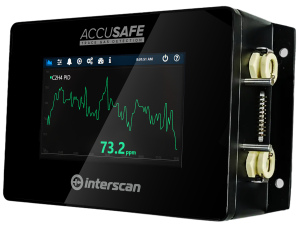
Accusafe
Potential monitoring points around sterilization operations can include:
- Sterilizer equipment areas
- Loading and unloading locations
- Adjacent workspaces
- Areas near doors or suspected leak paths
- Ventilation or exhaust pathways
Placement should be based on actual process conditions and airflow rather than arbitrary distance rules. Interscan discusses this in more detail in its guide to fixed toxic gas detector sensor placement.
AccuSafe also provides data logging, audible and visual alarms, network connectivity, and remote access capabilities. These features can help safety teams maintain visibility without requiring someone to constantly stand next to the detector.
Portable Monitoring for Investigation and Clearance Checks
Portable instruments provide flexibility when the sampling location changes.
The Interscan GASD 8000 supports hydrogen peroxide detection along with other target gases used in healthcare and sterilization environments. It incorporates active sampling through an integral pump, real-time concentration readings, data logging, audible and visual alarms, and rechargeable battery operation.
This makes portable monitoring useful for activities such as:
- Investigating suspected leaks
- Checking around sterilization equipment
- Comparing concentrations at different locations
- Evaluating areas outside a permanent monitoring network
- Performing post-process or clearance measurements
The Interscan healthcare sterilization literature specifically identifies surgical instrument off-gas detection, disposable medical device off-gas detection, and sterilization-unit leak detection as applications for the GASD 8000.
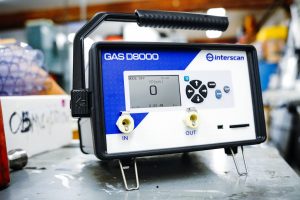
GASD 8000
There is an important operational consideration for hydrogen peroxide sensors in the GASD 8000. Interscan specifies that the H2O2 sensor can deplete rapidly with continuous exposure to the target gas at any level, so this configuration is intended for applications where hydrogen peroxide presence is brief or abnormal rather than prolonged exposure to the sterilization atmosphere itself.
That distinction matters when selecting equipment for a specific monitoring task.
Trace-Level Detection Matters Around Sterilization Equipment
A gas detector does not simply need to confirm that hydrogen peroxide exists. It needs a measurement range appropriate for the safety question being asked.
For occupational monitoring, relatively low concentrations can be meaningful. Interscan offers hydrogen peroxide configurations ranging from ppm measurement down into ppb-level detection, depending on the sensor configuration and application.
This is one reason specialized trace-gas detection can be more appropriate than a general-purpose atmospheric monitor. A standard multi-gas instrument may be designed around common confined-space hazards, while healthcare sterilization presents a specific target-gas problem.
For more background on the chemical itself and its healthcare applications, see Interscan’s guide to detecting hydrogen peroxide in healthcare.
Building Monitoring Into the Sterilization Safety Program
Hydrogen Peroxide Vapor Monitoring During Vaporized Sterilization Cycles works best as part of a broader exposure-control strategy.
Teams should evaluate likely release points, ventilation patterns, normal worker locations, sterilizer operating procedures, and the measurement range required for the application. Alarm levels should also be established according to applicable exposure requirements and facility safety procedures.
Monitoring equipment then provides the data needed to determine whether those controls are working as intended.
A fixed system can provide ongoing visibility around established hazard locations, while a portable analyzer gives staff the ability to investigate changing conditions or verify areas outside the permanent monitoring network.
For sterile processing teams working with vaporized hydrogen peroxide, real-time measurement provides something that a timer or completed-cycle indicator cannot: direct information about the atmosphere personnel may actually enter.
InterScan offers fixed and portable hydrogen peroxide monitoring solutions designed for low-level toxic gas detection in healthcare environments. Explore InterScan’s healthcare gas detection solutions to find the monitoring approach that fits your sterilization process, or talk with the InterScan team about the appropriate hydrogen peroxide range, sampling strategy, and instrument configuration for your facility.
Frequently Asked Questions
What is hydrogen peroxide vapor monitoring used for during sterilization?
Hydrogen peroxide vapor monitoring can be used to identify leaks around sterilization equipment, monitor surrounding work areas, investigate suspected releases, and determine whether residual hydrogen peroxide remains after a sterilization or decontamination process.
Where should hydrogen peroxide detectors be placed around a sterilizer?
Placement depends on potential release points, ventilation, worker locations, equipment layout, and how vapor is likely to move through the space. Monitoring near likely leak paths and occupied areas is generally more useful than selecting locations according to a simple spacing rule.
Can a portable hydrogen peroxide detector replace a fixed monitoring system?
The two approaches serve different purposes. Fixed systems are suited to ongoing monitoring at established risk locations, while portable detectors are useful for leak investigations, spot measurements, troubleshooting, and checking areas that are not continuously monitored. Many facilities can benefit from using both as part of the same gas safety program.