Choosing a gas detector is not only about sensor range, target gas, or detection limits. In a connected facility, you also need to decide how measurement data will move between detectors, controllers, plant systems, and the people responsible for responding to an alarm. That is where gas detector Modbus and MQTT communications become important. Modbus TCP, Modbus RTU, MQTT, and remote notifications each solve a different part of the communications problem, so the right choice depends on what your facility needs to do with its gas data.
For many sites, the answer is not choosing one protocol over every other option. A connected gas detection architecture may use multiple communications methods at the same time.
Start With What You Need the Gas Data to Do
Before comparing protocols, identify where gas readings need to go.
Ask a few practical questions:
- Does the detector need to communicate with a PLC or building control system?
- Is existing RS-485 wiring already installed?
- Do operators need to see readings through a browser or desktop application?
- Will gas measurements be sent to an IIoT or software platform?
- Who needs to receive an alarm when nobody is standing near the detector?
- Do you need historical records for exposure reviews, investigations, or compliance?
That last question is especially important. Communication and data logging are related, but they are not interchangeable. A communication protocol moves information. Data logging preserves measurements so the information can be reviewed later.
InterScan explains the operational value of maintaining those records in its resource on gas detection data logging. Historical gas data can support exposure tracking, incident analysis, and regulatory reporting.
When Modbus TCP Makes Sense
Modbus TCP carries Modbus communications across Ethernet networks. In a facility that already relies heavily on Ethernet-connected equipment, this can make gas detection easier to integrate into the broader control architecture.
Subscribe to receive our monthly round-up of articles.
InterScan’s AccuSafe platform supports Modbus TCP communication. A single controller can receive information from up to ten sensor modules, creating a practical architecture for facilities that need continuous monitoring at several locations.
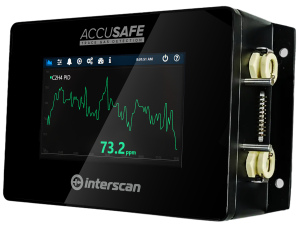
Accusafe
Modbus TCP is particularly useful when:
- Ethernet infrastructure is already available
- Multiple monitoring points need centralized visibility
- Gas measurements must be incorporated into a PLC, control, or facility network
- Longer-distance network communication is needed
- Expansion is likely in the future
For a new facility or a site undergoing controls modernization, TCP is often a logical place to start because it fits naturally into IP-based infrastructure.
When Modbus RTU Is the Better Fit
Modbus RTU performs a similar integration role but typically communicates over an RS-485 serial connection.
This can be valuable in established plants where RS-485 networks are already in service. Instead of redesigning communications around Ethernet simply to connect a gas detector, facilities can integrate compatible equipment with an existing serial architecture.
AccuSafe supports both Modbus TCP and Modbus RTU over RS-485. Its Solo sensor module can also operate in an automatic communication mode. According to InterScan documentation, the module can initialize Modbus TCP/IP when an active Ethernet connection is detected and use RTU when Ethernet is not connected.
Consider Modbus RTU when:
- The plant already has RS-485 infrastructure
- Serial communications are standard across existing controls
- Network requirements are relatively simple
- Direct integration with compatible industrial equipment is the priority
The choice between TCP and RTU is therefore often an infrastructure decision rather than a measurement decision. The detector is still measuring the same gas. What changes is how that information travels through the facility.
Where MQTT Fits Into Gas Detection
MQTT addresses a somewhat different requirement.
Rather than functioning primarily as a traditional industrial control protocol, MQTT provides a lightweight publish-and-subscribe approach that is widely useful for connected software and IIoT applications.
This makes gas detector Modbus and MQTT communications complementary rather than mutually exclusive.
For example, Modbus may provide the connection between a gas detection system and plant controls, while MQTT makes selected information available to another software environment.
AccuSafe provides an MQTT API alongside Modbus TCP and RTU, browser access, and a desktop application.
MQTT becomes particularly relevant when a facility wants to:
- Build gas measurements into a connected IIoT architecture
- Send information to software applications
- Develop centralized dashboards
- Combine gas readings with other operational data
- Create integrations beyond traditional PLC communication
That flexibility is useful as facilities move from isolated detectors toward connected monitoring environments.
Do Not Treat Remote Alerts as Another Protocol
Email and SMS notifications solve another problem entirely.
Modbus or MQTT can move data between machines and software systems. A remote alert is intended to get important information in front of a person.
That distinction matters during an alarm.
A fixed detector can identify a rising concentration even when nobody is physically nearby. The communication architecture should then make sure the appropriate personnel can learn about the event.
AccuSafe supports sound and email alarms along with SMS text notifications.
Remote alerts are especially useful for:
- Unoccupied rooms
- After-hours monitoring
- Gas storage areas
- Remote process locations
- Facilities with centralized safety teams
- Applications where a technician cannot continuously watch the detector
Local alarms remain essential for people near the hazard. Remote notifications extend awareness beyond the instrument’s immediate location.
Match Communications to the Type of Monitoring
Not every gas detector needs a network connection.
The InterScan GASD 8000, for example, is designed as a portable trace-gas instrument. It provides audible and visual alarms, 4-20 mA and 0-2.5 V analog outputs, and data logging through an integral 32 GB SD card.
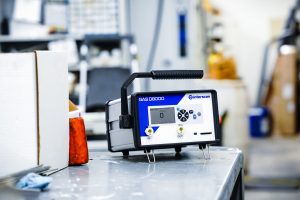
GASD 8000
AccuSafe approaches the problem differently. It is intended for fixed, continuous monitoring and provides connected communications including Modbus TCP, Modbus RTU, remote browser access, a desktop application, and MQTT.
This illustrates an important point when specifying gas detector Modbus and MQTT communications. Connectivity should follow the monitoring objective.
A technician collecting measurements at different locations may care more about portable operation and reliable onboard logging. A permanently monitored process area may require continuous network communication and remote notification.
For a broader comparison of these architectures, see InterScan’s guide to choosing between GASD 8000, GASD IS, and AccuSafe.
A Practical Communications Checklist
When evaluating a connected gas detection system, review the complete flow of information rather than checking whether a specification sheet lists a particular protocol.
Determine:
- Where the measurement originates.
- Which controller or plant system needs the reading.
- Whether Ethernet or RS-485 infrastructure is available.
- Whether software or IIoT integration requires MQTT.
- Which personnel need remote notifications.
- How historical measurements will be stored and reviewed.
- Whether the architecture can expand as monitoring requirements grow.
Doing this early helps avoid building a gas detection system that measures the right information but cannot deliver it where it is needed.
Frequently Asked Questions
Is Modbus TCP better than Modbus RTU for gas detection?
Not universally. Modbus TCP works well with Ethernet-based networks, while Modbus RTU can be a practical choice when RS-485 infrastructure is already installed. AccuSafe supports both, allowing facilities to choose according to their control architecture.
Why would a gas detection system need MQTT if it already has Modbus?
They can serve different purposes. Modbus is commonly used for industrial control-system integration, while MQTT can make data available to connected software and IIoT applications. A facility may use both in the same architecture.
Are remote alerts a replacement for local gas alarms?
No. Local audible or visual alarms notify personnel near the instrument, while email and SMS alerts can notify responsible personnel elsewhere. A connected fixed monitoring system can use both to improve visibility when gas conditions change.
Gas detection communications work best when they reflect how a facility actually operates. Modbus TCP can connect monitoring to Ethernet-based infrastructure, Modbus RTU can support established RS-485 systems, MQTT can extend gas information into connected software, and remote notifications can put alarms in front of the people who need to respond.
For facilities that need continuous trace-gas monitoring with flexible integration options, explore InterScan AccuSafe and see how its Modbus, MQTT, data access, and remote alert capabilities can fit into your plant’s monitoring architecture.