Fixed gas detector sensor placement has a direct impact on whether a monitoring system provides useful early warning or simply records a hazard after it has spread through the facility. A fixed detector can have excellent sensitivity and response characteristics, but the gas still needs to reach the sampling point. That makes placement a system-design question, not just an installation detail.
For toxic gas applications, the best approach starts with the hazard itself. Identify where a release can occur, how the gas is likely to move, where employees may be exposed, and how ventilation changes that movement. From there, sensors can be positioned around actual risk rather than according to a generic spacing rule.
Start With Potential Release Points
The first step in fixed gas detector sensor placement is identifying where the target gas could enter the atmosphere.
Look at the entire process, including:
- Chemical storage areas
- Valves and fittings
- Pumps and compressors
- Gas cylinders and manifolds
- Transfer connections
- Process equipment
- Sampling systems
- Production lines
- Enclosed rooms
- Areas where chemicals are mixed or transferred
Known release points usually deserve more attention than arbitrary locations around the room. A sensor installed near equipment with a realistic leak potential may provide much more useful warning than one mounted simply because it is at the geometric center of the space.
This becomes particularly important when monitoring toxic gases at low concentrations. Detecting a release early means getting representative air to the sensor before the contaminant becomes widely distributed.
Interscan discusses this distinction further in its article on where to mount a fixed toxic gas detector. Potential hazard zones, airflow, obstructions, and mounting height all affect the final installation.
Subscribe to receive our monthly round-up of articles.
Understand How the Gas Will Move
Gas density is useful when planning placement, but it should not be treated as the only deciding factor.
A lighter-than-air gas may tend to rise, while a heavier gas may accumulate in lower areas. In actual industrial environments, however, gas dispersion is also affected by:
- Air handling systems
- Exhaust fans
- Supply vents
- Open doors
- Temperature differences
- Process heat
- Equipment movement
- Outdoor wind
- Physical barriers
That means a simple rule such as “heavy gas low, light gas high” can be an incomplete design method.
For gases that present an inhalation risk, the worker breathing zone may also be important. The objective is not merely to find where the highest concentration might eventually collect. The system should provide useful information about the places where exposure can occur.
Before finalizing fixed gas detector sensor placement, review normal airflow and ask what changes when ventilation equipment starts or stops.
Consider Ventilation Carefully
Ventilation can help control a release, but it can also carry gas away from a poorly located detector.
For example, mounting a sensor immediately beside a clean-air supply vent may continuously expose it to diluted air while a hazardous concentration develops somewhere else. Conversely, an exhaust path may channel gas toward a particular area and create a logical monitoring point.
Map the expected path between the release source and ventilation outlet. Sensors should monitor meaningful points along that path without being isolated from the air being evaluated.
This is one reason field knowledge matters. Process engineers, operators, industrial hygienists, and maintenance personnel often know where vapors collect or where leaks have historically occurred. Their observations can improve a placement plan that otherwise looks reasonable on a drawing.
Avoid Obstructions and Dead Zones
Machinery, partitions, storage racks, vessels, walls, and other structures can change gas movement.
A detector hidden behind equipment may not see the same atmosphere as workers only a few feet away. Similarly, recessed spaces or poorly ventilated corners can create localized accumulation zones.
During a site survey, review the area from the perspective of air movement rather than simply equipment access.
Ask:
- Can air from the suspected release point reach the sampling location?
- Is large equipment blocking the likely path?
- Could gas become trapped in a nearby enclosure?
- Will future storage or process changes obstruct the detector?
- Can technicians safely access the equipment for inspection and maintenance?
A detector that cannot be maintained conveniently may also be more likely to receive inadequate routine attention.
Decide Whether You Need One Point or Several
There is no universal area of coverage for every toxic gas detector installation.
Large rooms, multiple release sources, separate process areas, and complicated ventilation patterns can require several sampling locations. In those cases, multi-point monitoring is usually more useful than trying to make one sensor represent an entire facility.
Interscan’s article on single-point versus multi-point gas detection explains how the decision changes as hazards become distributed throughout a facility.
The AccuSafe fixed gas detection system is designed for this type of fixed-point monitoring. A controller can support up to ten smart sensor modules, allowing measurement points to be distributed among rooms, process areas, or equipment locations. AccuSafe uses continuous monitoring and supports Modbus TCP and RTU communications, along with remote access options for centralized visibility.
That architecture lets facilities design coverage around their hazard map rather than force multiple risks into a single measurement point.
Think About Sampling, Not Just the Sensor
Another important consideration in fixed gas detector sensor placement is how the sample reaches the sensing element.
AccuSafe uses active sampling, meaning the system actively draws the gas sample rather than depending only on passive diffusion. Active sampling can be particularly useful when the objective is to monitor a defined location or detect low concentrations.
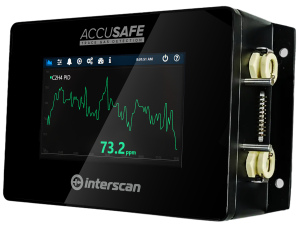
Accusafe
Still, active sampling does not eliminate placement considerations. Sampling line length, tubing material, filters, target-gas properties, and the position of the inlet can all affect the time required for the gas to reach the sensor.
This is why response time should be evaluated for the complete installed system.
A sensor with a fast nominal response cannot provide an immediate warning if the sampling arrangement creates a long transport delay.
Verify Placement After Installation
A placement plan should not become permanent simply because installation is complete.
Once sensors are operating, confirm that the system behaves as expected under realistic facility conditions. Review airflow, process changes, equipment additions, and alarm history. If operations change, sensor locations may need to change as well.
Periodic reviews are especially useful after:
- Ventilation modifications
- Production line changes
- New chemical storage arrangements
- Equipment relocation
- Facility expansions
- Changes in worker locations
- New gas-handling processes
Portable measurements can also help investigate areas outside the fixed network. Interscan notes that fixed and portable instruments often work well together because a portable analyzer can investigate conditions that a permanently installed detector cannot physically follow.
Planning fixed gas detector sensor placement ultimately comes down to understanding where the hazard begins and how it travels. Start with likely release sources, evaluate airflow and worker exposure, account for physical obstructions, and use multiple monitoring points when one location cannot represent the entire risk area.
For facilities that need continuous toxic gas monitoring across known hazard locations, explore Interscan AccuSafe and talk with the Interscan team about sensor configuration, measurement range, sampling requirements, and a fixed monitoring architecture suited to your facility.
Frequently Asked Questions
How high should a fixed toxic gas detector be mounted?
Mounting height depends on the target gas, expected release conditions, airflow, worker exposure, and the facility layout. Gas density can provide useful guidance, but ventilation and process conditions should also be considered rather than selecting height from density alone.
How many fixed gas detectors does a facility need?
There is no universal number. The required sensor count depends on the number of potential release points, room size, airflow, process layout, target gas, and desired monitoring coverage. Facilities with several independent hazard zones will often require multiple measurement points.
Should fixed gas detectors be installed directly next to ventilation systems?
Not automatically. A clean-air supply can dilute gas at the detector and make the reading less representative, while an exhaust path may carry gas toward a useful monitoring location. Fixed gas detector sensor placement should be based on actual airflow patterns and the likely route between the release source and the surrounding environment.