Choosing a portable gas detector is not simply a matter of comparing sensor lists. The detector has to fit the gas hazard, expected concentration, sampling method, operating environment, data requirements, and the way technicians actually work in the field. This Interscan portable gas detector buyer’s guide explains what to evaluate and how Interscan’s portable platforms fit different industrial monitoring applications.
For organizations that need trace-level toxic gas measurement combined with active sampling, data logging, alarms, and field portability, the GASD 8000 is the main general-purpose option in Interscan’s current portable lineup.
Start With the Gas You Need to Detect
The first question should always be straightforward: what gas are you trying to measure?
Interscan’s GASD 8000 can be configured for a range of gases commonly encountered in industrial hygiene, chemical processing, healthcare, semiconductor manufacturing, wastewater treatment, and other applications. Supported gases include:
- Ammonia
- Bromine
- Carbon monoxide
- Chlorine
- Chlorine dioxide
- Ethylene
- Ethylene oxide
- Formaldehyde
- Hydrazine
- Hydrogen
- Hydrogen chloride
- Hydrogen cyanide
- Hydrogen peroxide
- Hydrogen sulfide
- Nitric oxide
- Nitrogen dioxide
- Ozone
- Peracetic acid
- Phosphine
- Propylene oxide
- Sulfur dioxide
The GASD 8000 is particularly relevant when the monitoring problem involves a known target gas and low-level measurement is important. Interscan describes the platform as providing trace-level sensing, with exact sensitivity depending on the selected gas and sensor.
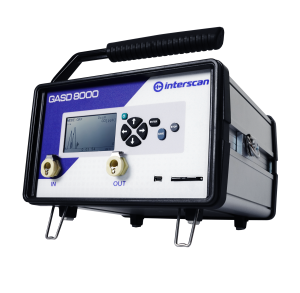
The Interscan GASD 8000 provides portable, continuous gas monitoring for field surveys, maintenance, and task-based applications.
This is an important distinction from buying a general multi-gas meter simply because it monitors more compounds. When one toxic gas drives the exposure concern, a dedicated sensing approach can provide a more focused measurement strategy. Interscan discusses this issue in its guide to single-gas versus multi-gas detectors.
Subscribe to receive our monthly round-up of articles.
Consider Active Sampling
Sampling method has a major effect on how a detector is used.
The GASD 8000 uses an integral pump for active and continuous air sampling. Instead of waiting for gas to diffuse naturally into the sensing chamber, the instrument actively draws a sample across the sensor.
Active sampling can be useful when technicians need to:
- Check potential leak points
- Sample through tubing
- Investigate process equipment
- Measure changing concentrations
- Survey specific work areas
- Collect readings from predetermined locations
For industrial hygiene and troubleshooting applications, this gives technicians more control over where the sample comes from.
Decide Whether the Area Is Classified
One of the most important decisions in this Interscan portable gas detector buyer’s guide is whether the detector will enter a hazardous classified area.
The GASD 8000 is designed for general industrial portable monitoring. Interscan does not present it as an intrinsically safe instrument.
For applications where combustible gases or vapors can create an ignition risk, Interscan offers the GASD IS. The GASD IS is designed around intrinsic safety requirements for hazardous locations. Interscan currently states that its intrinsic safety certification process is in the final administrative and documentation phase, so buyers should verify current certification status and their facility requirements before deployment.
The two platforms otherwise share many field-oriented capabilities. Both support active sampling, low-level toxic gas measurement, real-time readings, alarms, data logging, and portable operation. In many cases, the environment becomes the deciding factor.
For a closer comparison, see Interscan’s GASD IS vs GASD 8000 guide.
Evaluate Battery Life and Field Usability
Portable equipment needs to work away from permanent power.
The GASD 8000 uses a rechargeable 5000 mAh lithium-ion battery and provides up to eight hours of continuous service. It also includes a sunlight-visible transflective LCD, which matters when measurements are being taken outdoors or under bright industrial lighting.
The instrument measures approximately 5.5 inches high by 8.25 inches wide by 10 inches deep and weighs about 6.5 pounds. Its enclosure is anodized aluminum.
That combination makes it better suited to portable analytical and industrial hygiene work than to applications where a small wearable personal monitor is the primary requirement.
Look Beyond the Live Reading
A portable detector should do more than display the current concentration.
The GASD 8000 combines a digital concentration readout with real-time graphical information and onboard data logging. Data is stored through an integral 32 GB SD card. Audible and visual alarms provide immediate indication when conditions reach configured alarm levels.
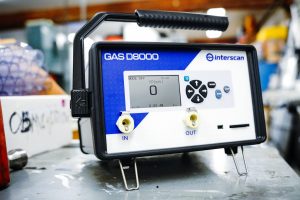
GASD 8000
The unit also provides 4-20 mA and 0-2.5 V analog outputs. These capabilities make the detector useful when measurements need to become part of a larger documentation, investigation, or safety workflow rather than remaining isolated spot readings.
For organizations moving toward connected industrial operations, Interscan also positions the GASD 8000 as an edge-enabled device capable of operating independently while supporting broader IIoT strategies.
Factor Maintenance Into the Purchase
Detector ownership includes calibration, sensor replacement, recordkeeping, and downtime.
The GASD 8000 can be calibrated using a standard gas mixture or supported through Interscan’s SensorExpress program. Interscan’s Interchange Sensor System is designed to allow sensor replacement without tools and without returning the complete detector to the manufacturer for routine sensor replacement.
For facilities operating multiple units, minimizing sensor-related downtime can matter almost as much as the initial detector specification.
Portable or Fixed Gas Detection?
A portable detector is not always the right answer.
Portable instruments work well for surveys, inspections, maintenance activities, leak investigations, and measurements that move from one location to another.
If a hazard needs continuous monitoring at the same location, a fixed system may be more appropriate. Interscan’s AccuSafe platform provides continuous active sampling through networked sensor modules and supports configurations with up to ten sensors connected to a controller. It also incorporates data logging, alarms, network connectivity, and remote access.
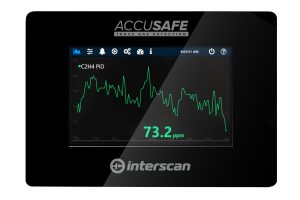
Accusafe
Many facilities use both approaches. AccuSafe can monitor known fixed points continuously, while a GASD 8000 gives technicians a portable instrument for field investigations and temporary measurements.
What Should You Prioritize?
When working through an Interscan portable gas detector buyer’s guide, narrow the purchase decision to a few practical questions:
- Which gas needs to be measured?
- What concentration range and sensitivity are required?
- Is active sampling necessary?
- Will the detector enter a classified hazardous location?
- How long must it operate between charges?
- Are data logging and analog outputs required?
- How will sensors be calibrated and replaced?
- Is the application portable, fixed, or a combination of both?
For general portable trace-level toxic gas monitoring outside classified areas, the Interscan GASD 8000 provides a strong combination of active sampling, low-level sensing, onboard data logging, alarms, field-ready battery operation, and flexible output options.
Selecting a gas detector becomes much easier once the application is defined clearly. Start with the target gas and concentration range, then consider the sampling environment, operating requirements, data needs, and maintenance workflow. If your application calls for portable, active toxic gas monitoring with trace-level sensitivity, review the Interscan GASD 8000 and contact Interscan to discuss the sensor and measurement configuration that fits your process.
Frequently Asked Questions
What is the GASD 8000 designed for?
The GASD 8000 is designed for portable industrial toxic gas monitoring. It combines active continuous sampling, low-level sensing, real-time readings, alarms, data logging, and rechargeable battery operation in a field-ready analyzer.
What is the difference between the GASD 8000 and GASD IS?
The primary difference is the intended operating environment. The GASD 8000 is a general industrial portable gas analyzer, while GASD IS is designed around intrinsic safety requirements for hazardous classified locations. Buyers considering GASD IS should confirm its current certification status before deployment.
When should I use AccuSafe instead of a portable detector?
AccuSafe is better suited to applications that require continuous monitoring at permanent locations. GASD 8000 is portable, making it more appropriate for surveys, investigations, inspections, temporary monitoring, and measurements that must move between locations. Facilities can also use both systems as complementary parts of a gas detection program.