When comparing Pump-Drawn Sampling vs Passive Diffusion in Low-Airflow Spaces, the most important difference is how the gas sample reaches the sensor. Passive detectors depend on gas moving naturally through the surrounding air and reaching the sensing element. Pump-drawn instruments actively move a controlled air sample to the sensor. In areas with weak ventilation, stagnant air, enclosed equipment spaces, or difficult-to-reach sampling points, that distinction can have a major effect on how quickly a developing leak becomes visible.
For applications where detecting low concentrations early matters, Interscan uses active sampling to provide controlled air intake and continuous delivery of the sample to the sensor.
How Passive Diffusion Gas Detection Works
A passive diffusion detector does not mechanically pull air toward its sensor. Instead, molecules in the surrounding atmosphere must move into the detector through natural diffusion and local air movement.
This approach has practical advantages. Diffusion detectors can be relatively straightforward because there is no sampling pump or associated tubing. In areas where gases mix effectively and detectors can be positioned directly where gas is expected to travel, passive monitoring can be appropriate.
The difficulty becomes more obvious when airflow is limited.
Imagine a small equipment enclosure where a fitting begins releasing a low concentration of toxic gas. The gas may accumulate locally instead of immediately spreading throughout the enclosure. A diffusion detector mounted some distance away can only respond after enough of that gas reaches the sensor.
The detector itself may be functioning correctly. The limitation is sample transport.
Subscribe to receive our monthly round-up of articles.
That is why Pump-Drawn Sampling vs Passive Diffusion in Low-Airflow Spaces is not simply a comparison of sensor specifications. The movement of the sample matters just as much as the sensor receiving it.
What Pump-Drawn Sampling Changes
An active sampling system uses a pump to continuously pull air into the detector. Interscan describes this approach as a way to control the volume and flow of air reaching the sensor, supporting rapid detection and accurate measurement, including at low concentrations.
Instead of waiting for the atmosphere to bring the gas to the detector, the instrument actively acquires a sample.
That can provide several advantages in low-airflow spaces:
- More consistent delivery of air to the sensing element
- Faster recognition of changing gas concentrations
- Better access to remote or difficult sampling locations
- Improved performance when natural air movement is unpredictable
- Continuous sampling rather than dependence on ambient transport
This distinction becomes increasingly important as concentrations get lower. A significant release may eventually reach almost any properly located detector. Trace-level leaks are less forgiving because small gas quantities may remain localized or become diluted before reaching a passive sensor.
Why Low-Airflow Spaces Are Difficult to Monitor
Gas does not distribute uniformly through every room, enclosure, cabinet, pit, or process area.
Air movement depends on ventilation, temperature differences, equipment operation, physical barriers, gas properties, and the location of the leak. Dead zones can form behind machinery, inside enclosures, near process connections, or in corners where normal facility ventilation has little influence.
This creates a basic problem for passive detection. A sensor can only measure the gas that actually reaches it.
Pump-drawn sampling gives safety teams another option. Sampling can be designed around the suspected source rather than relying entirely on general room airflow.
Interscan specifically identifies access to hard-to-reach areas as one advantage of active sampling. This is useful when the best detector mounting location and the best air-sampling location are not the same place.
For a deeper look at the approach, see Interscan’s guide to active air sampling for gas detection.
Leak Detection Is Also About Response Time
When monitoring toxic gases, the question is often not whether a detector will eventually respond. It is how quickly the system identifies a meaningful change.
Passive diffusion introduces a variable that can be difficult to control: the time required for gas to travel from the release point to the sensor.
Active sampling reduces dependence on that uncontrolled movement by establishing a defined sample flow.
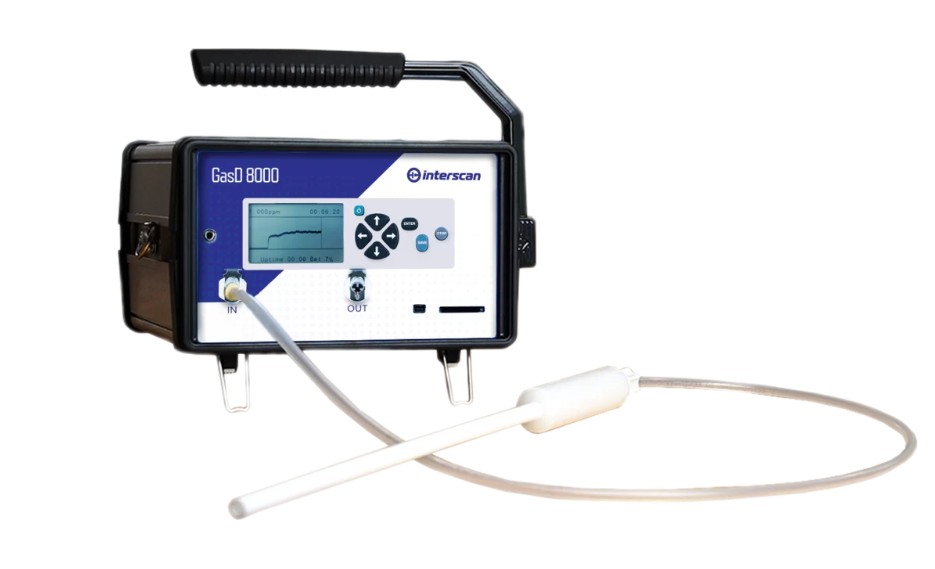
Interscan’s GASD 8000, for example, combines trace-level sensing with active, continuous sampling through an integral sample pump. The portable analyzer can detect up to 21 gases depending on configuration and includes real-time concentration readings, data logging, and audible and visual alarms.
GASD 8000
That combination is useful for technicians conducting:
- Leak investigations
- Process surveys
- Maintenance checks
- Temporary monitoring
- Troubleshooting around valves, fittings, seals, and equipment
- Measurements in locations where natural airflow is weak
Learn more about the GASD 8000 portable gas detector.
Fixed Monitoring Can Use Active Sampling Too
Pump-drawn detection is not limited to portable leak surveys.
Interscan’s AccuSafe platform uses active and continuous sampling for fixed-point gas monitoring. Each sensor module incorporates a sample-draw pump along with local data acquisition and processing. The system supports single-point or multi-point configurations, with up to ten sensor modules connected to one controller.
That architecture can be valuable when a facility has several known locations where low-level gas releases could occur.
Rather than assuming ambient circulation will consistently carry gas to a passive detector, the monitoring design can bring samples from selected locations into actively sampled sensors.
This makes active sampling particularly relevant in facilities containing process cabinets, gas storage areas, chemical handling locations, enclosed manufacturing equipment, and other spaces where airflow patterns may not be predictable.
For facilities requiring continuous monitoring, see the AccuSafe fixed-point gas detection system.
Does Pump-Drawn Sampling Always Make More Sense?
Not necessarily. Gas detection design should match the hazard and environment.
Passive diffusion may be suitable when airflow is predictable, detectors can be installed close to likely release points, and the required response characteristics fit the application.
Pump-drawn sampling becomes particularly useful when the sampling conditions themselves create uncertainty.
The stronger case for active sampling usually appears when:
- Air movement is weak or inconsistent
- Gas concentrations may initially be very low
- The suspected release point is difficult to access
- The detector cannot be installed directly at the desired sampling location
- Faster identification of changing concentrations is important
- Operators need to investigate multiple potential leak locations
The core difference in Pump-Drawn Sampling vs Passive Diffusion in Low-Airflow Spaces is therefore control. Passive detection waits for the atmosphere to deliver the sample. Pump-drawn detection actively establishes how that sample reaches the sensor.
For low-airflow environments where early leak identification is important, controlling sample movement can remove one of the biggest uncertainties from the measurement process.
Interscan builds active sampling directly into portable solutions such as the GASD 8000 and fixed monitoring platforms such as AccuSafe. If your facility needs trace-level detection in stagnant, enclosed, remote, or difficult sampling locations, explore Interscan’s active air sampling technology and find an instrument suited to your monitoring application.
Frequently Asked Questions
Is pump-drawn gas detection faster than passive diffusion?
It can be, particularly when natural airflow is limited. Pump-drawn systems actively move the air sample to the sensor, while passive detectors depend on the gas reaching the sensing element through diffusion and ambient air movement. Interscan notes that controlled sample flow supports rapid detection, including at low gas concentrations.
Where is active gas sampling most useful?
Active sampling is particularly useful in low-airflow spaces, equipment enclosures, remote sampling points, process areas, and other locations where gas may not reliably travel to a passive detector. It can also help during portable leak investigations when technicians need to sample specific locations.
Can Interscan systems provide continuous pump-drawn monitoring?
Yes. The GASD 8000 provides active and continuous sampling with an integral pump for portable applications, while AccuSafe provides active, continuous sampling in a fixed-point monitoring architecture.