When evaluating gas detection equipment, the number of gases an instrument can monitor is only part of the discussion. Detection range, sensitivity, sampling method, and the specific hazard all matter. That distinction becomes especially important when comparing Interscan Trace-Gas Instruments vs Standard Four-Gas Monitors. A conventional four-gas monitor is designed around several common atmospheric hazards, while an Interscan trace-gas instrument is designed to measure specific toxic gases at very low concentrations. The two approaches address different monitoring needs, and understanding that difference can help facilities choose equipment that matches the actual risk.
What Standard Four-Gas Monitors Are Designed to Do
A typical four-gas monitor simultaneously measures four common atmospheric hazards:
- Oxygen, or O2
- Combustible gas as a percentage of the lower explosive limit, or LEL
- Carbon monoxide, or CO
- Hydrogen sulfide, or H2S
This configuration is common in confined-space work and other applications where workers need a compact instrument that can quickly identify several broad atmospheric hazards. For example, RKI’s GX-3R uses the familiar LEL, O2, CO, and H2S configuration, with measurement ranges appropriate to personal and confined-space monitoring.
That makes a four-gas monitor useful equipment. But it does not make it a substitute for every type of gas analyzer.
The key limitation is straightforward: an instrument only measures the gases, concentrations, and ranges its sensors are designed to detect. If chlorine, ethylene oxide, hydrazine, formaldehyde, hydrogen chloride, ozone, or another specific toxic gas is the primary concern, a standard four-gas configuration may not address that hazard at all.
Why Detection Range Changes the Comparison
The central issue in Interscan Trace-Gas Instruments vs Standard Four-Gas Monitors is not simply how many sensors fit inside the instrument. It is how low a concentration the system is intended to measure.
For some applications, detecting a hazardous atmosphere after a concentration reaches a conventional alarm threshold is appropriate. Other processes require visibility much earlier.
Subscribe to receive our monthly round-up of articles.
Trace-gas analysis focuses on detecting very small concentrations of a target gas. Interscan specifically designs its sensor systems for low-level toxic-gas measurement, including gases such as hydrazine and chlorine. The purpose is to identify changes at low concentrations so operators have more information about developing leaks, releases, or exposure conditions.
This is particularly relevant where:
- The target compound is highly toxic at low concentrations
- Small leaks need to be identified before they become larger releases
- Process verification depends on low-level measurement
- A facility needs continuous data rather than a simple alarm state
- The target gas is outside a standard four-gas sensor configuration
Detection range, therefore, needs to match the hazard rather than the category of instrument that happens to be most familiar.
Trace Detection Is About the Target Gas
Four-gas monitors provide broad coverage of a predefined group of hazards. Interscan takes a more targeted approach.
The GASD 8000, for example, is a portable analyzer built for trace-level gas sensing. Interscan lists support for 21 gases, including ammonia, bromine, chlorine, chlorine dioxide, ethylene oxide, formaldehyde, hydrazine, hydrogen chloride, hydrogen cyanide, hydrogen peroxide, ozone, phosphine, sulfur dioxide, and others. The specific sensitivity depends on the gas and sensor configuration.
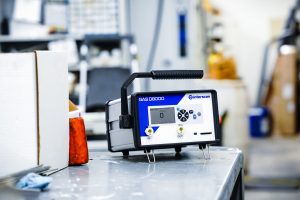
GASD 8000
That changes how the instrument is used.
Instead of asking, “Is there one of four common atmospheric hazards present?” operators can monitor a known target compound that is directly relevant to a process, chemical inventory, or exposure concern.
This type of specificity is useful in pharmaceutical operations, chemical processing, semiconductor environments, aerospace applications, sterilization processes, research facilities, and other workplaces where a particular toxic compound may be more important than the standard four-gas combination.
Active Sampling Adds Another Difference
Detection range is not the only distinction.
The GASD 8000 uses active, continuous sampling through an integral sample pump. It also provides a digital concentration readout, real-time graphical information, onboard data logging, audible and visual alarms, and analog outputs. The portable unit is designed for up to eight hours of continuous service on its rechargeable battery.
Active sample draw can be valuable when technicians need to pull a representative air sample through the sensor rather than depend entirely on gas diffusing naturally into a wearable detector.
This supports applications such as:
- Investigating suspected leaks
- Checking specific process locations
- Monitoring around equipment
- Collecting concentration data over time
- Verifying areas after maintenance or process changes
Again, this does not mean a trace-gas analyzer replaces personal four-gas monitors in every situation. It means the equipment serves a different measurement objective.
Portable and Fixed Trace-Gas Monitoring
Interscan also extends the same low-level monitoring philosophy beyond portable equipment.
The AccuSafe fixed-point gas detection system provides continuous trace-gas monitoring using distributed smart sensor modules. Each sensor module incorporates sample draw, data acquisition, and local processing. A system can support up to 10 smart sensor modules, with multiple gases monitored within the same network.
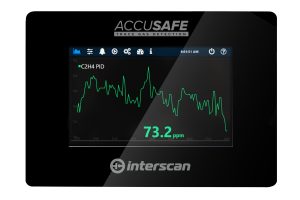
Accusafe
This is useful when the requirement moves from periodic checks to continuous facility monitoring.
A portable GASD 8000 can support technicians performing field investigations and targeted measurements. AccuSafe can provide ongoing monitoring at selected points around a facility. Both approaches retain the advantage of choosing sensors around the actual toxic-gas hazard instead of relying on a generic sensor package.
Why Early Visibility Can Matter
One of the strongest arguments for trace-level monitoring is that a developing problem does not begin at the alarm threshold.
A release can start small. Concentrations may increase gradually. A process seal may begin leaking before conditions become obvious. If the monitoring system can resolve low concentrations of the relevant gas, operators gain information earlier in that sequence.
That additional visibility can support:
- Faster investigation of abnormal readings
- Earlier leak identification
- Better understanding of concentration trends
- More informed maintenance decisions
- Reduced opportunity for a minor release to develop unnoticed
Interscan describes low-level sensitivity as a way to support quicker responses to toxic-gas releases and reduce the potential for operational disruption.
The important point is not that lower is automatically better in every application. The useful detection range depends on the toxicology of the gas, the process, applicable exposure limits, alarm strategy, and monitoring objective.
Choosing Between the Two Approaches
The Interscan Trace-Gas Instruments vs Standard Four-Gas Monitors comparison is easier when the starting question is the hazard rather than the instrument.
A standard four-gas monitor may be appropriate when the main objective is portable personal monitoring for O2, LEL, CO, and H2S.
A trace-gas analyzer becomes more relevant when the application calls for:
- A toxic gas outside the standard four-gas configuration
- Measurement at very low concentrations
- Target-specific monitoring
- Active sample draw
- Concentration trending and data logging
- Continuous fixed-point monitoring of a known compound
Some facilities may need both. A worker can use a four-gas monitor for general atmospheric safety while a dedicated trace-gas system monitors a specific process chemical. They solve different problems, so treating them as interchangeable can leave gaps in a gas detection program.
Detection range should ultimately follow the risk. When a process involves toxic gases that need to be identified at low concentrations, instrumentation designed specifically for trace measurement provides a level of information a conventional four-gas configuration may not offer.
If your application requires low-level monitoring of a specific toxic gas, explore Interscan’s trace-gas analysis capabilities and the GASD 8000 portable gas detector. For applications that require continuous fixed monitoring, the AccuSafe system provides a scalable approach to bringing Interscan trace-gas detection into facility-wide monitoring.
Frequently Asked Questions
What is the main difference between an Interscan trace-gas instrument and a four-gas monitor?
A standard four-gas monitor typically focuses on O2, combustible gas as %LEL, CO, and H2S. Interscan trace-gas instruments are configured around specific target gases and are designed for low-level toxic-gas measurement, making them suitable for applications where sensitivity and gas specificity are priorities.
Can a trace-gas instrument replace a four-gas monitor?
Not necessarily. The instruments serve different purposes. Four-gas monitors are commonly used for general atmospheric and personal safety monitoring. Trace-gas instruments are more appropriate when a facility needs sensitive measurement of a specific toxic compound. Many safety programs can benefit from using both technologies where their hazards justify it.
Which gases can Interscan trace-gas systems detect?
Interscan lists 21 gases across products such as the GASD 8000 and AccuSafe, including ammonia, chlorine, chlorine dioxide, ethylene oxide, formaldehyde, hydrazine, hydrogen chloride, hydrogen cyanide, hydrogen peroxide, hydrogen sulfide, ozone, phosphine, sulfur dioxide, and several others. Available detection ranges and sensitivities depend on the selected gas and sensor configuration.