Hydrogen Sulfide Monitoring in Wastewater Treatment and Oilfield Operations is a critical part of protecting personnel from one of the more serious toxic gas hazards found in industrial environments. Hydrogen sulfide, or H2S, can develop during the decomposition of organic material in wastewater systems and is also encountered in crude oil, natural gas, drilling, production, and processing operations. Because concentrations can vary considerably across a facility or work area, reliable gas monitoring needs to provide useful information where and when exposure can occur.
For safety teams, the challenge is not simply determining whether H2S is present. They need to understand concentration changes, identify developing releases, protect workers performing specific tasks, and choose monitoring equipment that fits the operating environment.
Why Hydrogen Sulfide Requires Reliable Monitoring
Hydrogen sulfide is a colorless toxic gas associated with serious respiratory and neurological effects at elevated exposures. It is also flammable. Although its characteristic rotten egg odor may be noticeable at low concentrations, odor should never serve as a monitoring method.
Instrument-based detection provides an objective measurement of the atmosphere and allows personnel to respond according to established safety procedures.
Interscan discusses these hazards in more detail in its guide to hydrogen sulfide risks and safety measures.
Hydrogen Sulfide Monitoring in Wastewater Treatment and Oilfield Operations becomes particularly important because H2S conditions are rarely uniform. Concentrations can differ between process areas, enclosed spaces, tanks, piping systems, wells, and maintenance locations.
H2S Hazards in Wastewater Treatment
In wastewater treatment facilities, hydrogen sulfide can form when organic material decomposes under anaerobic conditions. Potential monitoring locations may include sewage collection areas, wet wells, sludge handling systems, digesters, pumping areas, and enclosed process spaces.
Subscribe to receive our monthly round-up of articles.
Wastewater facilities may also deal with several other gases, including methane and chlorine, so H2S monitoring usually forms one part of a larger gas safety program.
Several conditions make wastewater monitoring challenging:
- Gas generation can change with biological activity and operating conditions.
- Enclosed or poorly ventilated areas can allow hazardous concentrations to accumulate.
- Maintenance work may bring personnel closer to potential emission sources.
- Gas conditions can differ substantially between locations within the same facility.
- Moisture, temperature, and other environmental conditions must be considered when choosing and positioning equipment.
This is why facilities often need both permanent monitoring at known risk points and portable instruments for inspections, troubleshooting, maintenance, and other task-specific measurements.
Fixed Monitoring for Known Wastewater Risk Areas
When a potential release is associated with a predictable location, fixed-point detection can provide a useful layer of protection.
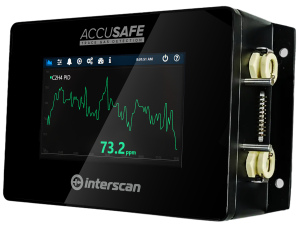
The Interscan AccuSafe system uses active sampling and a distributed architecture for fixed gas detection. A controller can support up to ten smart sensor modules, and configurations can monitor multiple gases depending on sensor selection. Sensor modules process information locally and communicate through the facility network.
Accusafe
AccuSafe also supports real-time concentration information, data logging, alarms, network connectivity, and remote access. For wastewater facilities, this architecture can help safety personnel monitor selected process areas without relying solely on employees to carry an analyzer to each location.
Facilities deciding how permanent and mobile detection should work together can also review AccuSafe vs Portable Gas Detectors.
Sensor selection still needs to match actual exposure conditions. Interscan’s technical documentation notes that H2S sensor cartridges can be depleted by continuous exposure to the target gas. Applications where H2S is routinely present should therefore be reviewed carefully for appropriate sensor range, monitoring strategy, and sensor replacement requirements.
Hydrogen Sulfide Monitoring in Oilfield Operations
Oilfield H2S monitoring presents a different set of operational challenges.
Hydrogen sulfide can be associated with crude oil and natural gas and may be encountered during drilling, production, transfer, processing, maintenance, and work around tanks or piping. Unlike a permanent wastewater process point, many oilfield monitoring requirements move with the work.
Personnel may need to measure the atmosphere around:
- Wellheads and production equipment
- Tanks and vessels
- Valves, flanges, and piping
- Maintenance locations
- Sampling points
- Confined or restricted spaces
- Temporary work zones
Portable active-sampling equipment can be particularly useful when personnel need to investigate a specific location or compare concentrations at several points.
Using Portable Active Sampling for H2S
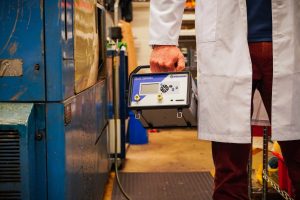
The Interscan GASD 8000 is a portable analyzer that can be configured for hydrogen sulfide and other toxic gases.
It uses an integral pump for active sampling, rather than depending only on ambient air movement to bring gas to the sensor. For field investigations, that allows users to deliberately collect air from the location they need to evaluate.
GASD 8000
The GASD 8000 also provides:
- Real-time digital concentration readings
- Real-time graphics
- Integral data logging
- Audible and visual alarms
- Rechargeable lithium-ion battery operation
- Up to eight hours of continuous service
- Analog outputs for integration
- Trace-level sensing, depending on the installed gas sensor
The platform supports sensors for 21 gases, allowing the same instrument family to address a range of industrial gas detection requirements.
For a deeper look at why pumped sampling matters, see Interscan’s Buyer’s Guide to Active-Sampling Gas Detection Systems.
Classified Oilfield Areas Need an Additional Consideration
Not every portable analyzer is appropriate for every oilfield location. Where combustible or explosive atmospheres may be present, intrinsic safety becomes a major equipment-selection requirement.
Interscan offers the GASD IS for applications requiring a portable instrument certified for use in explosive atmospheres. Hydrogen sulfide is among the gases supported by the GASD IS platform.
This distinction matters. Hydrogen Sulfide Monitoring in Wastewater Treatment and Oilfield Operations should always account for both the target gas and the physical classification of the monitoring location. An analyzer’s sensitivity is only part of the specification. The instrument must also be suitable for the environment where personnel intend to use it.
Building a Practical H2S Monitoring Strategy
No single detector placement or instrument type covers every H2S scenario.
A stronger monitoring strategy starts by identifying:
- Where H2S could originate
- Whether releases are predictable or change with work activity
- Expected concentration ranges
- Required detection limits and alarm thresholds
- Whether areas are classified as potentially explosive
- Environmental conditions at each sampling point
- Whether continuous records are needed
- How quickly personnel need access to concentration data
Fixed systems can monitor known locations while portable instruments allow teams to investigate changing or temporary hazards. In many facilities, combining the two approaches reduces gaps in coverage.
The most effective Hydrogen Sulfide Monitoring in Wastewater Treatment and Oilfield Operations program is ultimately one built around the actual behavior of the hazard rather than a one-size-fits-all detector.
Interscan provides fixed, portable, and intrinsically safe gas detection options for different H2S monitoring scenarios. Explore the Interscan gas detection systems or review the company’s wastewater treatment gas detection solutions to find an instrument and monitoring approach suited to your facility, sampling requirements, and operating environment.
Frequently Asked Questions
Why is hydrogen sulfide common in wastewater treatment?
Hydrogen sulfide can form when organic material decomposes under anaerobic conditions. Wastewater collection, sludge handling, digestion, and other treatment processes can therefore create locations where H2S monitoring is necessary.
Should I use fixed or portable H2S detection?
It depends on how the hazard behaves. Fixed detection is useful for known locations that require ongoing monitoring, while portable analyzers are better suited to inspections, maintenance, surveys, troubleshooting, and changing work areas. Some operations benefit from using both.
What gas detector is suitable for H2S monitoring in an oilfield?
The instrument should be selected according to the required measurement range, sampling method, environmental conditions, and area classification. In locations where explosive atmospheres are possible, an intrinsically safe instrument such as the Interscan GASD IS may be appropriate. Always confirm that the instrument certification and sensor configuration match the specific application.