Choosing between NDIR vs Electrochemical Carbon Monoxide Detection is less about deciding which technology is universally better and more about matching the sensor to the concentration range, monitoring objective, and operating environment. Carbon monoxide can be a personnel exposure hazard at relatively low concentrations, but it also appears at much higher concentrations in combustion processes, exhaust streams, and industrial process gases. Those applications do not necessarily require the same measurement approach.
For facilities where worker exposure and early warning are the priority, electrochemical sensing is widely used because it can provide sensitive CO measurements in a compact package. Nondispersive infrared, or NDIR, takes a different approach by measuring infrared absorption and can be particularly useful in analytical and process applications.
Understanding the practical differences helps engineers and safety teams specify the right instrument instead of selecting a sensor technology based on range alone.
How Electrochemical CO Detection Works
An electrochemical carbon monoxide sensor produces an electrical signal through a chemical reaction involving the target gas. CO reaches the working electrode, where an oxidation or reduction reaction generates current. That current is proportional to the concentration of gas reaching the sensor.
The approach is well suited to toxic-gas monitoring because relatively small changes in concentration can generate measurable changes in sensor output.
For example, Interscan offers CO sensor ranges of:
- 0 to 50 ppm, with resolution below 0.1 ppm
- 0 to 200 ppm, with resolution below 0.3 ppm
- 0 to 500 ppm, with resolution below 0.5 ppm
- 0 to 2,000 ppm, with resolution below 2 ppm
That range flexibility is useful because the best CO detector for an occupational exposure application is not necessarily the same configuration required around a process where concentrations can rise substantially higher.
Subscribe to receive our monthly round-up of articles.
Electrochemical sensors are also relatively compact and low power. These characteristics make them practical for both portable instruments and distributed fixed gas detection systems.
How NDIR Carbon Monoxide Detection Works
NDIR measurement relies on the fact that carbon monoxide absorbs infrared radiation at characteristic wavelengths, particularly around 4.7 micrometers. An NDIR analyzer passes infrared energy through a sample cell and determines CO concentration by measuring how much radiation is absorbed.
Because the measurement is optical rather than based on consuming or reacting with the gas at an electrode, NDIR technology can offer long sensor life and good stability in applications designed around its operating conditions.
NDIR is common in analytical, process, combustion, and emissions measurement. High-range instruments can measure CO at percentage-level concentrations, making the technology attractive when the expected concentration goes well beyond the range normally associated with workplace toxic-gas monitoring. Commercial analyzers, for example, are available with NDIR CO ranges extending to 10 percent and 100 percent by volume.
However, NDIR should not automatically be described as a high-concentration-only technology. ASTM has documented NDIR CO measurement from roughly 0.5 to 100 ppm, showing that properly designed optical systems can also work at low concentrations.
NDIR vs Electrochemical Carbon Monoxide Detection at Low Concentrations
For industrial hygiene and personnel protection, low-ppm performance matters because exposure decisions are made long before CO approaches percentage-level concentrations.
This is where electrochemical sensing becomes particularly practical. The technology can combine low-level sensitivity with portable hardware, low power requirements, and direct concentration measurements.
Interscan’s carbon monoxide detection platform illustrates that approach. Available CO ranges extend down to 0 to 50 ppm with resolution below 0.1 ppm, while higher-range configurations extend measurement to 2,000 ppm.
That makes electrochemical detection useful when the objective is early identification of exposure conditions, leak investigation, industrial hygiene surveys, or continuous facility monitoring.
The GASD 8000 provides portable active and continuous sampling using an integral pump. It combines real-time concentration readings with graphical display, data logging, audible and visual alarms, and up to eight hours of battery-powered operation. It supports carbon monoxide along with a broader selection of target gases.
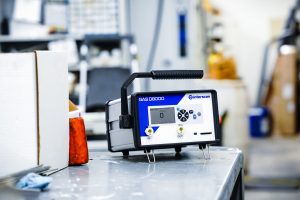
GASD 8000
For readers looking more broadly at targeted toxic-gas measurement, Interscan also explains the operating principles in its article on how electrochemical gas sensors work.
Where NDIR Makes More Sense
NDIR deserves consideration when CO is being measured as a process variable rather than primarily as an occupational exposure hazard.
Combustion analysis is an obvious example. Exhaust streams and industrial process gases can contain CO concentrations well above the ranges typically used for personnel monitoring. In those cases, an optical analyzer configured for percent-level CO may offer a more appropriate measurement span.
NDIR can also be attractive where long-term optical measurement and reduced dependence on consumable electrochemical sensing elements are major design priorities.
This is why NDIR vs Electrochemical Carbon Monoxide Detection should be evaluated in the context of the actual measurement task. A process engineer evaluating a concentrated gas stream has different requirements from an industrial hygienist looking for a developing CO exposure at worker breathing-zone levels.
Fixed Monitoring Changes the Decision
Sensor technology is only part of the system design. The way the sample reaches the detector, how continuously the area is monitored, and how quickly personnel receive an alarm also matter.
For permanent monitoring, Interscan’s AccuSafe fixed gas detection system uses electrochemical sensing with active, continuous sampling. The system supports up to ten smart sensor modules connected to a controller and provides data logging, concentration displays, network connectivity, and alarms.
That architecture can be valuable in chemical manufacturing facilities, where CO may exist alongside hydrogen cyanide, hydrogen chloride, nitrogen oxides, phosphine, sulfur dioxide, and other known process hazards. Interscan specifically supports carbon monoxide detection for chemical manufacturing applications.
For temporary surveys or troubleshooting, a portable instrument such as the GASD 8000 provides flexibility. For continuous surveillance of known locations, AccuSafe provides a fixed-point approach.
The detector should ultimately be selected around the expected CO concentration, required resolution, possible interfering gases, sampling method, environmental conditions, alarm strategy, and whether the application is safety monitoring or process measurement.
NDIR vs Electrochemical Carbon Monoxide Detection is therefore best treated as an application decision rather than a technology contest. NDIR can be an effective choice for optical process and emissions measurement, including high-concentration CO applications. Electrochemical sensing provides a strong fit for targeted industrial safety monitoring where compact equipment, low-ppm sensitivity, active sampling, and rapid operational response are priorities.
For facilities that need reliable carbon monoxide monitoring at concentrations relevant to worker safety and industrial operations, explore Interscan’s carbon monoxide detection options and the GASD 8000 portable gas detector to match the sensor range and instrument configuration to your application.
Frequently Asked Questions
Is NDIR or electrochemical detection better for low-level carbon monoxide?
Electrochemical sensing is commonly used for low-level industrial CO safety monitoring because it combines good sensitivity with compact size and low power consumption. NDIR systems can also achieve low-ppm measurements, but their advantages are often more compelling in analytical, process, and emissions applications.
Can electrochemical CO sensors measure high concentrations?
Yes. The usable range depends on the sensor design. Interscan offers carbon monoxide configurations ranging from 0 to 50 ppm through 0 to 2,000 ppm, with maximum overload specifications varying by sensor range.
When should a facility consider NDIR instead of an electrochemical CO detector?
NDIR is worth evaluating when CO is expected at relatively high process concentrations, when percentage-level measurement is required, or when an optical measurement method better suits the process. Electrochemical detection is generally well matched to targeted toxic-gas monitoring where low-level sensitivity, alarms, portability, or distributed fixed monitoring are central requirements.