- All welding types can generate hazardous gases.
- Inert and semi-inert shielding gases used to improve the welding process and weld quality pose an asphyxiation risk.
- Shielding gases that should be monitored are oxygen, carbon dioxide, hydrogen, argon, helium, and nitrogen.
- Gases produced during the process are toxic or asphyxiant and include carbon monoxide, carbon dioxide, ozone, nitrogen oxides, phosgene, phosphine, and VOCs.
Welding is an essential process in many industries, including automotive, construction, and manufacturing. Welding gases and fumes released during the process pose a significant health hazard for welders. Monitoring these gases is key to managing the risks they pose across industries. This article covers the major gases workers encounter in common welding processes.
Gaseous Hazards in Welding
Exposure to gases and fumes, especially in confined spaces, is one of the main dangers welders face, alongside risks from electricity, heat, fire, explosion, radiation, noise, and solvents; see Table 1.
Gases, fumes, and their mixtures can cause toxicity and asphyxiation. Full-time and part-time welders working in small shops, or others working near welding processes, should receive enough information about the gases to which they are exposed through education and training. Exposure to welding gases is a grave concern in confined spaces with poor ventilation, such as metal tanks, pipes, ship hulls, etc.
The USA regulatory agency, the Occupational Safety and Health Administration (OSHA), has various welding standards that employers must follow to protect workers from hazards, including gases and fumes.
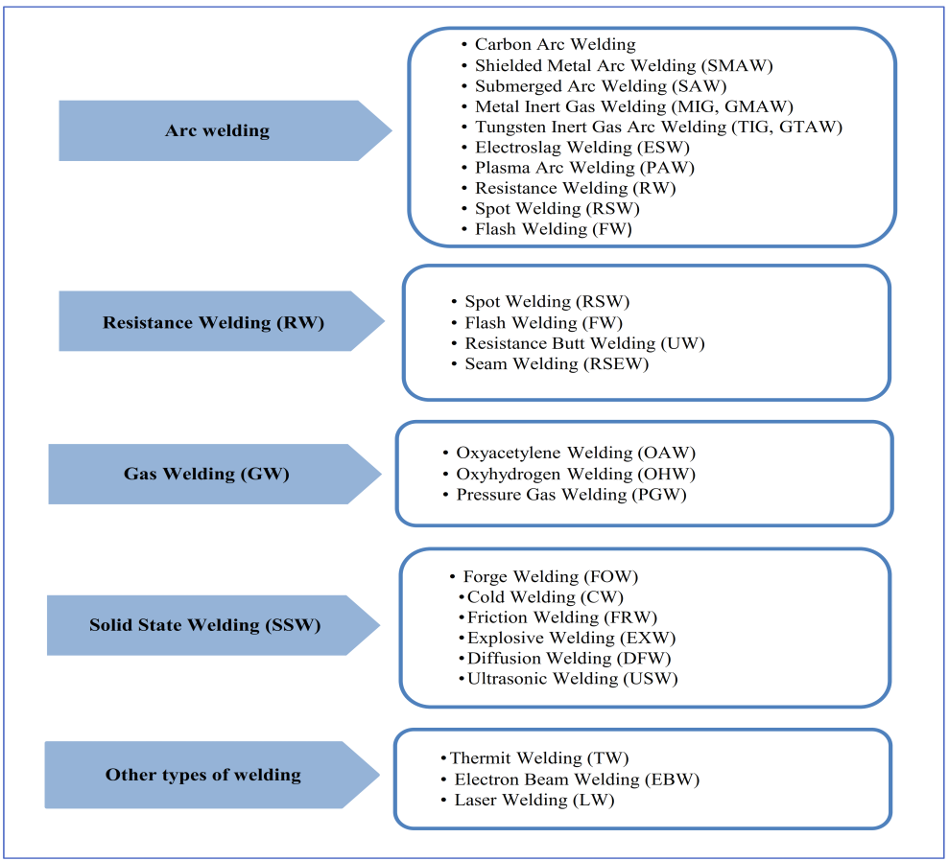
Figure 1: “Classification of welding processes,” Golbabaei and Khadem (2014). (Image credits: https://www.intechopen.com/chapters/48086)
Fumes and Gases Associated with Welding
The fumes and gases produced during welding depend on many factors such as welding type, the metals welded, the consumables used, and work practices.
Subscribe to receive our monthly round-up of articles.
- Type of welding process: Around fifty types of welding exist, which are broadly grouped under the categories: arc, resistance, gas, solid state, and others (including laser); see Figure 1.
- Materials: Base metal, filler metals, coatings, electrode composition, welding rod composition, and shielding gases influence the welding fumes produced.
- Location: Where welding takes place is crucial. Workers are exposed to higher concentrations in enclosed areas, especially confined spaces, than outdoors.
- Ventilation controls: Engineering controls that ensure proper ventilation and air movement can reduce exposure to fumes and gases.
- Welding safe practices: Several safe procedures and equipment are established to ensure worker safety, including welding clean surfaces, use of protective clothing, respirators, fire protection, local exhaust ventilation, and proper storage of gas cylinders.
Nearly all types of welding produce air pollutants, such as particulate matter, gases, metal fumes, and volatile organic compounds (VOCs); see Table 1.
- Welding fumes: The fumes are a mixture of the metals being welded, metallic oxides, fluorides, and silicates. When the metal is heated, its vapors form particulate matter. Electrodes and coatings also contribute materials to the fumes. Fume composition depends on the metal welded, the electrode, and the welding method. The fumes can contain aluminum, iron, chromium, copper, silver, tin, lead, zinc, cadmium, antimony, arsenic, cobalt, beryllium, nickel, manganese, molybdenum, titanium, and vanadium.
- Welding gases: The gases workers can be exposed to are those used as shielding gases and those produced during the processes.
Welding fumes and gases can have short- and long-term health effects. This article explains where welding gases are produced so industrial hygienists and safety managers can determine which gases to monitor in their welding sections.
Table 1. “The hazards associated with welding Processes.
x No hazards, + Hazard present, – Hazard present if SAW flux is absent,” Golbabaei and Khadem (2014). (Image credits: https://www.intechopen.com/chapters/48086)

Welding Gases Used in Shielding
Shielding gases used in welding serve several purposes and are listed below:
- Protect the weld pool: They are used in arc and laser welding to protect the weld pool from reacting with atmospheric gases, such as oxygen, nitrogen, and water vapor, which can contaminate the metal being welded. The shielding gases displace and replace reactive gases away from the molten metal.
- Plasma control: The shielding gases influence plasma formation and structure, which consists of molten metal, ionized gas, vapors, and slag. So, suitable shielding gases can control the plasma. In arc welding, the shielding gases also stabilize the arc and improve metal transfer.
- Improve weld properties: Shielding gases react with the base and filler metals to change mechanical properties such as toughness, strength, hardness, and corrosion resistance in the welded area.
- Bead profile: Specific shielding gases produce different weld bead profiles and penetration patterns.
- Remove defects: Shielding gases reduce porosity, a common defect formed depending on the welding atmosphere, which can decrease weld lifespan.
Shielding Gases
Common shielding gases used for welding include carbon dioxide, argon, helium, hydrogen, oxygen, and nitrogen. Argon and helium are inert gases, while hydrogen, oxygen, carbon dioxide, and nitrogen are semi-inert.
According to Kah and Martikainen (2013) and Tulsa Welding School, these shielding gases are used in specific welding types and metals, as discussed below. Shielding gases can be used alone, but most often as a combination of two or more gases in varying amounts.
Carbon Dioxide: Carbon dioxide (CO2) is preferred in a mixture with argon in gas metal arc welding for carbon steels as it improves welding speed, provides better penetration, and is low-cost. In ferritic stainless-steel welding, higher CO2 improves weld boundary properties. CO2 is not used alone because it leads to element loss and spatter.
Argon: The gas argon (Ar) is suitable for easier starts, longer arcs at lower voltage, and welding in the flat position and deep grooves. Argon is used alone for aluminum and non-ferrous metals. It is used in a mixture with CO2 and oxygen (O2) commonly for welding low- and mild-alloyed steels.
Helium: This gas is used in mechanized applications. Pure helium (He) is used for welding aluminum, copper, and magnesium. Helium is also used in mixtures with argon for aluminum and aluminum alloys to reduce defects and protect the weld pool. Pure helium produces an erratic arc and spatter with steel. So, helium is used for stainless steel with other shielding gases to improve penetration, speed, protect the weld pool, and reduce defects.
Hydrogen: This gas is used in mixtures with other gases to produce specific effects. With argon, hydrogen (H2) improves speed and penetration. With oxygen for stainless steel, H2 produces clean welds and improved bead profiles. It is used in a mixture with CO2 and argon to improve arc temperature and reduce arc width.
Nitrogen: Nitrogen (N2) can improve arc stability and weld penetration. It is added to mixtures to weld alloys that contain nitrogen, preventing element loss and pitting corrosion. It is used for welding duplex and super duplex stainless steels to increase corrosion resistance, and for austenitic stainless steels to improve bead appearance and weld hardness, tensile strength, and corrosion resistance.
Oxygen: Used with other gases like argon for arc stabilization, improved metal transfer, and spatter minimization. However, oxygen (O2) causes oxidation and is not used to weld copper, aluminum, or magnesium. Too much O2 can make the weld brittle.
Health Effects of Shielding Gases
Shielding gases are an asphyxiation hazard when welding is done in confined spaces and must be monitored before entry and during welding. The shielding gases can accumulate and displace oxygen, suffocating people.
Normal O2 levels in air are 20.9%. Oxygen levels below 19.5% and above 23.5% are hazardous. O2 deficiency can lead to death. Too much oxygen can be toxic and is harmful to health.
Moreover, above 23%, O2 becomes a fire hazard, and the risk increases as O2 levels rise. Fires and explosions hurt welders and damage property.
Therefore, it is crucial to monitor all shielding gases to ensure they remain below safe limits, and to monitor oxygen to keep it within its safe range.
Gases Released During Welding Process
The welding process also produces other hazardous gases that must be monitored.
Normal or shielding gases in the air or materials released during welding can produce these hazardous gases.
- Gases: The gases in ambient air or shielding gases in the welding atmosphere can be oxidized or react with ultraviolet (UV) light to produce hazardous gases.
- Materials: Decomposition of electrodes and their coatings, degreasing agents, and organic coatings on metals can also add to the gases and fumes produced during welding.
Common hazardous gases produced during welding include carbon monoxide, carbon dioxide, nitric oxide, nitrogen dioxide, ozone, hydrogen fluoride, phosgene, phosphine, and VOCs like formaldehyde. Table 2 lists the health effects of these gases.
Table 2. “Health Effects of Gases and Organic Vapors Produced During Welding,” Djerić et al. (2012). (Credits: Ecol Urban Areas, 575)

Carbon monoxide: Carbon monoxide (CO) is a toxic hazard. It forms when UV radiation reacts with CO2 in the atmosphere, where it acts as a shielding gas. It is also produced due to the decomposition of inorganic carbonates and organic compounds in cores and electrode coatings. CO can also be formed during the incomplete combustion of flux and acetylene in gas welding.
CO can accumulate and create an oxygen-deficient atmosphere in confined spaces. Sometimes, CO production is associated with the generation of sulfur dioxide and nitrogen oxides.
Carbon dioxide: Besides CO, carbon dioxide is also produced during the decomposition of organic compounds and inorganic carbonates in electrode coatings and cores.
Ozone: Ozone is produced in welding through the action of UV radiation on O2 in the air. UV wavelengths and intensity, the material welded, electrode type, shielding gas, and welding variables such as process, voltage, arc length, and current can determine the amount of ozone produced. Ozone is produced during tungsten inert gas welding of stainless steel and aluminum welding.
Nitrogen oxides: Nitric oxide (NO) and nitrogen dioxide (NO2) form when UV light interacts with air in arc welding processes.
Phosgene: During welding of metals degreased with chlorinated solvents, phosgene, a toxic gas, is produced. The gas forms when chlorinated hydrocarbon vapors escape from degreasing tanks or through spills and are oxidized.
Phosphine: The phosphine (PH3) gas is formed when the rust inhibitor on welded steel interacts with radiation.
Hydrogen Fluoride: Fluorides are common materials in electrode coatings and flux used in low- and high-alloy steels. When fluorides decompose, they release hydrogen fluoride.
VOCs: Several VOCs, including formaldehyde, are produced during welding processes from degreasing solvents, metal coatings, and pigment binders. High welding temperatures vaporize or decompose these compounds, producing VOC vapors.
Among the process gases, the main gases of concern are carbon monoxide, ozone, and nitrogen oxides. The welding processes associated with these gases are gas metal arc welding, shielded metal arc welding, and flux-cored arc welding.
How to Monitor Hazardous Gases
The information above introduces common occupational gas hazards in welding. Because welding processes and materials strongly determine the gases produced, industrial hygienists must identify the specific hazardous gases their facilities produce. They can then use gas detectors to monitor them. Fixed gas detectors placed strategically near welding areas can monitor the air around the clock and alert people when gas concentrations exceed safe permitted limits. Employers can provide individual welders with portable gas detectors in smaller facilities and for welding in confined spaces. Interscan provides both fixed and portable detectors for many of the hazardous gases produced during welding.
Contact us to learn about the Interscan gas detectors for your welding operations.
Sources
CCOHS. (2024, Sept 25). Welding – Fumes And Gases. Retrieved from https://www.ccohs.ca/oshanswers/safety_haz/welding/fumes.html
Doncheva, E., Krstevska, A., Petreski, M., Avramov, N., & Djokikj, J. (2022, May). A study on the environmental and health impact of hazardous substances during welding. Retrieved from
Djerić, J., Jovanić, D., Jašin, D., Kovačević, M., & Ludajić, G. (2012). Welding fume and gas exposure in the welding environment. Ecol Urban Areas, 575.
Golbabaei, F., & Khadem, M. (2015). Air Pollution in Welding Processes — Assessment and Control Methods. In Current Air Quality Issues. InTech. https://doi.org/10.5772/59793
Kah, P., & Martikainen, J. (2013). Influence of shielding gases in the welding of metals. The International Journal of Advanced Manufacturing Technology, 64(9), 1411-1421.
OSHA-gov. (2013, March). OSHA Fact Sheet- Controlling Hazardous Fumes and Gases during Welding. Retrieved from https://www.osha.gov/sites/default/files/publications/OSHA_FS-3647_WELDING.pdf
Tulsa Welding School. (n.d.). What Are Welding Shielding Gases, And Why Are They Important? Retrieved from https://www.tws.edu/blog/welding/what-are-welding-shielding-gases-and-why-are-they-important/