Ozone Monitoring Around Water Treatment and Industrial Ozone Generators is an important part of managing facilities that intentionally generate and use ozone for oxidation and disinfection. Ozone is valuable because it reacts quickly with contaminants and microorganisms, but that same reactivity makes uncontrolled ozone in workplace air a concern. Water treatment operators need monitoring strategies that provide useful information around ozone generators, process equipment, contact systems, and other areas where ozone could escape into occupied spaces.
For water and wastewater facilities, the goal is not simply to determine whether ozone is present. Operators need to know where it is present, at what concentration, and whether conditions are changing. A combination of fixed and portable ozone monitoring can provide that visibility.
Why Water Treatment Facilities Use Ozone
Ozone is used in drinking water and wastewater treatment because of its strong oxidizing properties. It can help address organic contaminants, microorganisms, taste and odor compounds, and several substances that are difficult to manage through conventional treatment alone.
Unlike chemicals that need to be stored in bulk, ozone is normally produced at the facility using an ozone generator. The generated gas is introduced into the treatment process, where it reacts with the water.
That approach offers process advantages, but it also creates several locations where atmospheric monitoring becomes relevant.
Potential monitoring areas can include:
- Ozone generator rooms
- Ozone contactor areas
- Gas feed equipment
- Piping and fittings
- Destruct systems
- Process equipment enclosures
- Maintenance locations
- Areas around seals and connections
The exact monitoring strategy depends on how ozone is generated, transferred, destroyed, and ventilated at a particular plant.
Subscribe to receive our monthly round-up of articles.
Why Ozone Monitoring Around Industrial Ozone Generators Matters
An ozone generator is supposed to keep ozone contained within a controlled process. In practice, operators still need a way to identify leaks or unexpected releases.
A leaking fitting, failed seal, damaged line, equipment malfunction, or problem with an ozone destruction system can allow ozone to enter the surrounding atmosphere. Because conditions can change while equipment operates, a single inspection does not provide the same information as continuous monitoring.
This is where Ozone Monitoring Around Water Treatment and Industrial Ozone Generators becomes particularly useful.
Continuous monitoring helps operators identify changes as they happen instead of discovering them during a later inspection. It can also provide historical information that helps teams determine whether an elevated reading was an isolated event or part of a recurring pattern.
Ozone also requires a targeted detection approach. A general-purpose gas detector is not automatically an ozone detector. Facilities should select instrumentation specifically configured to measure O3 at concentrations appropriate for the application.
For a broader look at the applications where ozone detection is used, see 15 Industries That Rely on Ozone Gas Detection for Safety.
Fixed Ozone Monitoring for Continuous Coverage
When the potential release point remains in a predictable location, fixed detection often makes sense.
The Interscan AccuSafe system provides fixed-point gas detection designed for continuous monitoring. AccuSafe uses electrochemical sensing technology and active, continuous sampling. Ozone is among the gases the platform can be configured to detect.
AccuSafe can support single-point installations or multi-point configurations with up to ten sensor modules reporting to a controller. That flexibility is useful in facilities where several areas surrounding an ozone process need independent monitoring.
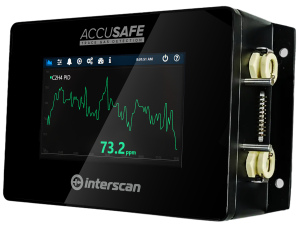
Accusafe
For example, sensors may be positioned around an ozone generator room, process equipment, or other locations identified during the facility’s hazard assessment.
AccuSafe also supports features useful for connected industrial operations, including:
- Real-time concentration readings
- Continuous sampling
- Data logging
- Audible and visual alarms
- Web-based access
- Modbus TCP and RTU communication
- Email alarms and SMS notifications
- Multi-point configurations
- Temperature and relative humidity measurement
The system’s distributed architecture can be useful when monitoring equipment is spread across a large treatment facility. Sensor modules perform data acquisition and processing locally before transmitting information through the facility network.
Sensor location still matters. Even a highly sensitive detector can only measure gas that reaches its sampling point. Facilities planning a fixed monitoring network should consider potential release points, ventilation, airflow, room geometry, worker locations, and equipment configuration. Interscan discusses these factors further in its guide to planning sensor placement for fixed toxic gas monitoring.
Portable Ozone Monitoring Adds Flexibility
Fixed detectors provide continuous coverage of predetermined areas, but maintenance teams sometimes need to investigate locations outside those monitoring points.
The GASD 8000 gives teams a portable option for trace-level ozone measurement.
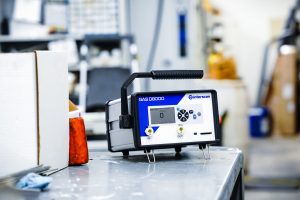
GASD 8000
The GASD 8000 uses active sampling through an integral sample pump and provides digital concentration readings along with real-time graphics. It also includes data logging and audible and visual alarms. The rechargeable lithium-ion battery supports up to eight hours of continuous service.
For ozone applications, operators can use portable monitoring for tasks such as:
- Investigating suspected leakage
- Checking areas around fittings or equipment
- Evaluating conditions before maintenance
- Comparing concentrations at different locations
- Troubleshooting ozone generation equipment
- Supplementing fixed detection during temporary operations
The GASD 8000 can detect 21 gases depending on the installed sensor configuration, including ozone, chlorine, chlorine dioxide, hydrogen sulfide, hydrogen peroxide, sulfur dioxide, and several other compounds that can be relevant in industrial and treatment environments.
This target-gas approach is particularly useful when the question is specifically whether ozone is present rather than whether an unspecified atmospheric contaminant exists.
Combining Fixed and Portable Ozone Detection
Fixed and portable instruments do not necessarily compete for the same job.
In many water treatment facilities, the strongest approach to Ozone Monitoring Around Water Treatment and Industrial Ozone Generators uses both.
Fixed detectors can continuously watch predictable risk points. Portable analyzers allow technicians to investigate conditions elsewhere.
Consider an elevated fixed-detector reading near an ozone generation system. The fixed sensor provides the initial warning. A technician can then use a portable ozone analyzer to investigate the surrounding equipment and determine where concentrations are highest.
The same portable instrument can also support maintenance activities when part of the ozone system is opened, serviced, or returned to operation.
This layered approach gives operators both continuous coverage and the flexibility to investigate changing conditions.
Data Is Part of the Monitoring Strategy
Modern ozone monitoring should provide more than an alarm.
Historical concentration data can help safety and maintenance teams understand how ozone levels behave during normal operation, startup, shutdown, maintenance, and abnormal process conditions.
Both the AccuSafe platform and GASD 8000 support data logging. That information can help teams examine concentration trends and identify repeated events that deserve further investigation.
For example, if ozone concentrations regularly rise during a particular operating phase, teams can investigate ventilation, process controls, equipment condition, or work practices instead of treating each alarm as an unrelated event.
That turns gas detection from a simple warning device into a practical source of process and safety information.
FAQs
Where should ozone detectors be installed around an ozone generator?
Placement should be based on likely release points, airflow, ventilation, room geometry, equipment configuration, and occupied areas. Monitoring near generators, ozone transfer equipment, destruct systems, fittings, and other potential leak points may be appropriate. Sensor placement should always follow a facility-specific hazard assessment.
Should a water treatment plant use fixed or portable ozone detectors?
Many facilities benefit from both. Fixed systems provide continuous monitoring at predictable risk locations, while portable instruments can be used for maintenance, leak investigation, troubleshooting, and temporary monitoring. Interscan offers both approaches through AccuSafe and the GASD 8000.
Can Interscan equipment monitor gases other than ozone?
Yes. Interscan systems can be configured for numerous target gases. Depending on the instrument and sensor configuration, available gases include ozone, chlorine, chlorine dioxide, hydrogen sulfide, hydrogen peroxide, ammonia, sulfur dioxide, and others commonly encountered in industrial facilities.
Ozone generation can be an effective part of modern water treatment, but effective use also requires visibility into what is happening in the surrounding atmosphere. A monitoring strategy built around continuous fixed detection and targeted portable measurements gives operators more information to respond to releases, troubleshoot equipment, and document changing conditions.
For facilities evaluating Ozone Monitoring Around Water Treatment and Industrial Ozone Generators, explore Interscan gas detection solutions for wastewater treatment and see how AccuSafe fixed monitoring and GASD 8000 portable detection can provide the coverage your ozone process requires.