Selecting instrumentation for low-concentration toxic gases requires more scrutiny than choosing a general-purpose safety monitor. A useful trace-level toxic gas detector checklist needs to go beyond asking which gases an instrument can detect. Sensitivity, sampling method, selectivity, calibration, data handling, alarms, installation requirements, and long-term maintenance all affect whether a detector will provide useful information when concentrations are very low.
This matters because detecting a toxic gas earlier can give personnel more time to investigate a release and respond before exposure or process conditions worsen. InterScan specifically designs its gas detection technology for trace gas analysis, including applications involving gases such as hydrazine, chlorine, hydrogen sulfide, ozone, and ethylene oxide.
Here is what to evaluate before choosing a system.
1. Start With the Required Detection Range
The first item on any trace-level toxic gas detector checklist should be the concentration range you actually need to measure.
A detector being capable of identifying a gas does not automatically mean it has the sensitivity required for your application. Determine:
- The target gas or gases
- Expected background concentrations
- Normal process concentrations
- Concentrations that should trigger investigation
- Required alarm thresholds
- Applicable occupational or process limits
Low-level sensitivity is particularly important when the objective is to recognize changing conditions before concentrations reach a more serious threshold.
InterScan systems are designed around trace-level toxic gas sensing. The company currently supports detection of 21 gases, including ammonia, bromine, carbon monoxide, chlorine, chlorine dioxide, ethylene oxide, formaldehyde, hydrazine, hydrogen cyanide, hydrogen peroxide, hydrogen sulfide, ozone, phosphine, sulfur dioxide, and others.
Subscribe to receive our monthly round-up of articles.
2. Look at the Sampling Method
Sampling is easy to overlook when comparing specifications, but it can have a significant impact on how effectively a system monitors an area.
Ask whether the detector relies on passive diffusion or actively draws the sample to the sensor.
InterScan uses active, continuous sampling in both its portable and fixed-point platforms. An integrated pump continuously moves the sample to the sensing system. This approach is useful when the monitoring point and instrument location need to be separated or when consistent sample delivery is important.
The GASD 8000, for example, incorporates an integral sample pump for active continuous monitoring. AccuSafe sensor modules also include sample-draw pumps as part of their distributed architecture.
When comparing instruments, consider the entire sample path rather than the sensor alone.
3. Confirm Accuracy at the Concentrations That Matter
A specification sheet may list impressive measurement ranges, but buyers should ask what accuracy the instrument provides within the intended application.
InterScan lists 5% accuracy for the GASD 8000 and AccuSafe sensor systems.
Accuracy should also be considered alongside:
- Calibration requirements
- Zero stability
- Sensor condition
- Sample tubing and transport
- Temperature and humidity
- Potential interfering gases
For trace monitoring, small changes can matter. A system should therefore make calibration and routine verification practical rather than turning them into occasional service projects.
4. Decide Between Portable and Fixed Monitoring
There is no universal answer to the portable-versus-fixed question. The correct approach depends on how the measurement will be used.
Portable instruments make sense for applications such as troubleshooting, surveys, temporary monitoring, maintenance work, and checking different sampling locations.
The GASD 8000 provides a portable platform with a rechargeable lithium-ion battery, up to eight hours of continuous service, digital concentration readings, real-time graphics, data logging, and audible and visual alarms.
Fixed monitoring serves a different purpose. It provides continuous coverage at defined locations without requiring an operator to carry an instrument through the facility.
The AccuSafe fixed gas detection system supports configurations with up to 10 smart sensor modules reporting to one controller. It can monitor up to 10 unique gases simultaneously, making it relevant for facilities where several toxic gas hazards must be watched continuously.
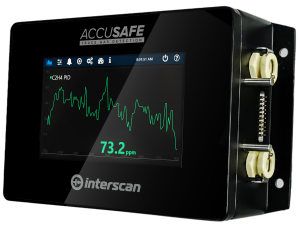
Accusafe
Some operations benefit from using both approaches.
5. Evaluate How the Detector Handles Data
A modern trace-level detector should do more than display a number.
Historical measurements can help industrial hygiene and safety teams evaluate incidents, identify concentration trends, verify process changes, and document conditions over time.
For this reason, a trace-level toxic gas detector checklist should include questions about:
- Onboard data logging
- Storage capacity
- Remote data access
- Network connectivity
- Data export
- Integration with existing systems
The GASD 8000 includes an integral 32 GB SD card for data logging and provides 4-20 mA and 0-2.5 V analog outputs.
AccuSafe takes a networked approach. Its controller supports Modbus TCP and RTU, remote web-browser access, a desktop application, and an MQTT API. Processing occurs at the sensor-module level before information is sent across the network.
This distributed architecture can be useful when gas detection needs to become part of a larger connected safety or facility-monitoring system.
6. Check Alarm and Notification Options
Detecting a gas is only useful if the information reaches the right people.
Portable monitoring should provide clear local alarms that operators can recognize immediately. Fixed monitoring may require additional notification methods so that an event is communicated even when personnel are not standing next to the detector.
The GASD 8000 provides audible and visual alarms for field use.
AccuSafe can provide sound and email alarms as well as SMS text notifications. That gives facilities several ways to communicate changing gas conditions.
When comparing systems, determine who needs the information, where they will be, and how quickly they need to receive it.
7. Consider Sensor Replacement and Downtime
Sensor maintenance should be part of the purchasing decision from the beginning.
Electrochemical sensors are consumable components. Their condition can be affected by age, operating conditions, and exposure to concentrations outside their intended measurement range.
Ask prospective suppliers:
- How often are sensors typically replaced?
- Does replacement require returning the instrument?
- Is recalibration required after replacement?
- How quickly are replacement sensors available?
- How much monitoring downtime should you expect?
InterScan addresses this with its Interchange Sensor System, which is designed to allow sensor replacement without tools or returning the detector for factory calibration. Its SensorExpress program provides replacement sensors according to the user’s requirements.
For facilities dependent on continuous monitoring, reducing sensor-related downtime can be just as important as the initial detector specification.
8. Match the System to the Actual Environment
Finally, check environmental ratings carefully.
The portable GASD 8000 is specified for operation from 32°F to 113°F (0°C to 45°C) and 0 to 90% relative humidity. Its anodized aluminum enclosure is intended for field operation.
AccuSafe sensor modules operate from 32°F to 122°F (0°C to 50°C) in non-condensing conditions and use IP68-rated sensor enclosures.
Those differences matter. A detector should be selected for the actual installation, not simply because its measurement range looks suitable.
A good trace-level toxic gas detector checklist ultimately connects measurement performance with the way the instrument will be used. Define the gas, concentration range, sampling requirements, monitoring location, alarm strategy, data needs, maintenance plan, and environmental conditions before comparing equipment.
For applications where early detection and very low-level toxic gas measurement are priorities, InterScan offers both portable and fixed-point approaches. Explore InterScan’s trace gas analysis capabilities or review the GASD 8000 and AccuSafe platforms to find a configuration that fits your monitoring requirements.
Frequently Asked Questions
What is trace-level toxic gas detection?
Trace-level toxic gas detection means measuring hazardous gases at very low concentrations. It is particularly useful when facilities want to identify leaks or changing conditions early rather than waiting for concentrations to increase substantially. The required sensitivity depends on the target gas and application.
Should I choose a portable or fixed trace-level gas detector?
Choose based on the monitoring task. Portable instruments such as the GASD 8000 are useful for surveys, troubleshooting, maintenance, and measurements at changing locations. Fixed systems such as AccuSafe are designed for continuous monitoring of predetermined points. Facilities with multiple monitoring needs may use both.
What should I prioritize when comparing trace-level toxic gas detectors?
Start with sensitivity to the specific target gas, then evaluate accuracy, active versus passive sampling, potential interferences, calibration, alarm capabilities, data logging, connectivity, environmental requirements, and sensor maintenance. Looking at the complete monitoring system provides a more useful comparison than evaluating detection limits alone.