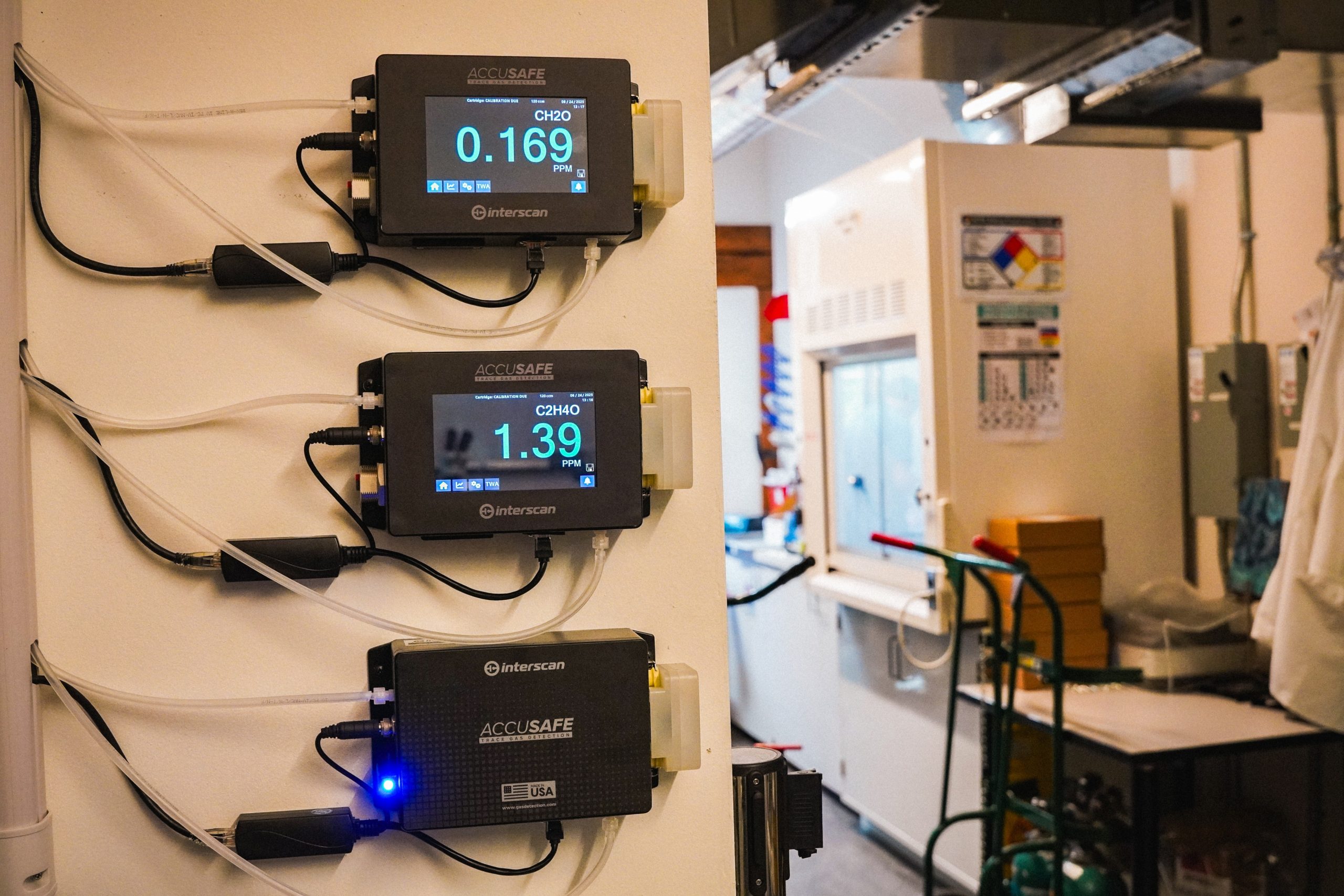
Modbus-Connected Gas Detection vs Standalone Monitors becomes a much more important comparison once gas monitoring expands beyond a few isolated points. A standalone detector can work well when one room, process, or piece of equipment needs local monitoring. But as facilities add sensors across production areas, storage rooms, utilities, laboratories, or processing zones, the challenge changes. Teams are no longer managing just gas detectors. They are managing data, alarms, communications, maintenance, and responses across an entire facility.
For larger installations, connected gas detection usually provides the more scalable architecture. Standalone monitoring still has a place, but the operational advantages of networking become more significant with every additional monitoring point.
Why standalone monitors work well at smaller scale
A standalone gas monitor is straightforward. It measures the target gas, displays the concentration locally, and can generate an alarm without depending on a central controller.
That simplicity has real value. Interscan’s AccuSafe architecture, for example, can be configured so a sensor unit with a concentration display and alarm indicators operates as a standalone detector for a single monitoring point. The same sensor technology can therefore support both independent and connected configurations.
Interscan’s AccuSafe architecture
Standalone monitoring can make sense when:
- Only one or a few fixed locations require monitoring
- Personnel regularly work near the detector and can respond to local alarms
- Centralized data access is not required
- The monitoring point operates independently from other process areas
- Network infrastructure is unavailable or unnecessary
The problem is not that standalone monitors stop working as more are installed. The issue is that administration becomes increasingly decentralized.
Subscribe to receive our monthly round-up of articles.
Ten independent detectors can mean ten places to check, ten sets of local information to review, and potentially several separate data sources. The hardware may scale, but the workflow does not always scale as efficiently.
What Modbus changes in a facility-wide system
Modbus gives gas detectors a standardized way to communicate with controllers and other compatible automation equipment.
AccuSafe supports both Modbus TCP and Modbus RTU over RS-485. A single AccuSafe controller can support up to ten smart sensor modules, with configurations capable of monitoring up to ten unique gases simultaneously. Those sensors can report their information to a central interface instead of requiring operators to treat every detector as an isolated instrument.
This is where Modbus-Connected Gas Detection vs Standalone Monitors begins to separate clearly from an operational standpoint.
A connected architecture can give safety teams:
- Centralized visibility into several monitoring locations
- Continuous communication between sensors and the controller
- Remote browser and desktop access
- Data logging across connected monitoring points
- Alarm notifications beyond the immediate sensor location
- Integration with compatible actuators and control equipment
AccuSafe also provides an MQTT API along with configurable I/O and control options, giving facilities additional ways to incorporate gas information into connected operations.
Scaling data is just as important as scaling sensors
Adding detectors is easy to understand. Adding useful data management is more complicated.
Every additional monitoring point creates another stream of concentration readings, alarms, operating conditions, and historical information. If those records remain isolated at individual instruments, someone eventually has to collect, organize, and interpret them.
A connected system can bring those measurements together.
This is especially useful because gas concentration data is more valuable when viewed as a trend rather than as a single number. Historical records can help teams identify recurring concentration increases, investigate incidents, compare operating conditions, and support reporting requirements.
Interscan discusses these applications in its guide to data logging in gas detection. Data logging can support continuous exposure tracking, incident analysis, and regulatory reporting rather than leaving teams to reconstruct conditions from isolated observations.
For a facility with dozens of important measurements, centralized access to that history can become one of the strongest arguments for networking.
Connected alarms can improve the response model
A local audible or visual alarm works when somebody is close enough to notice it. That assumption becomes less reliable in large buildings, low-occupancy areas, equipment rooms, or processes that operate with limited staffing.
AccuSafe can provide sound alarms along with email and SMS notifications. Its networked architecture also allows gas information to be viewed remotely.
That changes how facilities respond to an event.
Instead of requiring personnel to discover a condition while physically near a detector, a connected system can make the reading available elsewhere in the facility. Compatible control equipment can also be incorporated through Modbus-based I/O where the application calls for automated responses.
Interscan’s discussion of when fixed gas detection is necessary notes that fixed systems can be linked with control applications or building systems for actions such as shutting down equipment or closing valves.
For larger operations, the ability to move from a local alarm toward coordinated response is an important scalability advantage.
Maintenance also becomes a scaling issue
A five-detector installation and a fifty-detector installation create very different maintenance workloads.
Calibration schedules, sensor status, data retrieval, alarm settings, and troubleshooting all have to remain manageable as the system grows. A connected architecture gives personnel fewer interfaces through which to understand the condition of multiple monitoring points.
AccuSafe uses a distributed architecture in which each sensor module includes an integrated sample draw pump and onboard data acquisition. Processing occurs locally before information moves through the network. This allows the system to distribute sensing and processing while still providing centralized visibility.
That model avoids treating every monitoring point as a completely separate system.
Standalone instruments still matter
Modbus connectivity does not make standalone detection obsolete.
Portable monitoring is one obvious example. Interscan’s GASD 8000 provides active continuous sampling, a real-time display, automatic data logging, audible and visual alarms, and SD-card storage. It can operate independently in the field and provides up to approximately eight hours of battery-powered monitoring, depending on operating conditions.
That makes a standalone portable analyzer useful for inspections, industrial hygiene surveys, maintenance, investigations, and temporary monitoring locations where installing permanent infrastructure would not make sense.
In fact, a facility may get better coverage by combining architectures. AccuSafe can continuously monitor permanent risk areas while a GASD 8000 moves wherever technicians need additional measurements. Interscan explores that distinction further in its GASD 8000 vs AccuSafe comparison.
So, which architecture scales better?
For permanent multi-point monitoring, Modbus-connected gas detection generally scales more effectively because the communications architecture grows with the sensor network.
Standalone monitors scale by adding more individual devices. A connected system scales by adding monitoring points to a broader information and response structure.
That difference becomes increasingly important when a facility needs centralized data, remote visibility, coordinated alarms, historical records, or connections with automation systems.
The deciding factor should still be the monitoring objective. A single isolated hazard may only need a standalone detector. A facility with multiple permanent risk zones is much more likely to benefit from a connected approach. In many operations, the strongest strategy combines both.
Frequently Asked Questions
How many sensors can one AccuSafe controller support?
A single AccuSafe controller can support up to ten smart sensor modules. Configurations can monitor up to ten unique gases simultaneously, depending on the selected sensors and application.
Does Modbus replace local gas alarms?
No. Network communication and local alarming serve different purposes. AccuSafe can provide local monitoring while also transmitting information through Modbus and supporting remote notifications. This allows facilities to maintain immediate local warning while gaining centralized visibility.
Do portable gas detectors still make sense in a Modbus-connected facility?
Yes. Portable instruments such as the GASD 8000 can cover temporary work, inspections, maintenance areas, investigations, and locations outside the permanent sensor network. Fixed and portable systems often complement each other rather than compete.
If your facility is moving from isolated monitoring points toward a connected gas detection strategy, explore Interscan AccuSafe fixed-point gas detection to see how Modbus connectivity, continuous active sampling, centralized data access, alarms, and scalable sensor configurations can support facility-wide monitoring.