Choosing the right monitoring equipment for an ethylene oxide sterilization area is not simply a matter of finding a detector that lists EtO on its specification sheet. Effective ethylene oxide gas detector selection depends on sensitivity, sampling method, monitoring location, alarm requirements, data handling, and whether the application calls for portable or continuous fixed monitoring. In healthcare and sterile processing environments, those factors directly affect how quickly personnel can identify changing EtO concentrations and respond appropriately.
Ethylene oxide, or EtO, remains important for sterilizing medical products and equipment that cannot tolerate conventional high-temperature sterilization. At the same time, EtO requires careful monitoring because exposure limits are low. Interscan lists the OSHA permissible exposure limit as 1 ppm over an eight-hour time-weighted average, with a 0.5 ppm action level and a 5 ppm short-term exposure limit.
For facilities evaluating gas detection solutions for healthcare and sterile processing, that makes low-level measurement capability one of the first specifications to consider.
Start With the Required Measurement Range
The first step in ethylene oxide gas detector selection is defining what concentrations you actually need to measure.
A detector intended primarily to warn of a large accidental release may not provide the sensitivity needed for industrial hygiene measurements or low-level leak investigations. Sterilization facilities often need to identify EtO well before concentrations reach high alarm levels.
Interscan offers EtO sensor ranges including:
- 0 to 50 ppm
- 0 to 20 ppm
- 0 to 5 ppm
- 0 to 2,000 ppb
- 0 to 1,000 ppb
These options allow a monitoring system to be matched more closely to the actual job rather than forcing every application into the same measurement range.
Subscribe to receive our monthly round-up of articles.
For example, a safety team conducting low-level exposure investigations may prioritize a ppb-range sensor. A detector used for process-area leak checks may require a wider ppm range.
The important point is to select the range around the concentrations that matter operationally.
Consider Active Sampling
Sampling method is another important distinction between gas detectors.
Interscan systems use active sampling, with a pump drawing the atmosphere to the sensor. The GASD 8000, for example, incorporates an internal sample pump for continuous sampling.
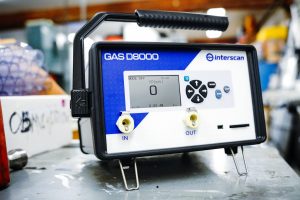
GASD 8000
Active sampling can be useful around sterilization equipment because personnel may want to evaluate a specific location rather than simply wait for gas to diffuse naturally toward a sensor.
Potential sampling points can include:
- Sterilizer doors
- Gas supply connections
- Cylinder storage or changeout locations
- Aeration areas
- Exhaust equipment
- Piping connections
- Maintenance locations
- Areas where employees routinely work
Detector placement still needs to reflect the actual sterilization process, room layout, ventilation, potential release points, and facility safety plan.
Decide Between Portable and Fixed Monitoring
There is no universal answer to whether portable or fixed equipment is better. The right option depends on the monitoring objective.
Portable instruments are particularly useful for troubleshooting, maintenance, leak investigation, surveys, and checking multiple areas with one instrument.
The GASD 8000 is designed for portable trace-level gas monitoring and can detect EtO as one of 21 supported gases. It provides a digital concentration readout, real-time graphical display, data logging, audible and visual alarms, and up to eight hours of continuous battery-powered operation.
Fixed monitoring serves a different role.
A permanently installed system can continuously watch locations where EtO releases may reasonably occur, even when employees are not actively performing a survey.
Interscan’s AccuSafe fixed gas detection system supports continuous active sampling and can operate in single-point or multi-point configurations. Up to ten smart sensor modules can report to a controller through its distributed architecture.
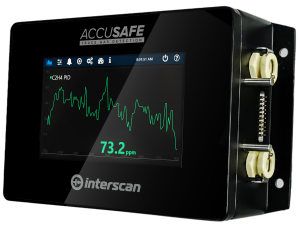
Accusafe
For many sterilization facilities, the strongest strategy may involve both approaches. Fixed sensors provide continuous surveillance at known risk points, while a portable detector gives personnel flexibility for investigation and verification.
Look at Alarm and Notification Requirements
An EtO reading only helps if the right people know about it.
During ethylene oxide gas detector selection, facilities should determine how alarms need to reach operators, environmental health and safety personnel, sterile processing staff, or facility management.
A local audible alarm may be enough for some portable applications. A larger healthcare facility may need remote access and networked notifications.
AccuSafe provides local and remote monitoring capabilities and supports sound, email, and SMS alarm notifications. Its communication options include Modbus TCP and RTU, remote browser access, a desktop application, and an MQTT API.
Those capabilities matter when gas detection needs to become part of a broader facility monitoring strategy instead of functioning as an isolated instrument.
Evaluate Data Logging and Exposure Investigation Needs
Gas concentration is rarely static.
A brief EtO increase during a particular procedure may be more informative than a reading taken several minutes later. This makes data logging an important consideration for exposure assessment and troubleshooting.
The GASD 8000 combines onboard processing with real-time graphics and integral data logging. AccuSafe also provides data storage and continuous measurement capabilities.
Historical data can help teams answer practical questions. Did the concentration increase when the sterilizer door opened? Does a recurring peak correspond with cylinder changeout? Are readings different during maintenance? Is a corrective action actually reducing concentrations?
Instead of treating an alarm as an isolated event, logged measurements provide context.
Consider Sensor Maintenance and Downtime
A gas detector only protects a facility when its sensor is available and performing properly.
Calibration schedules, replacement procedures, spare sensor availability, and instrument downtime should therefore be evaluated before purchasing a system.
Interscan uses its Interchange Sensor System to simplify sensor replacement. The company also offers SensorExpress, a sensor replacement program intended to provide calibrated replacement sensors when needed. The GASD 8000 can be calibrated against a standard gas mixture or through SensorExpress.
This is worth considering in sterile processing operations where sending an instrument away for sensor service can leave a gap in monitoring coverage.
Do Not Treat Every Gas Detector as Equivalent
A common mistake in ethylene oxide gas detector selection is focusing primarily on the number of gases an instrument can detect.
For a known toxic-gas hazard such as EtO, the more important questions are usually:
- Can the instrument detect EtO at the concentrations relevant to the facility?
- Is its measurement range appropriate?
- Does it continuously and actively sample the atmosphere?
- Can it provide alarms quickly enough for the intended application?
- Can operators review and store concentration data?
- Is portable, fixed, or combined monitoring required?
- How easily can the sensor be maintained or replaced?
For more background on why monitoring EtO has become an increasingly important issue for sterilization operations, see Interscan’s article on ethylene oxide health risks and changing regulatory attention.
Facilities considering remote sampling can also review Interscan’s evaluation of EtO detection at a 150-foot sampling distance, which examines AccuSafe response and sensitivity with an extended sampling line.
Selecting an EtO detector starts with the hazard, not the instrument catalog. Define the concentrations that matter, identify likely release locations, determine how frequently monitoring is required, and decide how alarms and measurement data will be used. From there, the detector specifications become much easier to evaluate.
For healthcare facilities that need sensitive portable measurements, continuous fixed monitoring, or a combination of both, explore Interscan’s healthcare gas detection solutions and talk with the Interscan team about configuring an EtO monitoring approach around your sterilization process.
Frequently Asked Questions
What range should an ethylene oxide gas detector measure?
The appropriate range depends on the monitoring objective. Interscan offers EtO ranges extending from wider ppm measurements down to 0 to 1,000 ppb. Low-level exposure monitoring generally requires greater sensitivity than detecting a larger process leak.
Should an EtO sterilization area use a portable or fixed gas detector?
Both can have a role. Portable detectors such as the GASD 8000 are useful for surveys, troubleshooting, maintenance, and checking specific locations. Fixed systems such as AccuSafe provide continuous monitoring at established sampling points. Facilities may use both when they need continuous coverage plus portable investigative capability.
Why is active sampling useful for ethylene oxide monitoring?
Active sampling uses a pump to continuously bring an air sample to the sensor. This allows monitoring to focus on defined sampling locations and provides continuous measurement rather than relying solely on passive movement of gas toward the detector. Both the GASD 8000 and AccuSafe use active sampling approaches.