When comparing Single-Gas vs Multi-Gas Detectors, the obvious assumption is that monitoring more gases must provide better protection. In some environments, that is true. A multi-gas detector makes sense when workers may encounter several hazards and need one instrument to watch for them simultaneously. But when a facility has one clearly defined gas hazard, a dedicated single-gas sensor can provide a more focused monitoring strategy. The right choice comes down to the gas, expected concentration, monitoring location, response requirements, and how the data will be used.
What separates single-gas and multi-gas detection?
A single-gas detector monitors one target gas. A multi-gas detector uses multiple sensing channels or technologies to monitor several hazards at the same time. Interscan’s own guidance notes that both approaches have legitimate applications, with the decision depending on factors such as the gases present, exposure frequency, facility size, and monitoring requirements.
Multi-gas instruments are particularly useful where the hazard profile changes or several gases may be present together. Confined-space work is a common example. A technician may need information on oxygen levels, combustible gases, hydrogen sulfide, carbon monoxide, or other hazards during a single entry.
A dedicated sensor becomes more compelling when the problem is narrower. If the safety team already knows that chlorine, hydrogen peroxide, ethylene oxide, hydrazine, ammonia, or another specific gas is the primary concern, there may be little operational value in adding unrelated sensing channels.
That is why the Single-Gas vs Multi-Gas Detectors decision should start with the hazard assessment rather than the number of sensors available.
When does a dedicated gas sensor make more sense?
There are several situations where concentrating the instrument around one target gas can be the more practical approach.
1. One gas dominates the risk assessment
Many processes have a clearly identifiable gas hazard. A sterilization area may center its monitoring strategy on a particular sterilant, while a chemical process may revolve around chlorine, ammonia, hydrogen peroxide, or another known substance.
Subscribe to receive our monthly round-up of articles.
In these situations, the safety team does not need a detector to answer, “What gases might be here?” The important question is, “How much of this specific gas is present right now?”
A dedicated detector keeps the measurement, alarm strategy, and operating procedure centered on that hazard.
2. Low-level detection matters
Detection range can be just as important as the number of gases measured. Some toxic gases need to be monitored at very low concentrations, particularly when early warning is part of the facility’s control strategy.
Interscan’s GASD 8000 brochure describes continuous active air sampling and sensor technology designed for extremely low trace-level detection. The portable system draws air continuously rather than relying only on passive gas movement toward the sensor.
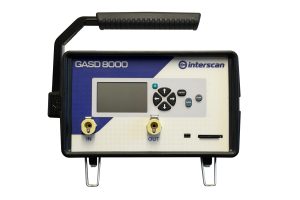
GASD 8000 portable gas detector for industrial gas surveys and on-site monitoring.
The current GASD 8000 also provides real-time concentration readings, graphical data, logging, audible and visual alarms, and up to eight hours of continuous battery operation.
For applications where a single toxic gas must be identified as early as possible, these characteristics may be more valuable than simply increasing the number of gases on the detector.
Dedicated does not have to mean inflexible
One concern about single-gas equipment is that a facility could become locked into one measurement capability. Interscan approaches this differently through interchangeable sensing technology.
The GASD 8000 platform supports sensors for a broad range of target gases, including ammonia, carbon monoxide, chlorine, chlorine dioxide, ethylene, ethylene oxide, formaldehyde, hydrazine, hydrogen, hydrogen cyanide, hydrogen peroxide, hydrogen sulfide, nitric oxide, nitrogen dioxide, ozone, peracetic acid, propylene oxide, and others. The detector can therefore be configured around the gas relevant to the application instead of requiring an entirely different analyzer platform for every target.
Interscan’s Interchange Sensor System also allows sensor replacement in the field without returning the detector for routine sensor exchange. The company’s current product information states that cartridges can be changed without tools and in under a minute.
That changes the Single-Gas vs Multi-Gas Detectors discussion. A dedicated measurement does not necessarily require a permanently dedicated instrument architecture.
What about facilities with several known gas hazards?
A multi-gas handheld detector is one way to cover multiple hazards, but it is not the only way.
Fixed monitoring can use multiple dedicated sensing points distributed around the areas where particular gases are most likely to occur. This allows the monitoring architecture to follow the actual process layout.
The AccuSafe fixed gas detection system takes this approach. AccuSafe supports continuous active air sampling and can connect up to ten sensor modules to one AccuSafe Connect display. Individual sensors can be installed in different rooms, zones, or process areas while their readings are brought into a centralized monitoring interface.
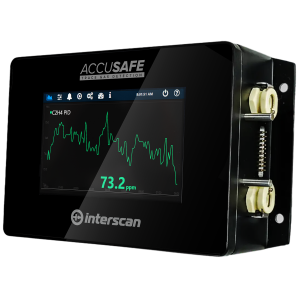
AccuSafe provides continuous fixed-point gas monitoring with connected smart sensors, centralized data access, alarms, and logging.
The current system uses distributed processing, integrated pumps, data acquisition, and network communication to support continuous facility monitoring.
For a facility with several well-understood gas hazards, multiple strategically positioned dedicated sensors can provide a different type of coverage than carrying one multi-gas instrument through the building.
When is a multi-gas detector the better choice?
Dedicated sensors are not automatically the right solution. Multi-gas detection has clear advantages when:
- Workers can encounter several gases during the same task.
- The exact hazard can change from location to location.
- Portable personnel need several measurements from one device.
- Space and equipment count are major considerations.
- A procedure specifically requires simultaneous monitoring of multiple atmospheric hazards.
Facilities often use both approaches. Fixed sensors may continuously monitor known process hazards while portable detectors support maintenance, inspections, temporary work, or entry into changing environments.
For a broader comparison of deployment strategies, see Interscan’s guide to fixed or portable gas detectors. Safety teams evaluating sensing methods can also review Understanding Gas Detection Technologies.
How to choose between single-gas and multi-gas detection
Instead of starting with instrument specifications, start with the monitoring problem. Ask:
- Which gases can realistically be present?
- Is one gas responsible for most of the exposure risk?
- How low a concentration needs to be detected?
- Is monitoring continuous, portable, or both?
- Does each gas originate in the same location?
- Will the detector support process monitoring, worker protection, leak investigation, or all three?
- How important are data logging, remote monitoring, alarms, and sensor replacement time?
These questions usually make the Single-Gas vs Multi-Gas Detectors decision much clearer. Interscan’s guide to choosing a gas detector provides additional factors to consider.
When one known gas drives the risk, a dedicated sensor can deliver a simpler and more targeted monitoring approach. When several hazards can appear together, multi-gas detection may be more practical. Many facilities ultimately need a combination of both.
Frequently Asked Questions
Are single-gas detectors more accurate than multi-gas detectors?
Not automatically. Accuracy depends on the sensor, target gas, measuring range, environmental conditions, and instrument design. The advantage of a dedicated detector is that the monitoring strategy can be optimized around one known hazard rather than several unrelated measurements.
Can one facility use several dedicated single-gas sensors?
Yes. Fixed systems can distribute dedicated sensing points around different process areas. AccuSafe, for example, can connect up to ten sensor modules to one Connect display, allowing facilities to expand monitoring room by room or zone by zone.
Should a facility choose between fixed and portable detection at the same time?
Yes. Sensor type and deployment method are separate decisions. A facility may use fixed monitoring for continuous coverage while keeping portable detectors available for inspections, maintenance work, leak investigation, and other mobile applications.
If your hazard assessment points to a known target gas, explore Interscan’s complete range of gas detection products, including the portable GASD 8000 and fixed AccuSafe platform, to build a monitoring system around the gases that actually matter in your facility.