Choosing between AccuSafe vs Portable Gas Detectors comes down to how gas hazards actually appear in your facility. Some risks remain tied to predictable locations, such as processing areas, chemical storage rooms, or production equipment. Others move with workers, maintenance activities, confined-space entry, or temporary operations. In many facilities, both types exist.
That difference matters because fixed and portable detectors solve different monitoring problems. Interscan’s AccuSafe provides continuous fixed-point monitoring with connected sensors and centralized visibility. Portable instruments such as the GASD 8000 bring active gas monitoring directly to the location where personnel are working.
The better approach starts with your risk profile, not simply the detector format.
What AccuSafe brings to fixed gas detection
AccuSafe is designed around continuous, always-on gas monitoring. Instead of relying on an employee to carry a detector into an area, sensors remain positioned where known hazards are likely to develop.
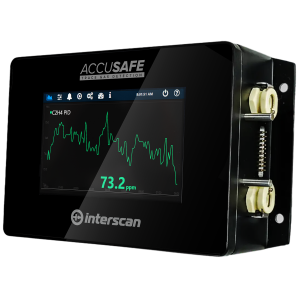
AccuSafe provides continuous fixed-point gas monitoring with connected smart sensors, centralized data access, alarms, and logging.
The system uses a distributed edge computing architecture. A single controller can support up to ten smart sensor modules through Modbus TCP/IP, and configurations can monitor up to ten unique gases simultaneously. Each sensor module incorporates its own sample draw pump and onboard data acquisition, allowing gas information to be processed locally before being transmitted across the network.
Subscribe to receive our monthly round-up of articles.
This architecture makes AccuSafe particularly relevant when a facility needs consistent visibility rather than periodic checks.
AccuSafe also supports real-time concentration displays, graphics, data logging, audible and visual alarms, and network access. Its controller can provide remote web-browser access, MQTT API connectivity, and notifications including email and SMS. That creates options for moving gas detection data beyond a local alarm and into a wider facility monitoring strategy.
For facilities evaluating AccuSafe vs Portable Gas Detectors, this is one of the most important distinctions. AccuSafe does not depend on a worker being present in the correct place at the correct time to identify a developing condition.
For additional background, Interscan discusses the role of permanent monitoring in Is Fixed Gas Detection Necessary?.
Where portable gas detectors make more sense
Portable detectors address a different problem. They allow monitoring equipment to move with the work.
The GASD 8000, for example, is a portable smart gas detector designed for field use. It provides active and continuous sampling using an integral pump, real-time concentration readings, data logging, audible and visual alarms, and up to eight hours of continuous operation from its rechargeable lithium-ion battery. The platform can detect 21 gases depending on sensor configuration.
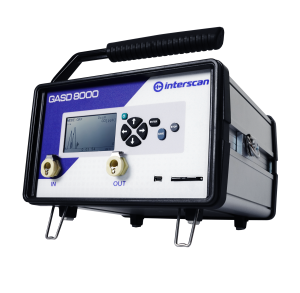
The Interscan GASD 8000 provides portable, continuous gas monitoring for field surveys, maintenance, and task-based applications.
That mobility can be essential when the hazard location changes.
Maintenance personnel might need to test several areas during a shift. Industrial hygienists may conduct surveys at different process points. Workers entering a confined space need atmospheric information where the work is actually occurring. Temporary operations may also introduce hazards in locations that do not justify installing permanent sensors.
In those cases, portable detection provides flexibility that a fixed system cannot replace.
Interscan’s article on confined-space accidents and prevention also explains why atmospheric monitoring before entry and during confined-space work is such an important part of risk management.
Match the detector to the behavior of the hazard
A practical AccuSafe vs Portable Gas Detectors evaluation should consider how predictable the hazard is.
A few questions help narrow the choice:
- Is the potential release associated with a known piece of equipment or process area?
- Could a hazardous concentration develop when no employee is nearby?
- Do you need continuous records of gas concentrations over time?
- Should alarms or gas data be accessible from another part of the facility?
- Does the monitoring point change frequently?
- Are employees conducting maintenance, inspections, surveys, or confined-space entries?
- Do temporary operations regularly create new sampling locations?
- Would the consequences of missing a release justify permanent monitoring?
If most of the risk is tied to known areas and exists continuously, AccuSafe has a strong operational advantage. If monitoring requirements follow workers and tasks, portable detectors are usually more practical.
Sensor location still matters with any fixed installation. Interscan covers factors affecting placement in How to Place Gas Detectors for Optimal Safety and Accuracy.
Continuous monitoring changes the response model
One reason AccuSafe stands out in the AccuSafe vs Portable Gas Detectors discussion is that continuous monitoring changes how a facility discovers gas hazards.
Portable instruments can provide highly useful real-time measurements, but they generally monitor where the instrument has been taken. Fixed detection watches designated areas whether or not someone is actively performing a test there.
AccuSafe extends that model through connected smart sensors. Its local network connectivity, continuous sampling, data logging, alarms, and remote access give safety teams a persistent source of information about monitored locations.
Historical data can also help teams examine when concentrations changed, determine whether an event is recurring, and identify relationships between gas readings and operating conditions.
That can make fixed monitoring useful not only for immediate hazard notification but also for longer-term industrial hygiene and process-safety programs.
In many facilities, the answer is both
AccuSafe and portable gas detectors should not always be treated as competing solutions. A layered approach can make more sense.
A facility might use AccuSafe around permanent process equipment, chemical handling areas, or other predictable emission points. The same safety program could use GASD 8000 instruments for troubleshooting, maintenance, temporary work, inspections, and locations outside the permanent sensor network.
This gives teams continuous coverage where the risk is persistent while preserving mobility where conditions change.
Interscan also offers a broader discussion of this decision in Fixed or Portable Gas Detectors: What Does Your Facility Need?.
The real decision in AccuSafe vs Portable Gas Detectors is therefore not which technology is universally better. It is which monitoring architecture leaves the fewest gaps in your specific operation.
A facility with stable, identifiable hazard points gains significant value from continuous fixed detection. An operation with changing work areas needs portable monitoring. Facilities dealing with both conditions should consider combining the two.
If your risk assessment shows that critical gas hazards are concentrated around known locations, explore the Interscan AccuSafe Gas Detection System and see how continuous, connected fixed-point monitoring can fit into your facility safety strategy.
Frequently Asked Questions
Is AccuSafe a replacement for portable gas detectors?
Not in every application. AccuSafe is designed for continuous fixed-point monitoring, while portable instruments are useful when monitoring needs to move with workers or tasks. Facilities with both permanent and changing hazards may benefit from using both approaches.
How many gases can AccuSafe monitor?
AccuSafe supports configurations with up to ten smart sensor modules and can detect up to ten unique gases simultaneously. Interscan lists 21 gases available across the AccuSafe detection platform, depending on sensor selection.
When should a facility choose fixed gas detection?
Fixed monitoring is particularly useful when hazardous gases may occur repeatedly in known locations, when continuous monitoring is necessary, or when teams need alarms and gas information without relying on personnel to conduct individual measurements. Portable detection remains useful for changing locations, field surveys, maintenance work, and similar task-based monitoring.