Ammonia is essential to fertilizer production and industrial refrigeration, but a release can quickly become a serious worker safety and operational issue. Ammonia Leak Detection in Fertilizer Plants and Refrigeration Areas therefore needs to do more than confirm that NH3 is present. A practical monitoring program needs to identify leaks early, provide continuous coverage where releases are most likely, and give operators a reliable way to investigate specific equipment and work areas.
For fertilizer manufacturers, ammonia moves through storage tanks, piping, pumps, compressors, valves, loading areas, and processing equipment. In refrigeration facilities, it circulates through compressors, evaporators, condensers, vessels, valves, and extensive piping networks. These systems create multiple potential leak points, which is why effective monitoring usually combines fixed and portable ammonia detection.
Facilities developing a broader gas safety program can also review Interscan’s agriculture and fertilizer gas detection solutions.
Why Ammonia Requires Early Leak Detection
Ammonia is a colorless gas with a strong, recognizable odor. Its odor, however, should never serve as the primary warning system for an industrial leak.
Exposure can irritate the eyes, respiratory system, and skin. Increasing concentrations create progressively greater health risks, particularly in enclosed or poorly ventilated locations. Interscan cites an OSHA permissible exposure limit of 50 ppm over an eight-hour workday, while the NIOSH recommended exposure limit is 25 ppm over ten hours and its short-term exposure limit is 35 ppm over 15 minutes.
Reliable Ammonia Leak Detection in Fertilizer Plants and Refrigeration Areas gives operators information before a developing problem turns into a larger release.
Early detection can support:
Subscribe to receive our monthly round-up of articles.
- Faster investigation of suspected leaks
- More informed evacuation and emergency response decisions
- Identification of deteriorating valves, seals, or piping
- Maintenance planning before equipment conditions worsen
- Exposure control for employees working near ammonia systems
- Documentation of gas concentrations during maintenance or inspections
The objective is not simply to generate an alarm. It is to provide useful concentration data that helps personnel understand what is happening.
Ammonia Leak Risks in Fertilizer Plants
Ammonia is a fundamental feedstock for nitrogen fertilizers, including products such as urea, ammonium nitrate, ammonium sulfate, and other nitrogen-containing compounds.
A fertilizer facility can also be physically large and complex. Storage, transfer, and processing equipment may be spread across multiple operating areas. Piping and valves can run through locations that are difficult to inspect manually.
Interscan identifies several areas that deserve particular attention when monitoring fertilizer facilities:
- Storage tanks
- Pumps and compressors
- Pipelines and valves
- Spray towers
- Rail and truck loading or unloading areas
- Shipping terminals
- Facility perimeters
Corrosion, equipment malfunction, seal degradation, and mechanical damage can all contribute to releases. Pipelines and valves deserve particular attention because even a relatively small developing leak can expose employees and eventually lead to more extensive maintenance problems.
Perimeter monitoring can also be important. Ammonia dispersion depends on leak size, wind, temperature, humidity, and other local conditions, so monitoring only directly beside process equipment may not provide the complete picture.
For additional background, Interscan discusses these risks in its article on why fertilizer factories need ammonia gas detection.
Ammonia Detection in Refrigeration Areas
Industrial refrigeration creates a different monitoring environment, but many of the same principles apply.
Ammonia is widely used as a refrigerant in facilities such as cold-storage warehouses, food processing plants, and industrial cooling systems. Refrigeration equipment can contain substantial amounts of ammonia distributed across compressors, piping, valves, receivers, evaporators, and other components.
Leak detection should therefore account for both equipment locations and how employees move through the facility.
Potential monitoring points include compressor rooms, valve stations, machinery areas, pipe runs, maintenance locations, and other spaces where an ammonia release could accumulate or expose personnel.
Portable detection is particularly useful when technicians need to investigate a suspected release, verify atmospheric conditions before beginning maintenance, or check equipment after service work.
Interscan discusses refrigeration alongside fertilizer manufacturing as one of the major industrial applications requiring ammonia monitoring.
Why Fixed and Portable Detection Work Better Together
There is no single detector placement that covers every possible ammonia release scenario.
Fixed systems provide continuous monitoring at designated locations. Portable instruments give operators the flexibility to investigate equipment, check changing work areas, and verify conditions during maintenance.
That makes a combined approach useful for Ammonia Leak Detection in Fertilizer Plants and Refrigeration Areas.
Continuous monitoring with AccuSafe
The Interscan AccuSafe platform provides fixed-point gas monitoring for locations that need ongoing surveillance.
AccuSafe sensors use electrochemical detection and continuously measure the target gas. The sensor enclosure is rated IP68, and the system supports Modbus TCP and RTU communications. AccuSafe Connect also provides a touchscreen interface, remote browser access, desktop software, data storage, and configurable alarm functionality.
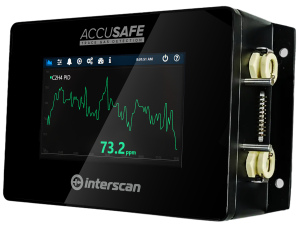
Accusafe
This type of architecture allows a facility to place sensors near known risk points while bringing measurements into a centralized monitoring system.
Learn more about the AccuSafe fixed gas detection system.
Portable investigation with GASD 8000
The GASD 8000 provides another layer of ammonia monitoring for applications where personnel need to take measurements at different locations.
Interscan offers ammonia configurations covering ranges including 0 to 10 ppm, 0 to 50 ppm, and 0 to 500 ppm. This gives facilities options for low-level monitoring as well as applications where a wider measurement range is required.
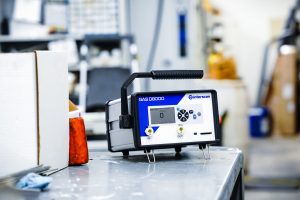
GASD 8000
For the 0 to 500 ppm ammonia configuration, Interscan specifies 0.1 ppm resolution and a lag time of less than one second. The GASD 8000 can also log measurement data to an integral SD card.
That combination is useful when maintenance personnel need to check equipment systematically rather than depend only on fixed monitoring locations.
Explore the GASD 8000 portable gas detector.
Building an Effective Ammonia Monitoring Strategy
Detector selection is only one part of the process. Sensor placement, inspection procedures, alarm response, maintenance, and employee training all influence the effectiveness of an ammonia detection program.
A practical plan should consider:
- Locations where ammonia is stored, transferred, or processed
- Equipment with a higher probability of leakage
- Ventilation and airflow patterns
- Enclosed or occupied areas
- Worker routes and maintenance activities
- Appropriate detection ranges for each application
- Alarm and notification requirements
- Procedures for verifying suspected releases
Facilities should also review measurement history rather than looking only at alarm events. Repeated low-level readings around the same component can provide useful information for preventive maintenance.
Frequently Asked Questions
Where should ammonia detectors be installed in a fertilizer plant?
Fixed detectors should be considered around likely release points such as storage systems, pumps, compressors, piping, valves, process equipment, and transfer areas. Perimeter monitoring may also be appropriate depending on facility layout and release scenarios. Final placement should account for ventilation, equipment configuration, potential leak sources, and the facility’s hazard assessment.
Are portable ammonia detectors still necessary if fixed detectors are installed?
Yes. Fixed and portable instruments serve different functions. Fixed detectors continuously monitor predetermined locations, while portable instruments allow employees to investigate suspected leaks, perform maintenance checks, and measure areas outside the coverage of installed sensors.
What ammonia detection range should a facility use?
The correct range depends on the monitoring objective. Interscan offers ammonia sensor ranges including 0 to 10 ppm, 0 to 50 ppm, and 0 to 500 ppm. Lower ranges can support applications focused on low-level detection, while wider ranges may be appropriate where higher concentrations are reasonably expected. A facility should select ranges according to its processes, expected concentrations, exposure criteria, and emergency response requirements.
Ammonia Leak Detection in Fertilizer Plants and Refrigeration Areas works best when monitoring is designed around the actual facility rather than treated as a single-point equipment decision. Interscan offers both AccuSafe fixed-point monitoring and GASD 8000 portable ammonia detection, giving safety teams the flexibility to combine continuous coverage with targeted field measurements. Explore Interscan’s ammonia detection solutions to build a monitoring approach that fits your fertilizer plant or industrial refrigeration operation.