Choosing gas detection for a propulsion facility is not simply a matter of finding an instrument that lists hydrazine on its sensor menu. A useful hydrazine gas detection buyer’s guide has to account for where propellants are stored and transferred, how low a concentration needs to be measured, whether monitoring must be continuous, and how technicians will investigate changing conditions. These questions are especially important in aerospace operations, where hydrazine and related propellants can create serious toxic exposure and operational hazards. Interscan’s aerospace gas detection solutions are designed around both portable and fixed monitoring for these applications.
Start With the Actual Propellant Hazard
Hydrazine remains relevant in aerospace because it and derivatives such as monomethylhydrazine and unsymmetrical dimethylhydrazine have been used in propulsion systems. The same properties that make these chemicals useful also make handling, maintenance, fueling, testing, storage, and emergency response important monitoring applications. Interscan discusses these risks in more detail in its guide to the importance of hydrazine gas detection in aerospace.
A buyer should therefore begin with a written hazard assessment. Hydrazine may be the primary concern, but propulsion operations can involve other gases or combustion products. Interscan detection platforms support gases including hydrazine, hydrogen, ammonia, carbon monoxide, nitric oxide, and nitrogen dioxide, allowing monitoring plans to be developed around identified hazards rather than a generic gas alarm.
Look for Trace-Level, Target-Gas Measuremen
Sensitivity matters in a hydrazine application. Waiting for a major release before an instrument provides useful information defeats much of the purpose of early warning.
This is where a target-gas instrument differs from broad atmospheric screening technology. A photoionization detector can be useful for indicating the presence of many volatile organic compounds, but a broad VOC response does not necessarily provide the same information as monitoring a known target gas. Interscan electrochemical systems are designed around specific gas measurement and trace-level detection. For facilities comparing technologies, Interscan provides a more detailed discussion of target-gas detection versus photoionization detectors.
For a hydrazine gas detection buyer’s guide, that distinction is important. Buyers should ask what gas the reading represents, the measurement range, resolution, expected accuracy, and how the sensor behaves around other chemicals present in the work area.
Active Sampling Should Be Part of the Evaluation
A detector only measures gas that reaches its sensor. In rocket propellant operations, the ability to actively draw a sample can make monitoring much more practical around valves, fittings, transfer equipment, maintenance locations, and other suspected release points.
Subscribe to receive our monthly round-up of articles.
Both the GASD 8000 and AccuSafe use active, continuous sampling rather than relying only on passive gas movement to reach the sensor. The GASD 8000 includes an integral sample pump for portable measurements, while AccuSafe sensor modules incorporate sample draw capability for permanent locations.
This gives aerospace teams two different ways to apply the same basic monitoring principle.
Decide Where Portable and Fixed Detection Fit
One of the most useful decisions in a hydrazine gas detection buyer’s guide is whether a facility needs portable detection, fixed monitoring, or both.
Consider how the instruments will actually be used:
- Choose portable monitoring for maintenance checks, leak investigation, surveys, temporary operations, verification work, and locations that change from one task to another.
- Choose fixed monitoring around predictable risk points such as storage, transfer equipment, process areas, or permanently occupied spaces where monitoring should continue without an operator present.
- Consider both when known high-risk locations require continuous coverage but technicians also need to investigate alarms or monitor work beyond fixed sensing points.
- Evaluate sensor placement carefully. Air movement, release points, equipment layout, work areas, and access for maintenance can all affect whether gas reaches a fixed sensor.
Interscan offers additional guidance on fixed versus portable gas detectors and gas detector placement.
Where the GASD 8000 Fits
The GASD 8000 is designed for mobile, active monitoring. It offers trace-level sensing, continuous sample draw, a digital concentration display, real-time graphics, data logging, and audible and visual alarms. Its rechargeable battery supports up to eight hours of continuous service, and the platform supports sensors for 21 gases, including hydrazine.
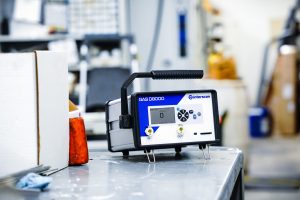
GASD 8000
For aerospace teams, this makes the GASD 8000 useful when technicians need to take the measurement to the work rather than wait for the gas to reach a permanently installed detector.
Its field-replaceable sensor approach is another practical consideration. Interscan’s Interchange Sensor System is intended to reduce downtime associated with routine sensor replacement. That can matter when a facility maintains multiple analyzers and cannot afford lengthy gaps in monitoring coverage.
Where AccuSafe Fits
AccuSafe addresses the other side of the monitoring problem. It is a fixed-point platform designed for continuous, always-on monitoring. A single AccuSafe Connect controller can support up to ten sensor modules, with centralized data access and communication through Modbus TCP and RTU. The system also supports browser access, a desktop application, MQTT connectivity, logging, and alarm notifications.
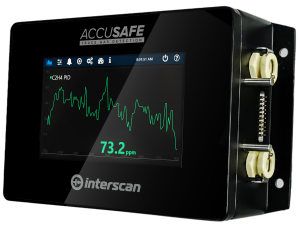
Accusafe
For a propulsion facility with identified hydrazine risk zones, that architecture can provide persistent monitoring without requiring a technician to perform every measurement manually.
The portable and fixed approaches are therefore complementary rather than competing. Interscan’s GASD 8000 vs AccuSafe comparison explains how the two fit different monitoring objectives.
Do Not Overlook Classified-Area Requirements
Rocket propellant facilities may include areas with combustible atmospheres. Hazardous-location requirements should be checked before selecting any electrical gas detector.
Do not assume a portable instrument is intrinsically safe simply because it is rugged or designed for industrial use. Interscan does not position the GASD 8000 as an intrinsically safe analyzer. Where classified-area operation is required, buyers should select equipment specifically approved for that environment and verify its current certification status before deployment. Interscan discusses this distinction in its GASD IS vs GASD 8000 guide.
For propulsion operations, this requirement should be addressed early in procurement rather than after the monitoring system has already been specified.
Frequently Asked Questions
What should I prioritize when buying a hydrazine gas detector?
Start with target-gas capability, required measurement range and sensitivity, sampling method, operating environment, alarm requirements, data logging, and whether the instrument must provide portable or unattended fixed monitoring. Hazardous-location classification should also be confirmed before equipment is selected.
Do hydrazine facilities need both fixed and portable gas detectors?
Many do. Fixed detection provides continuous monitoring at known risk points, while portable instruments help technicians conduct surveys, investigate alarms, check maintenance areas, and measure locations outside the permanent sensor network.
Can the GASD 8000 detect hydrazine?
Yes. Hydrazine is among the gases supported by the GASD 8000 platform. The instrument combines active sampling with trace-level sensing, real-time readings, data logging, alarms, and portable operation. The exact sensor range and configuration should be selected for the intended hydrazine application.
A good hydrazine gas detection buyer’s guide ultimately comes down to matching the detector to the way risk appears in the facility. Permanent release points, mobile maintenance work, trace-level measurement, data requirements, and classified areas may all require different approaches. Interscan offers portable and fixed systems that can be combined into a monitoring strategy built around those conditions. Explore Interscan’s gas detection solutions for aerospace and rocket propulsion facilities or contact the InterScan team to discuss the right hydrazine detection configuration for your operation.