The purchase price of a gas detector is only one part of what an organization ultimately spends on gas monitoring. A meaningful gas detection total cost of ownership calculation also includes installation, calibration, sensor replacement, labor, downtime, training, data management, and future system expansion. Those costs can look very different depending on whether a facility uses portable detectors, a permanently installed fixed system, or a gas detection system designed around a specific application.
For safety managers and engineering teams, the goal is not simply to choose the least expensive detector. It is to select an architecture that provides the required coverage without creating unnecessary operating costs over the system’s life.
What Goes Into Gas Detection Total Cost of Ownership?
Total cost of ownership, or TCO, evaluates what equipment costs from acquisition through replacement. For gas detection systems, several expenses should be included:
- Initial equipment and sensor costs
- Installation, wiring, and infrastructure
- Calibration and functional testing
- Sensor and consumable replacement
- Technician labor
- Training
- Equipment downtime
- Spare instruments or sensors
- Data logging and system integration
- Expansion when monitoring requirements change
Maintenance deserves particular attention. Gas detection instruments require calibration, testing, and eventual sensor replacement. A low purchase price can quickly become less attractive if maintenance frequently removes equipment from service or requires substantial technician time. InterScan discusses these considerations further in its guide to gas detection applications and calibration requirements.
Portable Gas Detection Costs
Portable gas detectors usually require less infrastructure than fixed systems. There is no facility-wide installation project, and operators can move the detector to different locations as monitoring requirements change.
That flexibility makes portable instruments practical for industrial hygiene surveys, maintenance work, investigations, temporary operations, and locations where hazards are not limited to a permanent monitoring point. For organizations with changing work areas, one portable instrument may perform measurements in many locations.
InterScan’s GASD 8000 portable gas detector combines active sampling with onboard processing, digital readout, real-time graphics, and integral data logging. Rechargeable lithium-ion batteries support up to eight hours of operation. Because processing and data capture happen at the instrument, users can collect information at the point of use without depending on a permanently installed monitoring network.
Subscribe to receive our monthly round-up of articles.
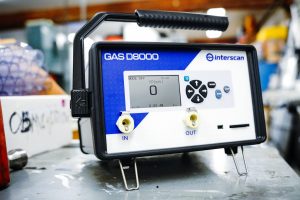
GASD 8000
Portable systems still have recurring costs. Batteries must be maintained, instruments must be checked and calibrated, and sensors eventually need replacement. Equipment that moves between locations may also experience more handling and environmental exposure.
Labor is another TCO factor. Portable monitoring generally requires someone to deploy or carry the instrument. If a hazard needs monitoring around the clock, repeatedly assigning personnel to perform measurements may cost more over time than installing continuous detection.
Fixed Gas Detection Costs
Fixed gas detection reverses much of that cost structure. Initial expenses can be higher because the system may require multiple monitoring points, power, communications, alarms, installation labor, and integration with facility systems.
Once installed, however, fixed gas detection continuously monitors predictable hazard locations without requiring an operator to bring an instrument to the area each time.
InterScan’s AccuSafe fixed gas detection system uses a distributed architecture supporting up to ten smart sensor modules reporting to one controller. Each sensor module includes an active sampling pump and onboard data acquisition and processing. The system supports Modbus communications, data logging, local and remote interfaces, and configurable alarms.
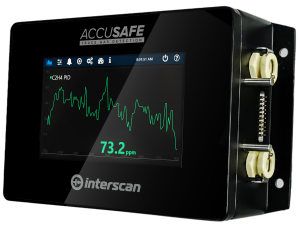
Accusafe
This architecture can influence gas detection total cost of ownership because functions that might otherwise require additional hardware are built into the system. InterScan specifically identifies the integrated pumps, processing, and data acquisition as a way to reduce dependence on external hardware and centralized systems, potentially lowering installation, integration, and long-term maintenance requirements.
Fixed monitoring is therefore often easier to justify when the same locations require continuous coverage for years. For a deeper comparison of the two approaches, see Fixed or Portable Gas Detectors: What Does Your Facility Need?.
Maintenance and Downtime Can Change the TCO Calculation
Sensor replacement can be easy to overlook in an initial budget. It becomes much more noticeable over several years, especially when a facility operates multiple monitoring points.
If routine sensor maintenance requires sending an entire instrument to a manufacturer, TCO can include shipping, technician administration, spare equipment, and lost monitoring availability.
InterScan addresses this through its Interchange Sensor System and SensorExpress program. Interchangeable sensors can be replaced on site without sending the complete instrument away for routine sensor replacement. SensorExpress can provide calibrated replacement sensors according to a planned schedule. The objective is to reduce maintenance disruption and make replacement more predictable.
That matters because downtime itself has a cost. A detector unavailable for maintenance may require temporary equipment, changes to work procedures, or even interrupted operations. InterScan’s article on minimizing gas detection downtime explains why sensor maintenance should be considered part of the broader monitoring strategy.
When a Custom Gas Detection System Can Lower Long-Term Costs
Portable versus fixed is not always a complete choice. Some facilities have unusual gases, specialized processes, multiple monitoring zones, challenging environmental conditions, or integration requirements that do not fit a standard configuration.
Trying to force those applications into an off-the-shelf architecture can create hidden costs. A facility might purchase more monitoring points than necessary, add separate controllers and accessories, or spend engineering hours adapting incompatible systems.
A customized gas detection solution from InterScan starts with the actual application requirements. InterScan works with EHS consultants, safety and engineering firms, environmental solution providers, and other organizations that have identified the required gases, operating conditions, and regulatory needs. Systems can include multi-gas configurations, custom sensors, hazardous-material monitoring, and solutions for specialized environments.
Custom engineering may involve a greater planning effort at the beginning, but the relevant TCO question is whether that effort prevents years of unnecessary equipment, integration work, or operational inefficiency.
Choosing the Architecture Based on the Application
There is no universal lowest-cost gas detection architecture.
Portable detection can provide strong economics when monitoring locations change and measurements are task-based. Fixed detection becomes attractive when hazards remain in predictable locations and continuous monitoring is required. Custom systems make sense when standard architectures introduce compromises or unnecessary complexity.
That is why gas detection total cost of ownership should be calculated around the actual monitoring job rather than equipment price alone. Include maintenance labor, sensor replacement, monitoring downtime, infrastructure, expected service life, and future expansion. The system with the lowest purchase price is not necessarily the system that costs the least to operate.
InterScan offers portable, fixed-point, and customized gas detection systems designed around different monitoring requirements. If your application does not fit neatly into a standard configuration, explore InterScan’s Customized Gas Detection Solutions and discuss an architecture designed around the gases, monitoring points, operating conditions, and integration requirements your facility actually has.
Frequently Asked Questions
What is included in gas detection total cost of ownership?
Gas detection total cost of ownership includes more than the detector purchase price. Organizations should account for installation, calibration, sensor replacement, consumables, labor, training, downtime, data management, integration, and eventual equipment replacement.
Are portable gas detectors cheaper than fixed systems?
Portable detectors typically require less installation infrastructure, which can reduce initial costs. Fixed systems may require a larger upfront investment but can provide continuous monitoring without repeatedly assigning personnel to perform measurements. The lower-cost option depends on the application and how often monitoring is required.
When should a facility consider a custom gas detection system?
A custom solution is worth considering when standard portable or fixed configurations do not adequately match the gases, number of monitoring points, environmental conditions, regulatory requirements, or facility integration needs. Designing around those requirements can reduce unnecessary equipment and complexity over the system’s operating life.