When comparing Interscan gas detectors vs Photoionization Detectors, the key question is what you actually need to know about the atmosphere. Do you need to monitor a known hazardous gas at a meaningful concentration, or do you need a broader indication that volatile organic compounds may be present? Both technologies can provide real-time readings, but they approach gas detection differently. Interscan systems are configured around specific target gases, while photoionization detectors, commonly called PIDs, respond to a range of compounds that can be ionized by their ultraviolet lamp.
That distinction affects how safety professionals interpret the number on the display and how they use it to make decisions.
How photoionization detectors work
A PID uses ultraviolet light to ionize gas molecules. When molecules absorb enough energy, electrons are released and an electrical current is produced. The instrument measures that current and converts it into a concentration reading.
Whether a compound can be detected depends largely on its ionization potential and the energy of the PID lamp. NIOSH specifically lists ionization potential as information that can help users select appropriate photoionization detector lamps.
This makes PIDs useful for broad VOC screening. They are commonly applied when industrial hygienists want to:
- Survey an area for organic vapor contamination
- Locate potential solvent releases
- Identify concentration changes during a process
- Screen hazardous waste or remediation sites
- Compare VOC levels between locations
- Find higher-concentration areas for additional investigation
The important word here is screening.
A PID may respond to several compounds in the same atmosphere. Unless the composition is already known and controlled, the instrument generally cannot tell the operator which compound is creating the response.
Subscribe to receive our monthly round-up of articles.
OSHA illustrates this limitation in guidance for methylene chloride. It notes that PID response is not specific to methylene chloride and that other chemicals in the work environment can contribute to the reading.
Target-gas monitoring answers a different question
The comparison between Interscan gas detectors vs Photoionization Detectors becomes clearer when the hazard is already known.
Suppose a facility knows that chlorine, ethylene oxide, hydrogen sulfide, formaldehyde, ammonia, or hydrogen peroxide is the primary concern. In that situation, the safety team is usually less interested in knowing that “something detectable” is present. They want a reading associated with that particular gas.
Interscan’s portable GASD 8000 can be configured for detection across 21 named gases. The current list includes ammonia, bromine, carbon monoxide, chlorine, chlorine dioxide, ethylene, ethylene oxide, formaldehyde, hydrazine, hydrogen, hydrogen chloride, hydrogen cyanide, hydrogen peroxide, hydrogen sulfide, nitric oxide, nitrogen dioxide, ozone, peracetic acid, phosphine, propylene oxide, and sulfur dioxide.
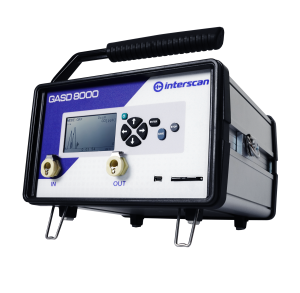
The Interscan GASD 8000 provides portable, continuous gas monitoring for field surveys, maintenance, and task-based applications.
eEectrochemical sensors as technologies designed to identify particular gases, with sensitivity and selectivity among their practical advantages.
That target-gas approach can make the displayed reading more directly useful when a facility has already identified the chemical hazard it needs to control.
Broad sensitivity is useful, but it changes interpretation
Broad VOC sensitivity is not a weakness when broad screening is the objective. In fact, it is exactly why PIDs are widely used in industrial hygiene.
A technician investigating an unknown solvent odor may not know which VOC is present. A PID can quickly help identify whether VOC concentrations increase near a tank, process line, waste container, or ventilation problem. OSHA has recognized photoionization detection as useful for locating high-concentration pockets, leak detection, and continuous ambient-air monitoring.
The problem occurs when a broad screening result is treated as though it were a selective chemical measurement.
Consider an atmosphere containing several solvents. A PID reading may reflect responses from multiple ionizable compounds. The displayed concentration therefore needs to be interpreted in the context of the calibration gas, lamp energy, known chemical mixture, and instrument response.
This is one of the biggest practical differences in Interscan gas detectors vs Photoionization Detectors.
A PID can tell you that VOC conditions are changing. A target-gas detector is better suited when the operational question is whether a specific hazardous gas is present and how its measured concentration is changing.
Continuous monitoring is available with both approaches
It is easy to describe this comparison as continuous versus occasional monitoring, but that would not be accurate. PIDs can provide continuous real-time measurements, and so can Interscan gas detectors.
The difference is what those continuous measurements represent.
The GASD 8000 uses active continuous sampling through an integral pump. It provides a digital concentration readout, real-time graphics, data logging, and audible and visual alarms. Interscan specifies up to eight hours of continuous battery operation for the portable instrument.
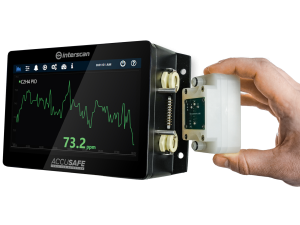
The AccuSafe Gas Detection System
For permanent installations, AccuSafe also provides active continuous sampling along with concentration displays, data logging, alarms, network connectivity, and configurations that can monitor up to ten unique gases simultaneously.
This gives facilities options for both portable and fixed target-gas monitoring.
When an Interscan detector makes more sense
A target-gas detector becomes particularly useful when the facility has already identified the hazard through its risk assessment or process knowledge.
Typical situations include:
- Monitoring ethylene oxide around sterilization processes
- Checking hydrogen sulfide where H2S is a known process hazard
- Monitoring chlorine around treatment or disinfection equipment
- Tracking formaldehyde in applications where it is specifically used
- Detecting hydrogen peroxide or peracetic acid around sterilization processes
- Monitoring ammonia where refrigeration or chemical operations create a known risk
In these cases, broad VOC screening may provide information that is less directly tied to the actual safety question.
Interscan’s article on choosing the right gas detector makes the same basic point: detector selection should begin with identifying the target gases present in the facility.
When a PID may be the better first tool
There are also situations where a PID’s broad response is exactly what is needed.
A PID is useful when:
- The contaminant is not yet identified
- Several VOCs may be present
- The goal is locating an emission source
- A technician needs to compare relative VOC concentrations
- The initial objective is screening before more selective testing
That makes PIDs valuable investigative tools.
The technologies can also complement each other. A facility might use a PID to identify areas with elevated VOC readings, then use compound-specific monitoring or another analytical method when the hazard has been identified and more selective concentration information is needed.
Interscan discusses PIDs alongside electrochemical and other technologies in its overview of gas detection technologies.
Select the instrument based on the decision you need to make
The most useful way to evaluate Interscan gas detectors vs Photoionization Detectors is to start with the decision that will follow the measurement.
If the question is, “Are VOC levels elevated somewhere in this area?” a PID can be an effective screening instrument.
If the question is, “What is happening to the concentration of this known hazardous gas?” a target-gas monitoring system often provides more actionable information.
For routine safety programs involving known toxic gases, Interscan also adds capabilities beyond the concentration reading itself. Its current portable platform provides active sampling, alarms, real-time graphics, data logging, and trace-level sensitivity that varies by gas. Fixed AccuSafe systems can extend that approach to continuously monitored locations throughout a facility.
Neither technology eliminates the need for a proper hazard assessment, calibration, maintenance, and an understanding of potential sensor interferences. The goal is to match the detector to the chemical hazard and the monitoring objective.
If your facility already knows which toxic gases it needs to monitor, explore the full range of Interscan gas detection products to compare portable and fixed systems designed for continuous, target-gas monitoring.
Frequently Asked Questions
Are photoionization detectors specific to individual VOCs?
Generally, no. A PID can respond to multiple compounds that can be ionized by the energy of its UV lamp. OSHA notes that other chemicals in an atmosphere can contribute to PID readings, so the result should not automatically be interpreted as the concentration of one specific compound.
Can Interscan gas detectors provide continuous readings?
Yes. The GASD 8000 provides active continuous sampling, real-time concentration displays, data logging, and audible and visual alarms. AccuSafe provides similar continuous monitoring capabilities for fixed installations.
Should a facility use a PID or a target-gas detector for VOC monitoring?
It depends on the objective. A PID is useful for broad VOC screening when the exact contaminant may be unknown or several VOCs may be present. When a facility has identified a specific hazardous gas and needs concentration information associated with that target, a gas-specific monitoring approach may provide more actionable data.