Choosing a gas detector based on a single specification can be misleading. Detection limit, accuracy, resolution, and response speed describe different parts of instrument performance, and each one affects how useful a detector will be in the field. A practical evaluation of gas detector accuracy and response time therefore starts by separating these specifications and asking how they relate to the actual monitoring objective.
This matters even more when measuring toxic gases at very low concentrations. A detector may respond quickly but lack the sensitivity needed for trace-level monitoring. Another may have excellent sensitivity but produce less useful results if sampling conditions, calibration, or detector placement introduce delays or measurement errors.
For applications where small concentration changes matter, start by looking at InterScan’s overview of trace gas analysis and low-level detection.
Start With the Detection Limit
The detection limit describes how low an instrument can reliably detect the target gas. It should not be confused with measurement range or display resolution.
For example, a detector that displays concentrations in 0.1 ppm increments does not automatically have a detection limit of 0.1 ppm. Resolution tells you the smallest change the display can represent. Detection capability depends on the sensor, noise level, calibration, operating range, and other characteristics of the measurement system.
That distinction becomes important when selecting equipment for occupational exposure monitoring, leak detection, process control, or environmental measurements. If the concentration you need to identify is close to the bottom of a detector’s usable range, low-level sensor performance should receive as much attention as the instrument’s maximum range.
InterScan designs its systems for trace-level toxic gas sensing, with sensitivity dependent on the gas and sensor configuration. The GASD 8000 and AccuSafe product families can be configured for numerous toxic gases, including ammonia, chlorine, hydrogen sulfide, hydrazine, ozone, formaldehyde, and sulfur dioxide.
Subscribe to receive our monthly round-up of articles.
Look Beyond the Accuracy Percentage
Accuracy tells you how closely the indicated concentration is expected to correspond to the actual gas concentration under specified conditions.
The current GASD 8000 product specifications list accuracy at 5%, while the current AccuSafe product specifications also list 5% sensor accuracy. More detailed gas-specific documentation may provide additional performance information. An ammonia-specific GASD 8000 document, for example, lists accuracy, repeatability, linearity, minimum detectability, and drift separately.
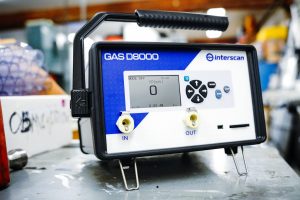
GASD 8000
That is a better way to evaluate gas detector accuracy and response time than simply choosing the detector with the smallest percentage on a comparison sheet.
When reviewing accuracy specifications, ask:
- Is accuracy stated as a percentage of the reading or full scale?
- Does the specification include an additional least-significant-digit allowance?
- What calibration standard was used?
- Are repeatability, linearity, and drift specified separately?
- Does accuracy depend on temperature, humidity, gas concentration, or sensor type?
- How often does the manufacturer recommend checking or recalibrating the sensor?
Calibration deserves particular attention because sensor sensitivity changes with use and exposure. InterScan’s GASD 8000 manual recommends periodic calibration to compensate for declining sensor sensitivity and maintain measurement accuracy. AccuSafe documentation likewise notes that calibration requirements depend on application, environmental conditions, regulations, and required accuracy.
For more detail, see InterScan’s guide to the importance of calibrated instruments in gas analysis.
Understand What “Response Time” Actually Means
Response time is often one of the most misunderstood gas detector specifications.
A manufacturer may report lag time, T50, T90, alarm time, or another response metric. These numbers should not automatically be compared with one another.
T90 generally describes the time required for an instrument to reach 90% of its final stabilized response after exposure to a gas concentration. Lag time usually describes the delay before the instrument begins responding. A short lag time therefore does not necessarily mean the complete measurement reaches its final value equally quickly.
This distinction appears in InterScan documentation. An ammonia-specific GASD 8000 specification lists a lag time of less than one second. The AccuSafe Solo manual, meanwhile, specifies a T90 of less than two minutes and explicitly notes that response varies widely by gas type. These are different performance measures, so treating the two numbers as a direct comparison would be inaccurate.
When evaluating gas detector accuracy and response time, make sure competing products are using the same definition.
Sampling Method Can Change Real-World Response
Sensor chemistry is only part of the response-time equation. The gas first has to reach the sensor.
InterScan’s GASD 8000 and AccuSafe systems use active sampling. A pump actively draws the sample through the instrument instead of relying solely on natural gas diffusion. This controlled intake can be particularly useful when measurements are required at a defined location or at low concentrations.
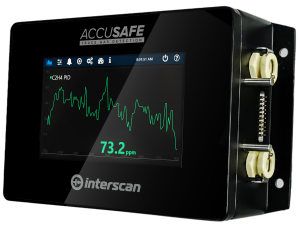
Accusafe
InterScan’s discussion of active air sampling explains how controlling sample intake can support rapid detection and consistent measurements at low concentrations.
However, active sampling does not eliminate every potential delay. Tubing length, tubing material, pump flow, filters, adsorption, the target gas’s properties, and the position of the sampling point can all influence how quickly gas reaches the sensing element.
That is why response time should be evaluated as part of the complete sampling system, not just as a sensor specification.
Test Performance Under Real Operating Conditions
Datasheets are useful for narrowing your options, but field verification tells you whether the complete system performs as expected.
A strong evaluation should include a known gas challenge, confirmation of the alarm response, calibration checks, and verification that sampling paths are clear. InterScan notes that a bump test verifies detector and alarm functionality, while calibration is the quantitative procedure used to evaluate measurement accuracy.
Detector placement also matters with fixed systems. Air movement, release points, equipment, obstructions, worker locations, gas behavior, and environmental conditions can determine whether gas reaches a sensor quickly enough to provide useful warning. InterScan covers those factors in its guide to gas detector placement for optimal safety and accuracy.
Evaluate the Instrument Against the Application
The best specifications are the ones that match the measurement problem.
For portable surveys, troubleshooting, temporary monitoring, and checking multiple locations, the GASD 8000 provides active continuous sampling, trace-level capability, onboard data logging, alarms, and up to eight hours of battery-powered operation. For permanent monitoring of known risk locations, AccuSafe provides continuous fixed-point sensing, network connectivity, logging, and scalable monitoring across multiple sensor modules.
InterScan’s GASD 8000 vs AccuSafe comparison provides a closer look at when portable monitoring or continuous fixed detection makes more sense.
Ultimately, evaluating gas detector accuracy and response time requires more than comparing two numbers. Define the lowest concentration that matters, understand how the manufacturer specifies accuracy, compare equivalent response metrics, and account for sampling conditions and calibration. Those steps give you a much clearer picture of how the detector will perform when a real gas release occurs.
If your application requires reliable trace-level detection, active sampling, and measurement options for a wide range of toxic gases, explore InterScan’s GASD 8000 and AccuSafe systems to find the configuration that fits your monitoring requirements.
Frequently Asked Questions
What is the difference between detection limit and resolution in a gas detector?
Resolution is the smallest concentration increment the instrument can display. Detection limit describes the lowest concentration the measurement system can reliably detect. A detector can therefore have fine display resolution without having an equally low practical detection limit.
Is a faster response time always better?
Not necessarily. Response speed matters, but it should be considered together with sensitivity, accuracy, selectivity, sampling method, and the target gas. Also make sure you are comparing the same metric, such as T90 to T90, rather than comparing lag time with full sensor response time.
How does calibration affect gas detector accuracy?
Calibration compares the detector response with a known gas concentration and adjusts the instrument so its readings remain reliable. Sensor aging, gas exposure, and environmental conditions can change performance over time, making routine calibration and functional checks important for maintaining accurate measurements.