The AccuSafe Multi-Point Monitoring vs Standalone Transmitters decision is less about which approach is universally better and more about how a facility needs to see and respond to gas hazards. A standalone fixed detector can be the right choice when one known hazard needs local, continuous monitoring. Once several rooms, process areas, or gases need coverage, however, managing each point independently can make it harder to see conditions across the facility. Interscan’s AccuSafe platform addresses that problem by combining smart fixed-point sensors with centralized monitoring, while still supporting independent operation when a single-point configuration makes more sense.
The architecture question behind fixed gas detection
A standalone transmitter or analyzer operates primarily as its own monitoring point. It measures gas at a selected location, displays the concentration locally, and can provide alarms without depending on a central controller.
That simplicity has real value. If a facility only needs to monitor one chemical storage room or one process point, adding a larger centralized architecture may provide more capability than the application requires.
Multi-point monitoring solves a different problem. It connects several sensing locations so operators can review them through a common interface. Instead of walking from instrument to instrument, the safety team gets a broader view of what is happening throughout the monitored areas.
Interscan discusses the broader role of this architecture in its guide to fixed gas detection systems.
What AccuSafe multi-point monitoring adds
AccuSafe uses a distributed architecture rather than treating every sensor as a simple input to a centralized box. Each smart sensor module includes its own sample draw pump and onboard data acquisition and processing. A single AccuSafe controller can support up to ten sensor modules, with configurations capable of monitoring up to ten unique gases simultaneously.
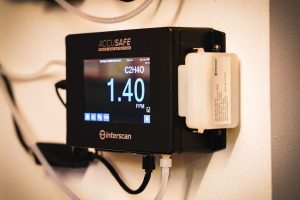
Interscan’s AccuSafe architecture
Subscribe to receive our monthly round-up of articles.
That architecture gives facilities several practical advantages:
- One interface can provide visibility into multiple monitoring locations.
- Different sensor modules can be selected around the hazards found in individual areas.
- Gas readings can be logged for historical review and trend analysis.
- Alarm information can extend beyond the detector location through sound, email, and SMS notifications.
- Modbus TCP and RTU communication provide options for connecting the system with compatible facility equipment and control infrastructure.
The AccuSafe Connect interface supports a 5-inch touch display, remote web-browser access, a desktop application, and an MQTT API. The controller also provides configurable I/O for compatible sensors or actuators.
For operations that already rely heavily on historical exposure records, Interscan provides more background on the role of data logging in industrial gas detection.
Where standalone transmitters still make sense
Centralization should solve an operational problem. It should not be added simply because networking is available.
A standalone detector remains attractive when the application is limited to one monitoring point and personnel respond locally. A treatment room with one known gas hazard, for example, may not need the same architecture as a large manufacturing plant monitoring several process areas.
AccuSafe itself reflects this distinction. Interscan’s product literature notes that a sensor unit equipped with a concentration display and alarm indicators can operate as a standalone detector for a single-point application.
The AccuSafe Solo takes that concept further. It is designed to operate without communication to an external PC or other device. It continuously draws a sample through its internal pump, provides real-time gas concentration readings, and stores measurement data locally. At the same time, Modbus TCP/IP and RTU connectivity remain available when communication with another system is required.
That is an important difference in the AccuSafe Multi-Point Monitoring vs Standalone Transmitters comparison. Choosing independent operation today does not necessarily mean giving up connectivity altogether.
Centralized visibility changes how teams use gas data
The biggest benefit of a multi-point system may not be the number of sensors. It is the ability to interpret those sensors together.
Suppose a facility monitors hydrogen sulfide near one process, ammonia in another area, and chlorine around chemical storage. With independent instruments, each point can still perform its measurement correctly. The operator, however, may need to check multiple displays or data records to understand conditions across the site.
With AccuSafe, those dedicated sensing points can report into a common monitoring environment. Safety personnel gain a central place to review concentrations and trends while individual modules continue performing acquisition and processing at the edge.
This architecture becomes more useful as the facility grows. Adding monitoring points does not require treating every new location as an isolated information source.
Facilities deciding whether dedicated sensors make sense for different gases may also find Interscan’s discussion of single-gas vs multi-gas detectors useful.
AccuSafe makes the choice less binary
A traditional comparison can make centralized and standalone gas detection sound like two completely separate strategies. AccuSafe provides more flexibility.
A facility can use an independent AccuSafe configuration where one local measurement is enough, then use connected sensor modules where centralized visibility matters. That allows the gas detection architecture to follow the actual hazard layout instead of forcing every application into the same configuration.
It also helps when facilities expand. A smaller operation may begin with a limited number of fixed monitoring points. As production changes or additional hazards are identified, connected monitoring can become more valuable.
Portable monitoring remains another category entirely. When measurements need to move with personnel rather than remain at fixed locations, the GASD 8000 serves that mobile role. Interscan covers that distinction in its GASD 8000 vs AccuSafe comparison.
The AccuSafe Multi-Point Monitoring vs Standalone Transmitters decision ultimately comes down to how many locations need coverage and what the team needs to do with the resulting information. Independent monitoring keeps a simple application simple. Centralized monitoring becomes more valuable when several sensors, gases, alarms, and data streams need to work together. AccuSafe is particularly useful because facilities do not have to commit rigidly to one architecture. Explore the Interscan AccuSafe fixed-point gas detection system to see how single-point and multi-point configurations can be matched to your facility.
Frequently Asked Questions
Can AccuSafe operate without a central controller?
Yes. The AccuSafe Solo can operate as a standalone fixed-point instrument without communicating with an external PC or other device. Modbus connectivity is also available if integration is needed later.
How many monitoring points can an AccuSafe system support?
A single AccuSafe controller can support up to ten smart sensor modules. The system can also be configured to monitor up to ten unique gases simultaneously, depending on sensor selection and application requirements.
When is multi-point monitoring preferable to standalone gas detection?
Multi-point monitoring becomes particularly useful when a facility needs continuous coverage across several rooms, process areas, or known release points and wants centralized alarms, logging, remote visibility, or integration with compatible control equipment. For a single isolated hazard where local indication is enough, a standalone configuration may remain the simpler option.