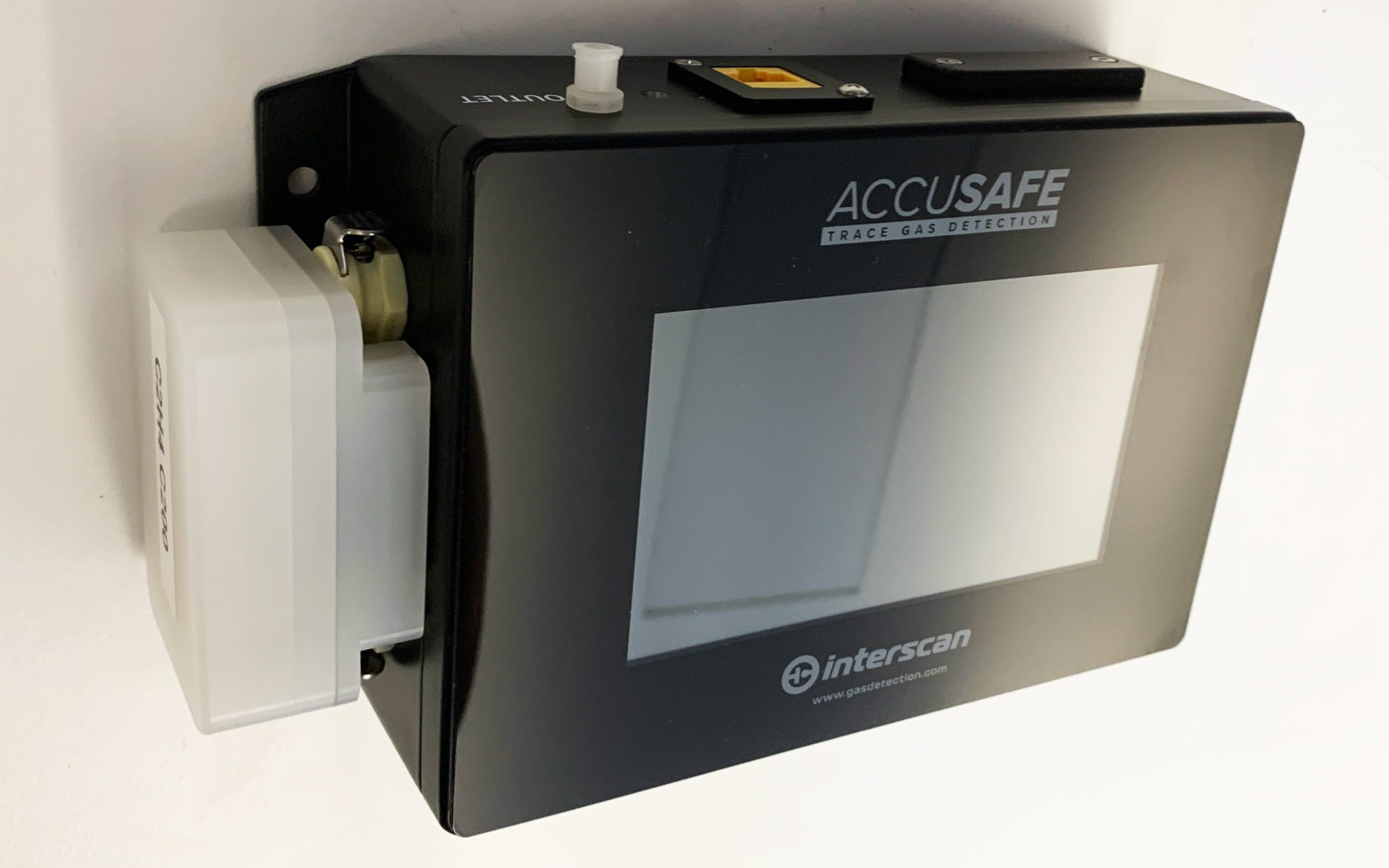
When toxic gases can create a hazard at very low concentrations, detection speed matters. The Active Sampling vs Diffusion Sensors comparison comes down largely to how quickly a representative air sample reaches the sensing element. Diffusion sensors depend on natural molecular movement and surrounding airflow to bring gas to the sensor. Active systems use a pump to continuously draw air across the sensor at a controlled rate. For applications focused on trace-level leaks and early warning, that difference can make active sampling the stronger approach. Interscan explains the underlying advantages in its guide to active air sampling.
How Active Sampling and Diffusion Detection Differ
A diffusion sensor is exposed directly to the surrounding atmosphere. Gas molecules must move from the leak source through the environment and eventually reach the sensing surface. Air movement, detector placement, temperature, humidity, and the characteristics of the gas can all influence that process.
Active sampling changes the way the gas reaches the detector. A pump actively pulls air into the instrument and transports it to the sensor. The sampling flow can therefore provide more controlled delivery of the target gas instead of depending entirely on natural movement.
Interscan’s overview of active versus passive sampling notes that passive sampling relies on natural diffusion, while active sampling uses a pump. It also points out that environmental conditions can affect passive sampling rates, whereas an active system allows the flow rate to be controlled.
Which Method Detects a Low-Level Leak Faster?
When other factors are comparable, active sampling has a practical advantage for early detection because air does not have to reach the sensor through diffusion alone. The pump continuously moves a fresh sample toward the sensing element.
This becomes especially important when the gas concentration is low. At trace levels, there may be relatively little target gas available at a given location. Waiting for enough molecules to naturally reach a diffusion sensor can add response time, particularly in areas with weak air circulation.
Interscan describes active sampling as providing controlled air intake that supports rapid detection and improved measurements at low concentrations. Its active air sampling guidance specifically emphasizes quicker detection compared with systems that rely on natural air movement.
Subscribe to receive our monthly round-up of articles.
That does not mean sampling method is the only factor controlling response time. Sensor chemistry, sensitivity, tubing length, pump flow, detector location, calibration, filters, and the physical properties of the gas still matter. An active pump cannot compensate for poor detector placement or an unsuitable sensor.
For a closer look at location strategy, see Interscan’s guide on how to place gas detectors for optimal safety and accuracy.
Why Active Sampling Matters for Trace-Level Toxic Gases

Active Sampling Matters for Trace-Level Toxic Gases
The Active Sampling vs Diffusion Sensors decision becomes more important as the concentration of interest decreases. Several characteristics of active sampling are useful in these applications:
- Controlled sample movement: The pump deliberately transports surrounding air to the sensor instead of waiting for diffusion.
- Continuous air exchange: Fresh air is continually presented to the sensing element during measurement.
- Better access to suspected leak points: Sampling accessories can draw air from locations where placing the complete instrument would be difficult.
- More repeatable sampling conditions: Controlled flow reduces dependence on unpredictable natural air movement.
- Earlier opportunity to respond: Faster delivery of a low-concentration sample can give personnel more time to investigate and control a developing release.
These advantages are particularly relevant around process equipment, storage areas, enclosed spaces, ventilation systems, and other locations where a small leak may not immediately produce a well-mixed gas concentration.
Portable Active Sampling with the GASD 8000
For teams that need to move between sampling locations, the GASD 8000 portable gas detector applies active sampling in a field-ready format.
According to the GASD 8000 brochure, the instrument provides continuous air sampling rather than passive sampling and is designed for extremely low trace detection levels. It also includes a sampling wand, which can help operators investigate specific points instead of waiting for gas to migrate toward the instrument. The system provides data logging and rechargeable battery operation for up to eight hours of continuous service.
The sampling wand is particularly useful during leak investigations. A technician can position the sampling point close to fittings, valves, ducts, equipment, or other suspected sources while keeping the detector itself in a practical operating position. Interscan notes that the wand can also help reach confined or otherwise difficult-to-access areas.
Continuous Active Sampling with AccuSafe
Portable spot checks solve one part of the monitoring problem. Facilities with known gas hazards may also need continuous fixed-point coverage.
The AccuSafe fixed gas detection system uses continuous active air sampling and is designed for trace-level gas detection. Its sensor modules incorporate sample-draw pumps, allowing each monitoring point to actively collect air rather than depending solely on diffusion. AccuSafe configurations can also connect multiple sensors for broader facility monitoring.
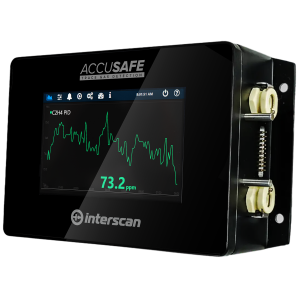
AccuSafe provides continuous fixed-point gas monitoring with connected smart sensors, centralized data access, alarms, and logging.
The AccuSafe brochure specifically identifies continuous active air sampling, compared with passive sampling, as a feature intended to support more accurate readings. It also highlights extremely low trace detection capability and configurations that can connect up to ten sensors to an AccuSafe Connect display module.
Facilities deciding between permanent monitoring and portable measurements can also review Interscan’s guide to fixed versus portable gas detectors. Fixed systems are generally suited to continuous coverage at known risk points, while portable systems provide flexibility for inspections and targeted investigations.
When Diffusion Sensors Still Make Sense
Active sampling is not automatically necessary for every measurement. Diffusion-based devices have fewer sampling components and can be appropriate where simplicity, lower equipment requirements, or longer-term passive sampling is the priority.
The question changes when the objective is catching a small toxic gas release as early as practical. In that situation, depending entirely on natural gas movement introduces a variable that an active pump can reduce.
For low-level toxic gas monitoring, the Active Sampling vs Diffusion Sensors comparison therefore favors active sampling when rapid sample delivery, trace sensitivity, targeted measurements, or continuous controlled monitoring are priorities. Interscan combines active sampling with dedicated toxic gas sensing in both portable and fixed configurations, giving facilities options for spot investigation as well as continuous monitoring. Explore the GASD 8000 or AccuSafe systems and contact InterScan to determine which active-sampling configuration fits your monitoring points and target gases.
Frequently Asked Questions
1. Is active sampling always faster than a diffusion sensor?
Not necessarily in every possible detector configuration. Response depends on sensor technology, gas concentration, pump flow, sample path, detector location, and other design factors. However, active sampling provides controlled transport of air to the sensor instead of depending entirely on natural diffusion, which can provide an important speed advantage for low-level gas detection.
2. Can active sampling detect gases in hard-to-reach locations?
Yes. A pumped system can use a compatible sampling probe or wand to draw air from a specific location. Interscan’s GASD 8000 includes a sampling wand designed to help operators investigate localized or difficult-to-access areas.
3. Should I use a portable or fixed active-sampling detector?
Use depends on the monitoring objective. Portable instruments such as the GASD 8000 are useful for spot checks, troubleshooting, and moving between locations. AccuSafe is intended for fixed, continuous monitoring at established points throughout a facility. For trace-level toxic gas applications, explore InterScan’s active sampling solutions to compare the approach that best fits your operation.