When evaluating Local Audible Alarms vs Remote Notifications, the most useful question is not which one is better. It is whether a gas detection system can deliver the right warning to the right person at the right time. Workers near a developing gas hazard need an immediate local warning. Safety managers may need the same information somewhere else in the facility, or even off-site. A modern gas detection system should support both layers, then document what happened through continuous monitoring and data logging.
That combination turns a detector from a simple alarm device into part of a broader safety and response system.
Why local audible alarms still matter
A local audible alarm serves one essential purpose: it warns the people closest to the hazard.
When gas concentration reaches a configured alarm condition, workers in the area should not have to wait for someone in a control room to notice a dashboard, read an email, or make a phone call. Audible and visual alerts provide an immediate indication that conditions have changed.
The Interscan GASD 8000, for example, combines active continuous sampling with real-time concentration readings, graphics, data logging, and audible and visual alarms. Its portable design makes that particularly useful for industrial hygiene surveys, maintenance work, leak investigations, and other applications where the monitoring point moves with the task.
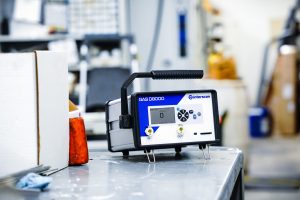
GASD 8000
For workers in the immediate area, local alarms offer several practical benefits:
Subscribe to receive our monthly round-up of articles.
- Immediate warning without requiring a phone, computer, or network connection
- Clear notification to personnel close to the detector
- Faster initiation of evacuation or other established response procedures
- Visual confirmation that can supplement an audible alarm in noisy environments
- Continued usefulness when the detector is operating as a standalone instrument
This is why Local Audible Alarms vs Remote Notifications should not be treated as a choice between old and new technology. Local alarms solve a specific safety problem that remote communications cannot fully replace.
Where remote notifications become important
A local alarm works well when someone is close enough to hear or see it. Fixed gas monitoring creates a different situation.
A facility may have sensors in equipment rooms, process spaces, laboratories, storage areas, or other locations that are not continuously occupied. An alarm occurring in one of those areas still needs to reach someone who can respond.
This is where connected gas detection becomes valuable.
Interscan’s AccuSafe system is designed for continuous fixed-point monitoring using a distributed architecture. A single AccuSafe Connect controller can support up to ten sensor modules, giving operators a centralized view of conditions across multiple monitored areas. The system supports local network connectivity, remote browser access, a desktop application, and Modbus communications. AccuSafe Connect also supports sound and email alarms along with SMS text notifications.
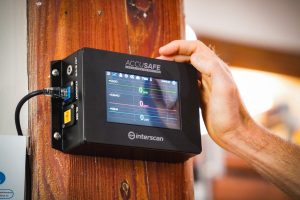
Interscan’s AccuSafe system
That means an alarm does not have to remain confined to the room where the sensor is installed.
For facilities with several monitoring points, remote notifications can help safety teams maintain awareness during normal operations, after hours, or when personnel are moving between areas. Interscan discusses this broader role of permanent monitoring in its guide to fixed gas detection systems.
Local Audible Alarms vs Remote Notifications is really about response time
Consider two scenarios.
In the first, a maintenance technician is working near a potential toxic gas source. If concentrations begin to rise, the technician needs an alert immediately. An audible and visual alarm at the monitoring location directly addresses that requirement.
In the second, a fixed sensor detects elevated gas levels in an unoccupied process room. A siren inside that room may provide little value by itself. Sending the condition to a centralized interface and notifying responsible personnel expands the response beyond the physical location of the detector.
Modern systems should therefore create overlapping notification paths.
Local alarms protect people at the point of risk. Remote notifications extend awareness to people who may need to coordinate evacuation, investigate a process problem, initiate ventilation, or implement the site’s emergency response plan.
Fixed systems can also integrate with broader control infrastructure. Depending on the facility design, gas detection data can be connected to control or building management systems so that detection becomes part of a larger automated safety strategy.
Data logging provides the missing context
An alarm tells you that a threshold was reached. It does not necessarily tell you how the event developed.
That is why a modern alerting strategy should also include real-time gas detection data logging.
Continuous records can show when concentrations began increasing, how high they became, how long elevated conditions lasted, and when conditions returned toward normal. Interscan identifies continuous exposure tracking, incident analysis, and regulatory reporting as key uses for logged gas data.
This information becomes useful after an alarm because safety teams can determine whether the event was a brief spike, a recurring process issue, or part of a longer concentration trend.
The GASD 8000 records data through an integral 32 GB SD card, while AccuSafe combines continuous monitoring, data logging, centralized access, and connected communications.
For a deeper look at how historical gas measurements support safety decisions, see Interscan’s article on the critical role of data logging in gas detection.
What should a modern gas detection system provide?
For many facilities, the strongest architecture includes several complementary capabilities rather than one alarm method.
Look for a system that can provide:
- Continuous gas measurement appropriate to the known hazard
- Audible and visual alarms for immediate local warning
- Remote notifications for designated personnel
- Centralized visibility across fixed monitoring points
- Real-time concentration information
- Data logging for exposure and incident review
- Connectivity with existing monitoring or control infrastructure
- Scalable sensor coverage as facility requirements change
The exact configuration depends on the application. A portable instrument such as the GASD 8000 may be the better fit when monitoring needs to move with workers or maintenance activities. A fixed system such as AccuSafe is more appropriate when known locations require continuous monitoring and centralized visibility.
Many facilities use both approaches. Interscan’s comparison of fixed and portable gas detectors provides additional guidance on where each configuration fits.
The Local Audible Alarms vs Remote Notifications discussion ultimately points to a layered approach. An alarm should reach workers immediately, reach responsible personnel wherever they are, and leave behind enough data to understand the event afterward. Interscan’s portable GASD 8000 and fixed AccuSafe platforms address these needs from different operational angles, giving facilities options for building monitoring around actual workflows rather than forcing every application into the same architecture.
If your gas detection plan currently relies on only one notification path, explore Interscan’s gas detection systems to see how local alarms, connected monitoring, remote notifications, and real-time data logging can work together to create a more complete safety strategy.
Frequently Asked Questions
Are remote gas notifications a replacement for audible alarms?
No. Remote notifications extend alarm awareness to supervisors, safety teams, or other designated personnel, but workers at the point of risk still benefit from immediate audible and visual warning. A layered system can provide both.
Can gas detection systems send text or email alerts?
Some connected systems can. AccuSafe Connect supports sound and email alarms as well as SMS text notifications, along with remote browser access and other network interfaces.
Why is data logging important if the detector already has alarms?
Alarms identify when a configured condition occurs. Data logging preserves the concentration history around that event. Those records can help teams analyze incidents, identify recurring trends, document exposure conditions, and support reporting or compliance activities.