- Chlorine is an occupational hazard because it is toxic, corrosive, and flammable.
- Industries that produce pesticides and chlorine fertilizers, as well as dairy production, must monitor chlorine to prevent occupational hazards.
- Industries should use fixed and portable devices to monitor chlorine.
Chlorine is an indispensable industrial chemical, but it also has severe health and environmental impacts. Around 86% of agrochemicals have chlorine or are produced from chlorine derivatives. Most are used for crop protection, but some chlorine is also used as fertilizer and in dairy for disinfection. This article covers the major agrochemical production facilities and farms that need to monitor and control chlorine.
Why Chlorine is Useful
Chlorine is a greenish-yellow gas with a strong odor at room temperature and pressure. It is very reactive, toxic, corrosive, and non-combustible. It is heavier than air and settles in low-lying areas.
Chlorine is widely used in pharmaceutical and chemical production, bleaching, and disinfection because it is a highly reactive halogen. It is also cheap and abundant, as it can be produced from sodium chloride (common salt) and water. Despite its main production process, chloralkali electrolysis, which is energy-intensive, chlorine is one of the cheapest base chemicals available.
Chlorine is a strong oxidant and reacts readily with organic and inorganic compounds, making it a common ingredient in many products, including agrochemicals used as pesticides, insecticides, herbicides, and fungicides as well as fertilizers. Although the portion of total annual chlorine used to make crop chemicals is small compared with other end uses, chlorine is used to make 86% of crop chemicals. Chlorine gas is also used directly as a disinfectant because of its antimicrobial properties.
Occupational Hazards of Chlorine
The reactivity that makes chlorine useful also makes it dangerous. Chlorine reacts with water to form hydrochloric acid (HCl) and hypochlorous acid (HClO). The latter is unstable and breaks down to produce oxygen free radicals, making chlorine a strong oxidant and corrosive.
- Toxicity: Chlorine reacts with water in human tissue to form hydrochloric acid, which attacks organs. Chlorine is dangerous when inhaled and when it contacts skin and eyes. In poorly ventilated areas and rooms, it can ultimately cause asphyxiation.
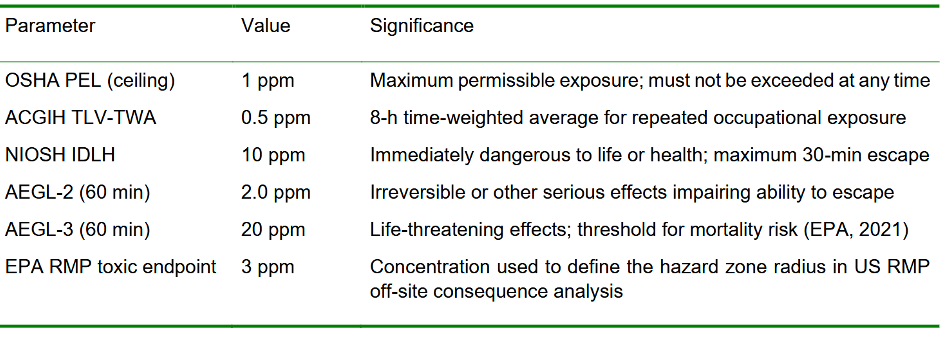
Given its high toxicity and severe health effects on people, agencies have set strict permitted levels, as shown in Table 1.
- Corrosive: Chlorine’s reactivity also makes it highly corrosive, so special resistant materials are necessary for its storage.
- Fire risk: Although chlorine is non-combustible, leaks can form heavy gas clouds that can mix with hydrogen, ammonia, and hydrocarbons to form explosive mixtures that self-ignite, making it a fire and explosion risk.
Subscribe to receive our monthly round-up of articles.
Table 1: “Key chlorine exposure thresholds for risk management,” Křivánek et al. 2026. (Credits: https://www.cetjournal.it/cet/26/126/022.pdf)
Industries produce most chlorine in small quantities because of its toxicity. Storage is limited to small buffer amounts for a limited period, as long -term storage poses high risks due to its corrosivity, toxicity, and fire risk in case of leaks. When chlorine is transported, it is turned into a liquid under pressure. Chlorine’s toxicity increases the risk of accidents during transport. Though rare, the high pressures can cause ruptures, killing people and polluting the environment.
People handling chlorine gas or its liquid form must do so with extra care because of its toxicity. The chemical should be mixed with other compounds in safe, controlled conditions and facilities, using safety apparatus and personal protective equipment (PPE).
Production of Pesticides
Pesticides are chemicals that can destroy insects, bacteria, fungi, weeds, or rodents, and are classified as insecticides, bactericides, fungicides, herbicides, or rodenticides, respectively. While some agrochemicals have a broad spectrum and can be used against many pests, others are effective only against specific pests or microbes.
In 2020, total pesticides used in agriculture stood at 2.7 million tonnes (active ingredients) and 7.2 Mt (formulated products), according to the Food and Agriculture Organization (FAO). Of these, 40% of pesticides are organochlorines (OC) or compounds containing a high proportion of chlorine, including DDT, aldrin, dieldrin, DDD, hexachlorocyclohexane (HCH), Dicofol, Endrin, Chlorobenzoate, Lindane, Chlordane, Heptachlor, Endosulfan, chlorpyrifos, Isodrin, Isobenzan, and Toxaphene. Another subset of pesticides is produced from chlorine derivatives.
The pesticides interfere with the physiological activities of the target organism, leading to reduced vitality and dysfunction.
Workers in factories producing the pesticides must handle and transport chlorine very carefully to avoid exposure to gas leaks or splashes of liquefied chlorine. Safety managers must take adequate precautions when choosing a storage location. Fixed sensors in low-lying areas where chlorine is handled can monitor the air to ensure gas leaks do not rise above permitted limits. Workers should use portable sensors when entering poorly ventilated areas to check for chlorine gas accumulation.
Production of Chlorine Fertilizers
Besides pesticides, chlorine fertilizers are also produced, albeit in small amounts. Chlorine is a micronutrient essential in small quantities but crucial for plant processes, including disease resistance. Chlorine is used to produce the following compounds that are applied to crops:
- Ammonium Chloride (NH₄Cl)
- Potassium Chloride (KCl)
- Calcium Chloride (CaCl₂)
- Magnesium Chloride (MgCl₂)
These compounds are combined with other elements also necessary for plant growth and health. Workers in factories producing these fertilizers must take adequate precautions when handling chlorine, including using PPE. Safety managers must install fixed chlorine sensors to monitor areas with high risks of chlorine exposure and ensure workers carry portable chlorine gas sensors in confined spaces.
Exposure to Chlorine in Dairy Farms
In addition to agrochemical production, chlorine can also be an occupational hazard on farms.
Workers on dairy farms can be exposed to chlorine. Dairy farmers use hypochlorite or gaseous chlorine to disinfect equipment against bacteria in milking parlors and the milk bulk tanks. Install fixed gas sensors in the milking parlor, and workers should use portable sensors when cleaning bulk milk tanks; see Figure 1.
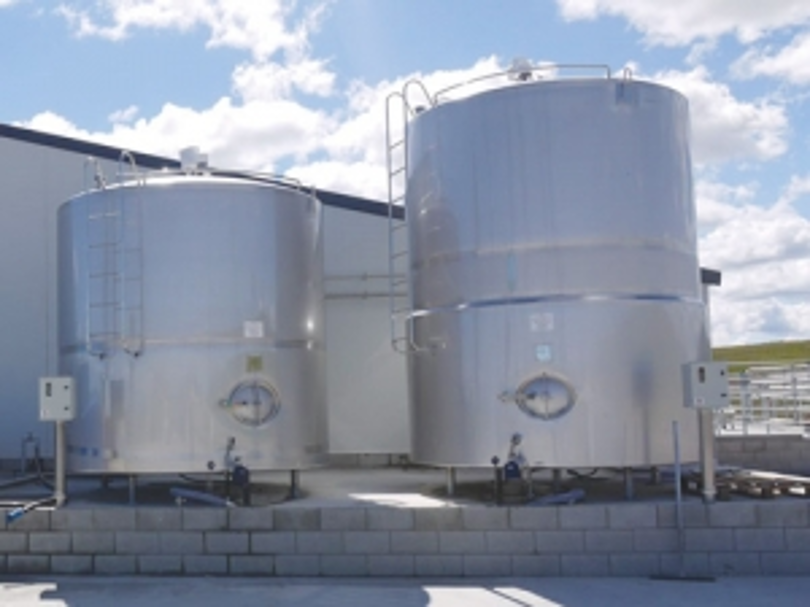
Figure 1: It is necessary to clean milk tanks to limit bacterial growth, Rural News Group (2015). (Image credits: https://ruralnewsgroup.co.nz/dairy-news/dairy-management/keeping-the-bulk-milk-tank-clean)
Although automated systems exist to clean bulk milk tanks, manual cleaning may still be necessary due to power cuts or as a regular practice; in such cases, the tanks qualify as confined spaces, and an established protocol must be followed before entry, including checking air for safe oxygen levels and unsafe chlorine levels.
Although chlorine helps with effective disinfection, chlorine residues and chlorine disinfection byproducts may remain in milk or equipment. Many chlorine disinfection byproducts are potentially carcinogenic and cause mutations. So, chlorine monitoring can also be used after disinfection to ensure no residues are present. The chlorine risks have led some countries, like Ireland, to use chlorine-free alternatives for disinfection on dairy farms.
Fixed and Portable Chlorine Gas Detection
Besides large industrial facilities that produce agrochemicals, dairy farms should also have chlorine sensors. Though milk production is increasing, the number of farms is falling due to consolidation in the USA. By the end of the decade, only 20,000 dairy farms may remain in the USA, and chlorine sensors can improve operational efficiency.
Interscan offers fixed and portable chlorine sensors for both industries to monitor the gas. The devices are very sensitive and provide real-time audio and visual alerts for any increases above permitted levels. Staff can use the alerts to control processes, check equipment to prevent further leaks and risks, and evacuate to safety.
Contact us for more information on Interscan fixed and portable devices for your chlorine monitoring needs.
Sources
CDC. (n.d.). Medical Management Guidelines for Chlorine. Retrieved from https://wwwn.cdc.gov/Tsp/MMG/MMGDetails.aspx?mmgid=198&toxid=36
Jayaraj, R., Megha, P., & Sreedev, P. (2016). Organochlorine pesticides, their toxic effects on living organisms and their fate in the environment. Interdisciplinary toxicology, 9(3-4), 90–100. https://doi.org/10.1515/intox-2016-0012
Krivánek D., Trávnícek P., Kotek L., 2026, Analysis of Industrial Accidents related to the Operation of Chlorine Management Systems in Water Treatment Plants. Chemical Engineering Transactions, 126, 127-132. DOI: 10.3303/CET26126022
Mobo, B. H. P., Rabinowitz, P. M., Conti, L. A., & Taiwo, O. A. (2010). Occupational Health of Animal Workers. Human-Animal Medicine, 343–371. https://doi.org/10.1016/B978-1-4160-6837-2.00012-9
New Jersey Department of Health. (2015, Oct). Right to Know Hazardous Substance Fact Sheet- Chlorine. Retrieved from https://nj.gov/health/eoh/rtkweb/documents/fs/0367.pdf
Schwan, J., Kleoff, M., Dreyhsig, G. H., Voßnacker, P., Fiedler, T., Rosental, M., & Riedel, S. (2025). Rethinking chlorine: essential chemical or replaceable risk?. ChemSusChem, 18(13), e202402697.
Slattery, M., & Garvey, M. (2025). Chlorine Disinfection Byproducts: A Public Health Concern Associated with Dairy Food Contamination. Dairy, 6(2), 18. https://doi.org/10.3390/dairy6020018
Wang, Y., Liu, X., Wang, L., Li, H., Zhang, S., Yang, J., Liu, N., & Han, X. (2023). Effects of Long-Term Application of Cl-Containing Fertilizers on Chloride Content and Acidification in Brown Soil. Sustainability, 15(11), 8801. https://doi.org/10.3390/su15118801