Interchangeable Sensor Modules vs Factory Servicing comes down to a practical question for most safety teams: how long can you afford to have a gas detector unavailable? Gas sensors are consumable components. Their sensitivity changes with age, exposure, and operating conditions, so every monitoring program eventually has to deal with calibration, sensor replacement, or both. The difference is whether routine sensor maintenance can happen at the facility or requires the instrument to leave the site.
For operations that depend on continuous or frequent toxic gas monitoring, that difference can have a direct effect on monitoring availability, maintenance planning, and the number of backup instruments required.
Where factory servicing creates downtime
A traditional factory-service model usually means removing the detector from service, arranging shipment, waiting for inspection or calibration, and then waiting for the instrument to return.
The actual factory work may only be part of the elapsed time. Shipping, internal purchasing processes, RMA procedures, receiving, and instrument recommissioning all add to the service window.
Interscan has noted that older sensor-replacement workflows could leave an instrument unavailable from a week to several months in some cases.
For a facility with multiple detectors, those intervals can turn sensor maintenance into a logistics problem. Safety teams may need to:
- Maintain spare instruments specifically for service periods
- Rotate analyzers through calibration schedules
- Track shipments and RMA paperwork
- Reconfigure monitoring assignments while equipment is unavailable
- Delay monitoring work when no suitable backup is available
Factory service still has an important role when an instrument requires troubleshooting or repair beyond routine sensor replacement. The issue is whether the entire detector needs to be shipped out every time a sensor reaches the end of its useful service period.
Subscribe to receive our monthly round-up of articles.
How interchangeable sensor modules change the workflow
The Interchangeable Sensor Modules vs Factory Servicing comparison looks very different when the sensor itself becomes a replaceable, calibrated module.
Interscan developed its Interchange Sensor System so users can release the existing sensor, install a replacement, and reset the device. Interscan describes the replacement process as tool-free and capable of being completed in under a minute without sending the analyzer back for calibration.
That changes maintenance from a shipping event into an on-site task.
For technicians, the benefit is straightforward. Instead of taking the complete monitoring platform out of circulation, the component that needs replacement is changed while the rest of the instrument remains at the facility.
This is particularly valuable when monitoring schedules are tight or when a detector is assigned to a specific process, production area, or industrial hygiene program.
Pre-calibration matters as much as physical replacement
A sensor module is only useful if replacing it does not create a second maintenance problem.
Interscan’s approach addresses that through calibrated replacement sensors. The current GASD 8000 documentation describes the SensorExpress program as providing a certified spare sensor with sensitivity information determined during manufacturing. In the current cartridge design, that sensitivity value is already programmed into the cartridge for the instrument to read.
That is an important distinction in the Interchangeable Sensor Modules vs Factory Servicing discussion. Quick mechanical replacement alone does not necessarily reduce the total maintenance burden if technicians must then perform a complicated calibration procedure before returning the detector to work.
A pre-calibrated replacement model moves more of that work upstream.
Interscan also offers its SensorExpress subscription service, which is designed to provide calibrated replacement sensors according to a planned schedule. This can help facilities combine fast field replacement with predictable sensor availability.
The effect on portable monitoring
The benefit becomes easy to see with a portable analyzer such as the GASD 8000.
The GASD 8000 is designed for active, continuous sampling using an integral pump and supports low-level gas detection across a range of toxic gases. It also provides onboard data logging, concentration displays, audible and visual alarms, and up to eight hours of continuous battery-powered service.
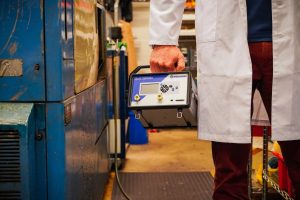
GASD 8000
When a portable analyzer supports inspections, surveys, temporary monitoring, or industrial hygiene measurements, sending it away for routine sensor service means losing that capability unless another analyzer is available.
An interchangeable sensor approach keeps the analyzer itself in the user’s hands.
That can be especially useful for organizations running several portable analyzers. Instead of managing an instrument rotation around factory servicing, the maintenance schedule can focus more directly on keeping replacement sensors available.
The same principle applies to continuous fixed monitoring
Downtime becomes even more important in fixed applications because the purpose of fixed detection is continuous coverage.
The AccuSafe fixed gas detection system uses smart sensor modules in a distributed architecture. Interscan describes the system as supporting up to ten smart sensor modules reporting to a controller, with active continuous sampling and local processing at each sensor module.
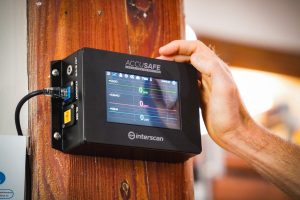
Interscan’s AccuSafe system
A fixed monitoring point is usually installed because a hazard exists in a predictable location. Losing that point for routine sensor servicing can create a gap exactly where continuous detection was considered necessary.
This is why maintenance architecture matters when evaluating fixed gas detection. Detector sensitivity, alarm functions, communications, and data logging are important, but maintainability determines how easily those capabilities remain available over the life of the system.
For more context on that issue, Interscan’s article on the importance of minimizing gas detection downtime explains why sensor maintenance should be considered part of the overall monitoring strategy.
Interchangeable modules do not eliminate all maintenance
Interchangeable sensors should not be treated as a reason to ignore maintenance procedures.
Gas detection equipment still needs inspection, functional checks, cleaning, battery maintenance where applicable, and sensor replacement according to the manufacturer’s recommendations. Exposure to unusually high gas concentrations can also affect sensor condition and may justify earlier replacement.
Calibration and verification remain important as well. Interscan’s GASD 8000 supports calibration against a standard gas mixture in addition to its SensorExpress approach.
The advantage is not that maintenance disappears. It is that routine sensor replacement does not automatically require removing the entire instrument from the facility.
For a deeper look at this topic, see Interscan’s discussion of calibrated instruments in gas analysis.
Which approach reduces monitoring downtime?
For routine sensor replacement, interchangeable calibrated modules have a clear operational advantage over a model that requires the entire detector to return to the factory.
They allow facilities to keep control of the instrument, shorten the maintenance window, reduce shipping dependencies, and simplify the use of spare equipment. When replacement sensors are supplied in advance through a program such as SensorExpress, maintenance can also become much easier to plan.
Factory servicing remains appropriate for repairs that cannot reasonably be completed at the facility. It simply does not need to be the default process for every routine sensor change.
Frequently Asked Questions
How quickly can an Interscan interchangeable sensor be replaced?
Interscan states that its Interchange Sensor System allows a user to replace a sensor without tools and in under a minute. The replacement sensor is pre-calibrated, which reduces the work required before returning the detector to monitoring service.
Does an interchangeable sensor mean gas detectors never need calibration?
No. Calibration and performance verification remain part of proper gas detector maintenance. Interscan instruments can be calibrated using appropriate standard gas, while SensorExpress provides another approach based on calibrated replacement sensor cartridges.
Are interchangeable sensors useful for both portable and fixed gas monitoring?
Yes. Interscan incorporates its low-downtime sensor replacement approach across systems including the portable GASD 8000 and the AccuSafe fixed gas detection platform. The practical benefit is similar in both cases: routine sensor replacement can be handled without sending the complete detector away for service.
When evaluating Interchangeable Sensor Modules vs Factory Servicing, look beyond the sensor specification and consider what happens when that sensor eventually needs attention. Explore InterScan’s Interchange Sensor System and gas detection platforms to see how on-site sensor replacement can help keep critical monitoring equipment available when your team needs it.