- Revised Workplace Exposure Limits (WELs) will come into effect from 1 December 2026 for around 200 airborne contaminants.
- The permissible limits for phosphine have been lowered due to the serious acute and chronic health effects and the fire and explosion risk it poses.
- Among the available commercial technologies, electrochemical sensors, which can be integrated into fixed and portable gas detectors, are best suited for phosphine detection in a wide range of industries.
Australia is revising the exposure level limits of industrial airborne contaminants to reflect state-of-the-art scientific and medical information to improve worker health and safety at workplaces. Phosphine exposure levels have been revised, and all industries using this toxic gas must comply. This article examines the changes in phosphine exposure limits and the technologies industries can use to improve their monitoring of the chemical.
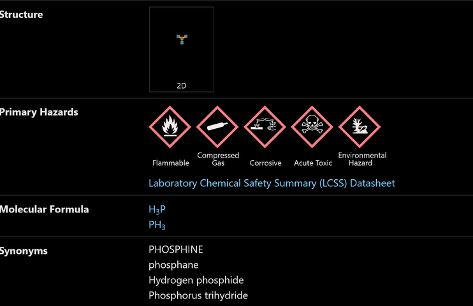
Figure 1: Phosphine properties, National Library of Medicine. (Image credits: https://pubchem.ncbi.nlm.nih.gov/compound/Phosphine)
Why Australia is Changing Airborne Contaminant Limits
Under the past Work Health and Safety (WHS) Regulations, businesses and undertakings (PCBU) were required to ensure that their staff were not exposed to air contaminant levels above the workplace exposure standard (WES).
In 2019, the WHS ministry agreed to review the exposure levels of the hazardous substances to improve protection for workers based on current scientific and medical evidence. Safe Work Australia conducted a review of over 600 chemicals based on the latest information on their adverse health and safety effects, including burns, respiratory diseases, lung damage, nerve damage, cancer, and reproductive health. Multiple sources were used for each chemical for the initial findings, with recommendations opened for stakeholder feedback and public consultations. In 2022, Safe Work Australia recommended changes for a third of the reviewed chemicals. The recommendations for all but nine chemicals were accepted. In 2023, the WHS ministers requested further assessment for these nine chemicals.
The WHS ministers also agreed to replace the terminology ‘workplace exposure standard’ with
‘workplace exposure limit’ (WEL) to align it with international terms and indicate that these levels should not be exceeded. The implementation of the revised WEL must start from 1 December 2026. Until 30th Nov 2026, the current WES for airborne contaminants standards apply.
Subscribe to receive our monthly round-up of articles.
The revised list for airborne contaminants suggests
- additions, removals, increases, or decreases in exposure limits
- merging or splitting of contaminant groups
- addition or removal of contaminant listing
Phosphine is one of the chemicals for which revised and recommended levels have been accepted by the WHS ministers and will come into effect from Dec 2026.
Changes to Phosphine Exposure Levels
Phosphine is a colorless gas, which has no odor when pure. So, smell is not a reliable detector of the gas. It can smell like garlic or rotting fish when it has contaminants. Phosphine gas is heavier than air and will accumulate in low-lying areas in poorly ventilated rooms.
Phosphine is hazardous because it is very toxic, reactive, and highly flammable see Figure 1.
- Toxic effects: When people breathe in phosphine, it reacts with the moisture in the lungs to turn into an acid.
- Its acute health effects include throat, nose, and lung irritation. Higher exposure causes pulmonary edema, liver, heart, and kidney damage, coma, and death.
- Chronic and repeated exposure can cause anemia, bronchitis, gastrointestinal disorders, weight loss, weakness, spontaneous fractures, swelling of jaws, toothache, jawbone necrosis, and motor and speech disturbances. Chronic effects can last from months to years. The gas has not been tested for cancer.
- Flammability: Phosphine poses a serious fire and explosion risk.
Australia has lowered the exposure limits for phosphine in recognition of its dangers:
- The 8-hour time weighted average (TWA) has been changed from 0.3 ppm to 0.05 ppm.
- The Short-Term Exposure Limit (STEL) over a 15-minute period has been lowered from 1 ppm to a Peak Limit of 0.15 ppm, to protect against acute health effects.
Industries That Must Monitor Phosphine
Phosphine is used in many industries, but mainly in agriculture, forestry, food processing, chemical, electronic, and semiconductor sectors. It is transported as liquefied gas. Solids that release phosphine gases are also used in many industries.
- Semiconductor and electronics industry: Phosphine is used as a dopant to introduce phosphorus into silicon in semiconductor chips for computers. The intentional introduction of an impurity allows conductivity in the chips produced for computers. Phosphine is also used to manufacture red and yellow LEDs.
- Chemical industry: Phosphine is used as an intermediate for the production of many flame retardants, including textiles, and it is also a polymerization initiator.
- Welding: Operations such as welding and machining produce phosphine, and the workers are exposed at close range to the gas. Hence, those involved in these operations must be protected from the gas through monitoring.
- Agriculture and Forestry: One of the most widespread uses of phosphine is as a fumigant, insecticide, and rodenticide to control microbes and pests, as it interferes with their breathing and metabolism. It is used in agriculture and forestry to kill insects and rodents infecting grain, tobacco, and wood. It is used in silos, transport containers, and fumigation areas of food and wood.
It is applied as tablets, pellets, or sachets of aluminum phosphide or magnesium phosphide mixed with other compounds to control the release of the gas and reduce its flammability. Phosphine is the most toxic fumigant and is used in very low amounts. Phosphine remains popular because it is low-cost, suitable for many commodities, effective against many pests, compatible with logistics operations, and globally accepted by regulatory authorities because it leaves no residues.
Monitoring is necessary to detect increases in phosphine levels above the permitted limits to reduce occupational hazards. Moreover, very low and precise amounts must be used for the semiconductor and electronics industries and during fumigation in agriculture and forestry.
Equipment Types
For overall coverage and efficacy, the technology requires different instruments for continuous and spot checks.
- Continuous monitoring: Air must be continuously monitored by positioning gas sensors in locations and workstations most likely to experience spikes of phosphine gas, such as storage, handling, and use. More than one sensor may be necessary and must be placed in low-lying areas as phosphine is a heavy gas. Continuous monitoring by fixed devices requires no manual intervention and works around the clock. The devices provide automatic audio and visual alarms when phosphine levels rise over permitted limits. It allows personnel to take corrective action and/or evacuate workers as needed.
- Spot checks: In addition to continuous monitoring, it is also necessary to make spot checks for personal safety before entering confined spaces such as silos and poorly-ventilated chambers and work areas. Portable gas detectors used or worn within the breathing zone (300mm radius in front of a person’s face) must give real-time readings in parts per million (ppm).
Monitoring Technology for Phosphine
To maintain phosphine levels below the revised lower limits, precise, high-resolution, rapid technology is necessary. Such technology is already available on the market, and industries can choose from several methods: electrochemical sensors, infrared (NDIR) spectroscopy, colorimetric indicator tubes, and gas chromatography (GC).
Electrochemical sensors: These sensors have two to four electrodes (anodes) that react with the target gas, in this case phosphine, and quantitatively measure the resulting electric current to estimate gas levels. They are state-of-the-art gas detectors and are an alternative to traditional gas chromatography and NDIR technology. These gas detectors are widely used for their precision, compact size, robustness, and cost. Electrochemical sensors are suitable for both spot checks and continuous monitoring, are reusable, and can be integrated into radio telemetry-based and IoT systems.
The electrochemical sensors must be regularly calibrated and can suffer from cross-sensitivity. A study that evaluated electronic devices with electrochemical sensors found they had an accuracy of 60 to 100% and were able to provide adequate warnings for worker safety. The results are displayed digitally on a monitor, making them easy to use and interpret. The results are available in real time, so workers’ exposure is minimal during gas measurements with portable sensors or zero with fixed devices.
Colorimetric indicator Tubes: The tube-type gas detectors use graduated transparent glass tubes, 10 x 0.5 cm in size, filled with a white reactive compound. The compound changes color along the tube length in proportion to the phosphine drawn into the tube. In theory, the principle is accurate; however, in practice, operator errors can lower precision, as the concentration must be read through the progression of colors, like a mercury thermometer, producing inconsistent readings when multiple workers read the device. Moreover, the tube can be used only once, making repeated or continuous measurements over 50 times per year more expensive than electrochemical devices. However, it requires no calibration. The method is suitable only for spot checks.
Optical sensors: Optical sensors are based on absorption infrared spectroscopy (NDIR). It is useful for continuous monitoring, such as fumigation operations, where air-fumigant mixtures are pumped into the device. The method can accurately measure down to only 0.25 ppm, so it is not suitable for the new WEL established in Australia, which sets the 8-hour TWA at 0.05 ppm.
Gas chromatography: This is the traditional laboratory method used for experimental purposes, and is the most accurate of all phosphine methods. The laboratory method is destructive. Small portable commercial instruments for use in industries, such as semiconductor production, can measure below 0.02 ppm.
Though gas chromatography is precise, for industrial hygiene and safety, electrochemical and colorimetric methods are recommended.
Interscan Gas Detectors for Phosphine
Interscan has been producing portable and fixed gas analyzers for many years that are based on electrochemical sensors for phosphine detection. The company produces AccuSafe for fixed-point gas detection, which can be connected to an IoT system for automatic monitoring and control of phosphine levels. Interscan has two types of portable devices, the Interscan GasD 8000 Series and the GASD IS, which is intrinsically designed for explosive gases like phosphine. All three devices can measure trace gas concentrations starting from zero at high resolutions of ppb (parts per billion), making them suitable for monitoring phosphine for compliance with the revised lower WEL in Australia.
Contact us for more information on the three gas detectors for phosphine.
Sources
Brabec, D., Campbell, J., Arthur, F., Casada, M., Tilley, D., & Bantas, S. (2019). Evaluation of Wireless Phosphine Sensors for Monitoring Fumigation Gas in Wheat Stored in Farm Bins. Insects, 10(5), 121. https://doi.org/10.3390/insects10050121
CDC. (n.d.). Phosphine. Retrieved from https://www.cdc.gov/niosh/ershdb/emergencyresponsecard_29750035.html
Danley, R., Adam, B. D., Criswell, J., Noyes, R., & Phillips, T. W. (2008). How accurate are phosphine monitoring devices? Journal of Pesticide Safety Education, 7, 1-9.
Grain Trade Australia. (n.d.). SafeWork Australia Phosphine. Retrieved from https://graintrade.org.au/nwpgp/safework-australia-phosphine/
FAO. (n.d.). Phosphine. Retrieved from https://www.fao.org/4/x5042e/x5042e0a.htm
Public Health Association. (2026, March 16). Lower limits save lives – WHS Ministers must protect workers from toxic and cancer-causing chemicals. Retrieved from https://www.phaa.net.au/Web/Web/News/Media-releases-2026/Lower-limits-save-lives.aspx
Salem, A. (2025, Jan 23). Meet phosphine, a gas commonly used for industrial fumigation that can damage your lungs, heart and liver. Retrieved from https://research.uiowa.edu/news/2025/01/meet-phosphine-gas-commonly-used-industrial-fumigation-can-damage-your-lungs-heart-and
Safe Work Australia. (2025, May 29). Changes to Workplace Exposure Limits. Effective from 1 December 2026. Retrieved from https://www.safeworkaustralia.gov.au/sites/default/files/2025-07/changes_to_workplace_exposure_limits_-_june_2025.pdf
Safe Work Australia. (2025, Dec). Proposed workplace exposure limits for 9 chemicals. Decision Regulation Impact Statement. Retrieved from https://www.safeworkaustralia.gov.au/sites/default/files/2026-06/decisionris-proposed_wel_for_9_chemicals_june2026.pdf
Thorn, T.G., Chodyniecke, E.M., Ingold, et al. (2022). Continuous real-time monitoring of phosphine concentrations in air using electrochemical detectors interfaced by radio telemetry. Environ. Sci. Technol., 36, 2048–2053. https://doi.org/10.1021/es015774+
Tregenza, H. (2026, June 24). Chemical exposure limits put on hold despite Safe Work Australia advice. Retrieved from https://www.abc.net.au/news/2026-06-24/hazardous-chemical-exposure-limits-on-hold/106833750
Verstuyft, A. W. (1978). Sampling and analytical methods for phosphine—a review. American Industrial Hygiene Association Journal, 39(6), 431-437.
WorkSafe.Qld.Gov. Au. (n.d.). Phosphine gas. Retrieved from https://www.worksafe.qld.gov.au/safety-and-prevention/hazards/hazardous-exposures/phosphine-gas
……………….