- Carbon monoxide (CO) is the most dangerous among the hazardous gases that can be released in mines.
- CO is dangerous because it is highly toxic and can be flammable and explosive.
- Continuous monitoring, spot checks, PPE, rigorous risk assessment, and planning are necessary to reduce CO exposure risks.
- Rescue teams called in to help during mine fires must detect gases present and use software to predict CO movement patterns to find a safe escape route.
Carbon monoxide poisoning is a leading cause of fatalities in underground mine fires. Miners also encounter carbon monoxide in daily operations. Rescue teams and miners can identify some gases by their distinct color or odor, alerting them to the dangers of potential exposure. However, carbon monoxide is colorless, odorless, and tasteless, making it the “most dangerous gas” in mines. The only way to detect carbon monoxide is through sensors. This article discusses why carbon monoxide is a high occupational risk in mines and how it can be controlled.
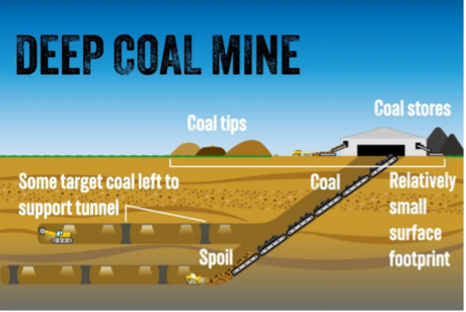
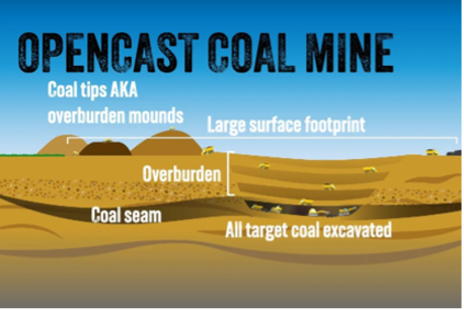
Figure 1: Schematic depiction of underground and surface mining, Coal Action Network. (Image credits: https://www.coalaction.org.uk/2026/05/07/opencast-vs-deep-coal-mines/
Carbon Monoxide Sources in Mines
Miners can be exposed to hazardous gases, including carbon monoxide (CO), in confined spaces and poorly ventilated areas of both underground and surface mining (see Figure 1):
- Underground mines are located deep in the earth and can be room-and-pillar, longwall, or block-caving types, used to extract coal, gold, copper, and nickel.
- Surface mining involves mineral extraction from shallow soils and can be open-cut or strip-mining type. These mining methods involve blasting, drilling, land clearing, and material removal, and are used to extract coal, iron ore, and bauxite.
Carbon monoxide can be generated in mines during daily operations or accidents such as fires.
Daily operations
Some of the daily operations that produce carbon monoxide are as follows:
- Blasting: Explosive detonation for blasting produces significant amounts of carbon monoxide.
- Machines and vehicles: The exhaust from heavy machinery and vehicles operating in confined spaces can contain carbon monoxide due to incomplete combustion of fossil fuels such as diesel. Nowadays, electric equipment is replacing diesel-powered tools to prevent the production of CO and other hazardous gases from incomplete combustion.
- Spontaneous combustion: At ambient temperatures, when adequate oxygen is present, coal oxidizes. The resultant heat produced is not dissipated in mines, increasing temperatures that lead to spontaneous combustion and fires, which produce carbon monoxide. The quantity of gas produced depends on the quality of coal.
Accidents
Explosions, though rare, can occur in any mine and cause the most fatalities. Mine fires and explosions can start due to the following causes:
Subscribe to receive our monthly round-up of articles.
- Spontaneous combustion
- Frictional ignition
- Gas and dust explosions
- Equipment leakages
- Conveyor belt fires
- Tire fires
- Human error, such as burning debris
- Natural causes like forest fires, lava flows, and lightning strikes
Vents provided in mines for exhaust can become inlets for oxygen-rich air, feeding the fire underground; see Figure 2.
A National Institute of Occupational Safety and Health (NIOSH) 2021 report found that fire accidents are the second most important reason for fatalities in underground mines in the US, including coal, metals, non-metals, and stone. Coal mines are more prone to fires because of the combustible nature of the material. Fires occur in active and abandoned coal mines.
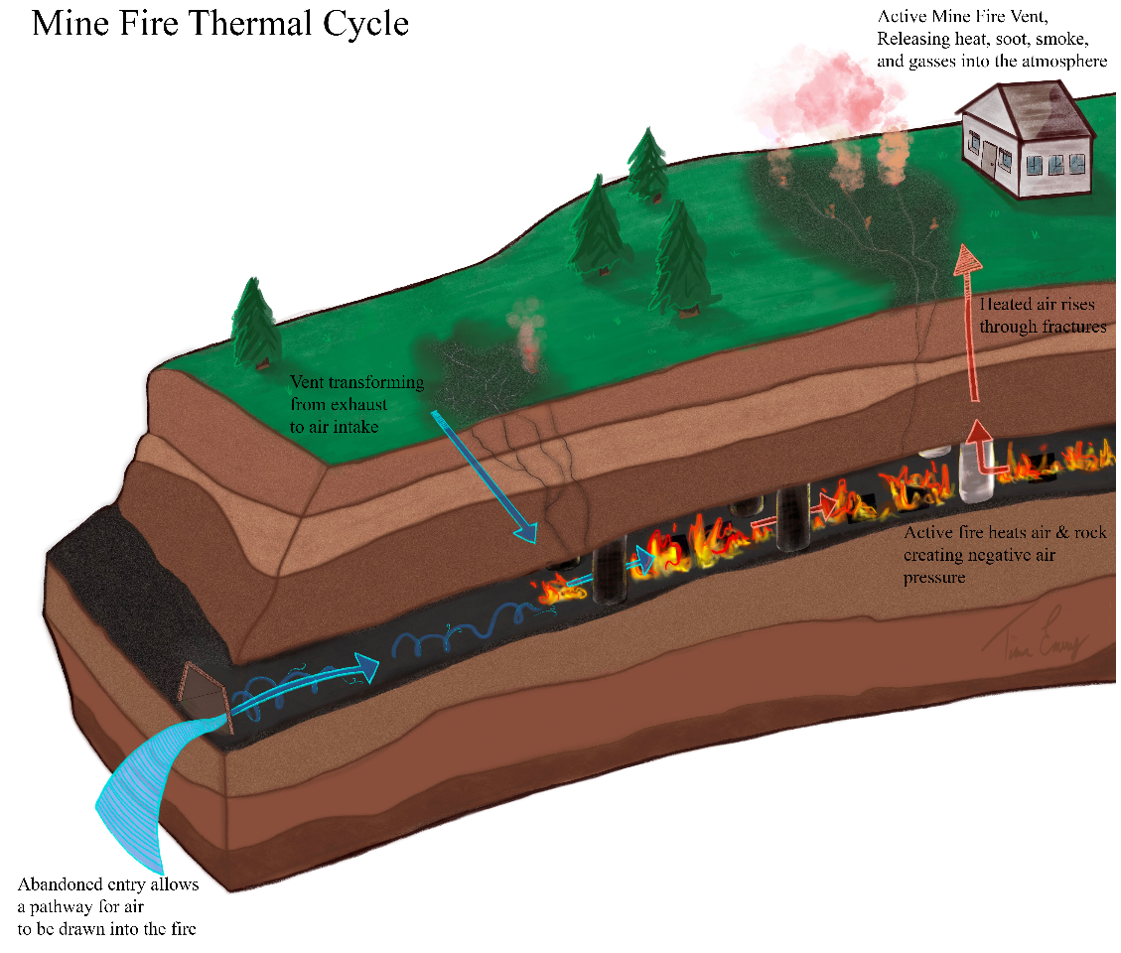
Figure 2: Mine fire thermal cycle, OSMRE. (Image credits: https://www.osmre.gov/programs/mine-fires)
Carbon Monoxide Spreads in Underground Mines
Mine fires produce vast amounts of carbon monoxide, enough to cause primary fatalities. Often, during mine fires, miners die due to carbon monoxide poisoning more than the fire itself. For example, in Aracoma Alma Mine in West Virginia, two miners were separated from the rest of the crew while trying to escape the fire and died due to carbon monoxide poisoning from a burning conveyor belt. The risks are high as carbon monoxide does not stay where it is produced but spreads in the mines. It endangers not only people near fires or other sources but also those far away due to ventilation airflow.
Smoke and dust from the fire spread through the many entries via ventilation airflow or leakage from one entry to another due to a temporary stoppage.
In the event of a mine fire, it is therefore crucial for rescuers to identify the hazardous gases produced and to establish a secure escape route.
Researchers have been developing software programs that can quickly predict the spread of carbon monoxide based on the number of entries, airflow, and temperatures. Examples include the Fire Dynamics Simulator (FDS) and the MFIRE programs. Simulations have suggested that the carbon monoxide levels rise dramatically initially at the source. When the airflow rate is low, below 0.5 m/s, fresh air leaks in through the lower part of the mine entry, while the smoke with CO leaks out in the higher parts of the entry. Carbon monoxide is lighter than air, with a relative density of 0.97 compared to normal air, and has a high affinity for heat, so it floats above air and is found in higher spaces near the roof. The flow of air dilutes the CO levels, making it uneven. Whereas CO moves at a constant speed before airflow leakage, its speed is reduced by fresh-air inflow.
Tools such as MFIRE can generate simulations involving 165 mine entries in less than a minute, providing fast, valuable information on CO spread and helping to plan an escape route for miners.
Carbon Monoxide Dangers
Carbon monoxide is dangerous in mines as it is toxic and flammable.
Toxicity
CO is toxic because hemoglobin has a greater affinity for carbon monoxide than oxygen. Hemoglobin reacts with CO to form carboxyhemoglobin instead of oxyhemoglobin with oxygen. Thus, the blood supplies less oxygen to tissues. As exposure to CO continues, blood becomes saturated with CO and is unable to transport any oxygen, which can cause death due to chemical asphyxiation.
Carbon monoxide toxicity is cumulative. So, people can be exposed to short durations without any ill effects, but the gas’s impact builds over time, making the person vulnerable, since the half-life of carboxyhemoglobin is 4 to 5 hours. Luckily, CO effects are reversible if people are taken out into fresh air and the level of CO in their blood can be reduced.
According to Özmen and Aksoy (2015), some of the toxic effects of carbon monoxide at varying concentrations are as follows:
- CO levels lower than 0.04%–0.06% in the air can go unnoticed without any effects
- CO levels of 10%–20% cause nausea, tiredness, clumsiness, tachypnea, and confusion
- CO exposure for less than an hour to above 0.20%–0.40% is dangerous. Exposure to 31%–40% causes dizziness, drowsiness, vomiting, and impaired vision and decision-making
- Exposure to CO concentrations between 41%–50% causes unconsciousness, tachypnea, and amnesia; and above 0.40% CO causes death within an hour.
- At levels of 51%–60%, CO causes coma, crisis, apparent acidosis, and death.
Flammability
CO can cause fires and explosions. Carbon monoxide flammable limits are 12.5 to 74% in air, with the greatest risks of explosion being around 29%.
Controlling and Minimizing CO Risks in Mines
Mines have to be prepared for carbon monoxide production due to daily operations and fires.
Monitoring: Continuous air monitoring via fixed sensors at several locations is essential for alerting people to CO, as miners can’t see, smell, or taste it. Gas sensors can save lives by providing early alerts of CO above permitted levels. The permitted levels of CO Time-Weighted Average (TWA) in an eight-hour shift in the USA are set at 50 ppm by OSHA and 30 ppm in Australia.
In fact, in the recent 2026 coal mine fires in China’s Shanxi province, where 82 people died, a carbon monoxide sensor in the mine was triggered and alerted people to the explosion. In the event of a mining accident, it is crucial for rescue teams to know which gases are in the air to protect miners and themselves from potential health risks and explosions. Miners and rescue teams should also carry portable sensors for measuring CO when they enter confined spaces, as the gas can accumulate there due to poor ventilation.
Personal Protective Equipment (PPE): Miners entering confined spaces should use PPE, including a self-contained breathing apparatus (SCBA), to avoid exposure to hazardous gases, including CO. Rescuers must use fireproof PPE and wear an SCBA before entering mines on fire.
Risk evaluation and evacuation plans: Mine safety managers must conduct risk assessments, identify potentially dangerous gases that may be produced, and provide training in gas detection, evacuation, and rescue procedures.
Rescue operations: Rescuers should have a software program that can predict CO movement in the tunnels to plan safe escape routes. Teams will have to identify where miners are stuck, the risks, the gases present, first aid, rescue vehicles with medical facilities, tools and equipment for cutting and digging, pneumatic lifts, and steel ropes.
Gas Detectors for Carbon Monoxide
Gas detectors for carbon monoxide in mines must provide precise, accurate results for trace amounts of the gas in real-time readings to prevent exposure to CO, as permissible levels are very low at 30-50 ppm. The detectors must have audio and visual alert systems that can immediately capture miners’ attention. Usually, electrochemical sensors are used in CO detectors. Interscan offers both fixed and portable instruments with electrochemical sensors for continuous CO monitoring in confined spaces. The portable instruments the company offers, which can be carried by miners into confined spaces, are the GASD 8000 for all environments and the GASD IS, designed for intrinsic safety in environments with ignition risks, such as in mines. The AccuSafe is a fixed device for around-the-clock monitoring. Several fixed sensors should be placed closer to the roof to detect any CO produced during daily operations and prevent risks to miners.
Contact us for more information or a demo of our carbon monoxide detectors for increased safety in mines.
Sources
Coal Action Network. (2026, May 7). Opencast vs deep coal mines: what’s the difference? Retrieved from https://www.coalaction.org.uk/2026/05/07/opencast-vs-deep-coal-mines/
Fernandez, S. (2025, Jan 7). Understanding Open-Cut vs. Underground Mining. Retrieved from https://www.australianminingservices.com.au/understanding-open-cut-vs-underground-mining-the-australian-perspective/
Johnstone, S. (2015, April 17). A Coal Miner’s Silent Killer: Carbon Monoxide. Retrieved from https://www.wvlaw.net/2015/04/17/a-coal-miners-silent-killer-carbon-monoxide/
Kabwit, H.M., Muzang, N.K., Chikomb, R. M., et al. (2026). Indoor carbon monoxide concentrations in artisanal mining households in Kolwezi, Democratic Republic of the Congo. Journal of Interventional Epidemiology and Public Health. 2026; 9(2):82. https://doi.org/10.37432/jieph-d-26-00011
OSMRE. Gov. (n.d.). Coal Mine Fires and Burning Refuse. Retrieved from https://www.osmre.gov/programs/mine-fires
Özmen, İ., & Aksoy, E. (2015). Respiratory Emergencies and Management of Mining Accidents. Turkish thoracic journal, 16(Suppl 1), S18–S20. https://doi.org/10.5152/ttd.2015.005
Resources Safety and Health Queensland. (2007, March 28). Flammable and toxic gases in open cut coal mines. Mines safety bulletin no. 61| Version 1. Retrieved from https://www.rshq.qld.gov.au/safety-and-health-alerts/mines/flammable-and-toxic-gases-in-open-cut-coal-mines?SQ_DESIGN_NAME=print_preview
Salami, O. B., Xu, G., Kumar, A. R., & Pushparaj, R. I. (2023). Underground mining fire hazards and the optimization of emergency evacuation strategies (EES): The issues, existing methodology and limitations, and way forward. Process Safety and Environmental Protection, 177, 617-634.