- Hydrazine exposure risks in workplaces can cause health, fire, and explosion hazards.
- Hydrazine and its derivatives are used in many industries as raw materials, intermediates, or chemical reactants.
- Detection of hydrazine requires specially designed intrinsically safe gas detectors.
Hydrazine is hazardous because it poses a fire and explosion risk, is toxic, and is corrosive. It is also a versatile chemical, with industrial, military, and aerospace applications. Due to the liquid’s hazardous nature, which readily evaporates under ambient conditions to produce vapors, industries that use or produce it must take adequate precautions, as prescribed by the hierarchy of controls, to prevent harm to workers, facilities, and the neighborhood. Safety managers can check whether their processes involve hydrazine in this article, which lists major workplaces where the chemical may be present.
Exposure Risks of Hydrazine
Hydrazines can include hydrazine anhydrous, 1,1-dimethylhydrazine, and 1,2-dimethylhydrazine. The hydrazines are colorless liquids that look like water but have an ammonia-like odor, which can lull people into a false sense of security and lead to mistakes in their identification. Hydrazine evaporates at ambient temperature and pressure, forming vapors that can spread far.
Hydrazine is , and the usual routes of entry into people are inhalation, contact of skin, eyes, and rarely through accidental ingestion. Even acute exposures can harm people and affect the neurological, hematological, pulmonary, dermatological, and hepatic systems.
Hydrazine also comes with a very high risk of fire, explosions, and runaway reactions that have a large impact, leading to death, property destruction, and environmental pollution.
The risk of exposure to hydrazine is highest at the workplace, though it can also be an environmental pollutant.
Hydrazine can be released into the air during venting, storage, and transfer, so workers should be well protected with personal protective equipment, complete with a breathing apparatus.
According to historical records,
Subscribe to receive our monthly round-up of articles.
- In 1983, in the Federal Republic of Germany, 02-0.03 kg of hydrazine was emitted into the air, water, and soil for every ton of the chemical handled and processed.
- Toxics Release Inventory (TRI) record release of a total of 17,000 and 200 pounds of hydrazine anhydrous and 1,1-dimethylhydrazine, respectively, in 1995 in the USA.
Most exposures occur in or near industrial, aerospace, and hazardous-waste facilities.
Environmental releases are accidental and can occur during storage, handling, transport, and through improper waste disposal. Most releases occur in the air, followed by water and soil. According to ATSDR, when hydrazine is released into the air, it evaporates and breaks down into simple compounds within minutes or hours due to reactions with oxygen. Hydrazine dissolves in water and breaks down more slowly into harmless compounds; therefore, it is a harmful pollutant to aquatic life. In soil, hydrazines stick to particles, but break down into harmless compounds within a few days. People can be exposed to hydrazine by breathing contaminated air, drinking contaminated water, swimming in contaminated water, or touching contaminated soil at waste disposal sites.
Based on recent reports from the European Union, most exposures are reported in the military and aerospace industries and in paper and tire manufacturing. Historically, the USA’s aerospace and military industries have had the most exposure to and damage from hydrazine. The broad sectors and processes where hydrazine exposure is likely are listed below.
-
Hydarzine Production
According to Mordor Intelligence, the global demand for hydrazine is expected to grow at a 5.71% CAGR between 2026 (388.76 kilotons) and 2031 (513.16 kilotons). These figures also include hydrazine hydrate, the anhydrous form, and the two derivatives.
Hydrazine can be produced by many methods, but three are used for industrial-scale production:
- Raschig Process
- Ketazine-peroxide Process
- Urea-based process
Most worker exposures occur at facilities that produce hydrazine, so safety managers in these sites should take adequate measures to protect people and buildings.
-
Fuel for Spacecrafts and Aircrafts
The industrial use of hydrazine began through applications as rocket fuel. Currently, 1,1-Dimethylhydrazine is used more than hydrazine as a fuel in the aerospace sector.
Spacecrafts
In spacecrafts, the applications of hydrazine are as follows:
Used as Fuel: Hydrazine is used to provide propulsion in scientific, commercial, and military satellites in Earth orbit.
Monopropellant systems: Hydrazine is used alone in a monopropellant system, where the energy from its exothermic reactions is harnessed, as at NASA’s Jet Propulsion Laboratory. In spacecraft, hydrazine is used as a monopropellant in space probes, such as the Pioneer missions to Jupiter and Saturn. The absence of oxygen in space removes the risk of explosions or unplanned reactions. It can be stored as liquid in storage tanks and fed into thrusters through precision-engineered systems. It is used in satellite orbital adjustments, station-keeping, and spacecraft maneuvers.
Bipropellant systems: It is also used as a bipropellant when it is mixed with an oxidizer. Hydrazine is used in space as a bipropellant, for example, in the Orbital Maneuvering System (OMS) on the Space Shuttle. Several unmanned space missions have used a mix of monopropellant and bipropellant systems, as in Viking’s Mars lander.
Hydrazine thrusters: Hydrazine is also used as a propellant for upper-stage propulsion of satellites into space, for example, the Voyager TJI, Centaur, TITAN-III, and OMV.
Hydrazine thrusters are also used by the military, for example, for submarine launching of missiles.
Power generation: Hydrazine gas generators provide rotary and pneumatic power in spacecraft. For example, in Solid Rocket Boosters (SRBs) in the Space Shuttle orbiter, see Figure 1.
Workers are exposed to hydrazine at rocket propulsion testing and launch sites, and during aircraft refueling and routine maintenance tasks, at levels above OSHA-permitted limits. Workers can be exposed to 0.29-2.59 mg/m3 and up to 800 mg/m3 at leak sites. Using PPE with respiratory equipment can reduce exposure to 0.013 mg/m3 inside the PPE at a rocket propellant-handling facility, which is below the detection limit.
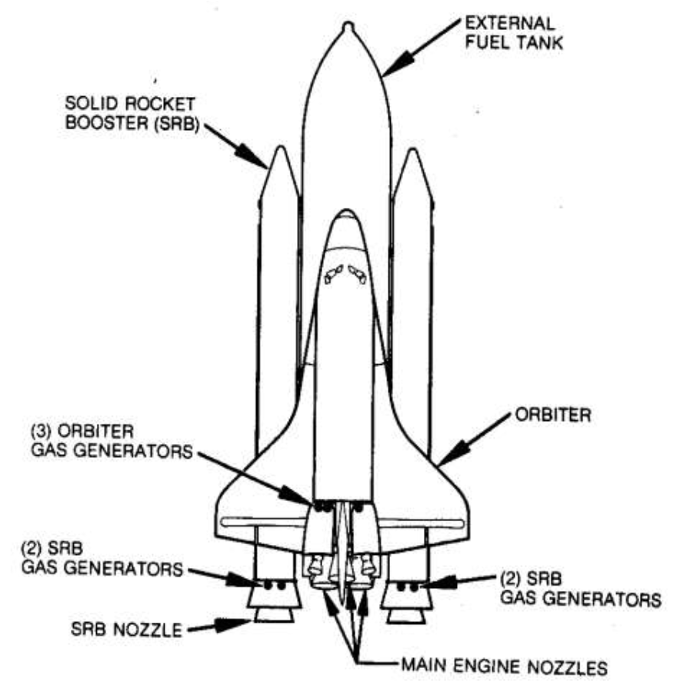
Figure 1. “Location of Hydrazine Gas Generators on Space Shuttle Vehicle,” Schmidt 1987. Image credits: https://www.researchgate.net/profile/Eckart-Schmidt-2/publication/232709239_One_hundred_years_of_hydrazine_chemistry/links/0912f508d7cc6b5e4c000000/One-hundred-years-of-hydrazine-chemistry.pdf)
Aircrafts
Hydrazine is not used routinely as fuel in aircraft because of its explosive nature. However, it is used for emergencies in fighter planes. The F-16 fighter aircraft uses hydrazine as an Emergency Power Unit (EPU) during emergencies, such as engine fires. The chemical is used only for emergency landings and crashes due to its toxicity. Rescue and fire response crews must be fully protected when clearing crash sites.
-
Agricultural Chemicals Production and Use
Agrochemical production is the industry that uses the most hydrazine (54.49%) and accounts for the largest market growth (1.8%) for the chemical, according to Mordor Intelligence.
Hydrazine is used in the manufacture of a wide range of agricultural pesticides, including insecticides, herbicides, and fungicides. It is used as an intermediate chemical reactant in the production process. Workers involved in handling and processing hydrazine can be exposed to it.
Agricultural workers who use hydrazine-containing pesticides on farms can also be exposed to the compound and should be adequately protected.
-
Pharmaceutical Industry
According to Mordor Intelligence, production of pharmaceutical intermediaries is expected to account for the second-highest growth (1.2%) in hydrazine demand in 2026. Hydrazine is used as a metabolite for making several drugs, such as hydralazine and isoniazid, which are used to cure life-threatening illnesses, especially tuberculosis, cancer treatment, and sickle cell disease. It is also used to produce antidepressants and anti-inflammatory drugs.
-
Corrosion Inhibitor
Hydrazine is used as a corrosion inhibitor because it acts as an oxygen scavenger, removing dissolved oxygen that causes metal degradation and the formation of insoluble deposits. Hydrazine reacts with oxygen to form harmless, environmentally friendly nitrogen and water, thereby reducing its concentration and preventing rust formation and metal pitting. Hydrazine also decomposes into ammonia, which raises the pH of water and protects boilers and metal containers. It is highly effective at maintaining a clean, corrosion-free surface in high-pressure boilers. Hydrazine’s ability to protect steel is well established. People can be exposed to dilute hydrazine solutions while working with or around high-pressure boilers.
Applications as an oxygen scavenger:
- Water treatment: Hydrazine is used in desalination water treatment plants and water boilers.
- Energy generators: It is also used as a corrosion inhibitor in steam generators at thermal and nuclear power plants.
- Paper factories: Hydrazine acts as an oxygen scavenging of steam in paper mills. Paper mills are among the industries that report a high number of hydrazine exposures.
According to Mordor Intelligence, hydrazine use as a corrosion inhibitor accounted for the second-highest demand globally (36.5%). At present, water treatment accounts for an estimated 0.7% of global market growth of hydrazine.
-
Plastic Production
In plastic production, several properties of hydrazines are leveraged.
Blowing agent: One of the major applications of hydrazines is as a blowing agent in polymer production. Currently, hydrazine derivatives, such as azodicarbonamide and para-toluenesulfonyl hydrazine, are used as blowing agents, driving 0.9% growth in the global hydrazine market, according to Mordor Intelligence. Hydrazine decomposes into nitrogen and hydrogen gases, which produce the foam structure. This technique is used to manufacture foamed plastics, such as polyurethane and polystyrene, for building insulation, packaging, automotive lightweighting, and furniture production. Hydrazine is used as a blowing agent in vinyl flooring production.
Polymerization: Hydrazine can act as the monomer in polymerizations to produce polyurethane coatings.
-
Clean Energy Production
Hydrazine compounds are being tested and employed in many cutting-edge technologies to produce clean energy, such as hydrogen cell production and biofuel production.
Biofuel: Efforts to increase renewable energy from biomass waste include using lignin produced as a byproduct from the paper and pulp industry. Bio-oil yield of 10-60% are possible from lignin. Hydrazine is used in the lignin depolymerization processes in microwave-assisted liquefaction to produce the usable aromatic chemicals. At high concentrations (2.5%) of hydrazine, even at low temperatures, it acts as a hydrogen donor, increasing the production of the biofuel- guaiacol.
Fuel cell production: Hydrazine’s high heat of combustion is used in fuel cells, as it releases energy when it decomposes into hydrogen and nitrogen without a platinum catalyst. As hydrazine is a liquid at ambient temperature, it can be transported easily and is suitable for long-term operations, such as submarines. Hydrazine-based hydrogen fuel cells are driving a 0.6% increase in the hydrazine market in 2026, according to Mordor Intelligence.
-
Hydrazine Waste Disposal
Waste disposal sites have been identified as one of the locations where workers are exposed to hydrazine. People living near such facilities can also be exposed to hydrazine pollution. Therefore, the chemical should be strictly monitored here.
The U.S. Environmental Protection Agency (EPA) has classified waste containing hydrazine compounds (hydrazine, 1,1-dimethylhydrazine, and 1,2-dimethylhydrazine) as hazardous waste. Industries that produce waste containing hydrazine should comply with EPA regulations regarding its treatment, storage, and disposal. Liquid injection, oxidation of spills, ozonation of wastewater with hydrazines, and biodegradation are acceptable treatment methods.
-
Metal Plating and Production
Hydrazine has useful applications in many metal industries, as listed below:
Plating: Hydrazine’s strong reducing properties are useful for nickel, chromium, tin, and precious metals plating. It is useful for plating metals onto plastics, glass, and fuel cells.
Refining: Hydrazine derivatives, such as hydrazine sulfate, are used in rare-metal refining.
Recovery: As a reducing agent, hydrazine is used to recover basic and precious metals from metallic salt solutions.
-
Chemicals’ Production
Hydrazine and its derivatives are used in many chemical applications as raw materials or chemical reactants.
Chemical production: The compounds are used as stabilizers for aromatic amines, producing organic dyes, inks, and paints for textiles and paper. Hydrazines are also used to synthesize nanostructures, including nanoferrites and nanometal oxides.
Photography: Hydrazine is used in photoenhancers.
Adhesives: Hydrazine can act as a monomer to build complex compounds used as adhesives through polymerization.
Textiles: In textile production, hydrazine is used as a treating agent. Hydrazine is also useful in the production of spandex through polymerization.
Rubber production: Hydrazine is used to modify natural rubber, enabling the production of tires with enhanced performance.
-
Electronics Industry
Hydrazine has many applications in the electronics industry.
Soldering: Hydrazine compounds are used as fluxes for soldering light metals such as copper and its alloys. Contact dermatitis has been reported among workers involved in soldering, so they will need protective gear and air monitoring.
Semiconductors: Hydrazine is a specialty gas used in semiconductor production, valued for its high reactivity, which enables the production of high-quality films that enhance storage capacity in memory chips. The gas is monitored so it is supplied in accurate amounts through safe systems.
-
Research
Hydrazine is used as a laboratory chemical reagent in cancer treatments. An incident of accidental ingestion of hydrazine by a laboratory technician was reported, as the colorless hydrazine looks like water, though it does have an ammonia-like odor. So, caution is necessary even in laboratories using hydrazines. The laboratory technician developed a slight but persistent leukocytosis, but he recovered after five days.
Tools for Monitoring Hydrazine
In most industries where hydrazine is produced, processed, or used, it must be monitored to keep its levels as low as possible due to its fire, explosion, and health hazards. However, in some industries, such as semiconductor facilities, gas monitoring is required to supply chemicals in precise amounts. Given hydrazine’s propensity for fires and explosions, specially designed intrinsically safe devices suitable for use in explosive environments must be used. Other regular instruments can cause fires and explosions. One of the few such highly sophisticated and precise devices is Interscan’s new portable GASD IS. The company can provide safe devices with analyzers for over twenty gases, including hydrazine. The company’s devices are widely trusted and used even by NASA. Being portable, the device can be taken onsite for use in possibly explosive environments.
Contact us to find out more about the new GASD IS for your hydrazine detection needs.
Sources for Hydrazine Industries
Brough, M. B. (2016). Best Practices: Emergency Medical Management to Hydrazine Exposure. Wright State University, Dayton, Ohio.
ATSDR. (2014). ToxFAQsTM for Hydrazine, 1,1-Dimethylhydrazine and 1,2-Dimethylhydrazine. Retrieved from https://wwwn.cdc.gov/TSP/MMG/MMGDetails.aspx?mmgid=500&toxid=89
Gouda, V. K., & Sayed, S. M. (1973). Corrosion inhibition of steel by hydrazine. Corrosion science, 13(9), 647-652.
IARC Working Group on the Evaluation of Carcinogenic Risks to Humans. (1999). Re-evaluation of Some Organic Chemicals, Hydrazine and Hydrogen Peroxide. Lyon (FR): International Agency for Research on Cancer. (IARC Monographs on the Evaluation of Carcinogenic Risks to Humans, No. 71.) Hydrazine. Available from: https://www.ncbi.nlm.nih.gov/books/NBK499150/
IARC Working Group on the Evaluation of Carcinogenic Risks to Humans. (2018). Some Industrial Chemicals. Lyon (FR): International Agency for Research on Cancer. (IARC Monographs on the Evaluation of Carcinogenic Risks to Humans, No. 115.) 1, Exposure Data. Available from: https://www.ncbi.nlm.nih.gov/books/NBK506764/
Kohnke, H. (2010). Hydrazine fuel cells. Handbook of Fuel Cells. https://onlinelibrary.wiley.com/doi/10.1002/9780470974001.f207053
Nde, D. B., Barekati-Goudarzi, M., Muley, P. D., Khachatryan, L., & Boldor, D. (2021). Microwave-assisted lignin liquefaction in hydrazine and ethylene glycol: Reaction pathways via response surface methodology. Sustainable Materials and Technologies, 27, e00245.
Nguyen, K. H., Hao, Y., Chen, W., Zhang, Y., Xu, M., Yang, M., & Liu, Y. N. (2018). Recent progress in the development of fluorescent probes for hydrazine. Luminescence, 33(5), 816-836.
Niemeier, J. K., & Kjell, D. P. (2013). Hydrazine and aqueous hydrazine solutions: evaluating safety in chemical processes. Organic Process Research & Development, 17(12), 1580-1590.
Rattan TM, Patil KC (2014) Hydrazine and its inorganic derivatives. In: Rattan TM, Patil KC (eds) Inorganic hydrazine derivatives, pp 1–36
Sari, T., Akgul, D. Hydrazine (Bio) synthesis and separation: Advances, state-of-the-art methods, and patent review. Biomass Conv. Bioref. 15, 19553–19574 (2025). https://doi.org/10.1007/s13399-025-06572-y
Schmidt, E. W. (1987, September). One hundred years of hydrazine chemistry. In Third Conference on Environmental Chemistry of Hydrazine Fuels (pp. 1-16).
Toxicological Profile for Hydrazines. Atlanta (GA): Agency for Toxic Substances and Disease Registry (US); 1997 Sep. 4, PRODUCTION, IMPORT, USE, AND DISPOSAL. Available from: https://www.ncbi.nlm.nih.gov/books/NBK595574/
Wheeler, C.E., Penn, S.R., & Cawley, E.P. (1965). Dermatitis From Hydrazine Hydrobromide Solder Flux. Arch Dermatol. 91(3):235–239. doi:10.1001/archderm.1965.01600090043008
WHO. (1987). Environmental Health Criteria 68- HYDRAZINE. Retrieved from https://iris.who.int/server/api/core/bitstreams/235ce31c-cea8-4dcb-bc6e-08ac6f37dd87/content