- Industries need to reduce hydrazine levels because it poses an explosion, fire, and health risk, including carcinogenicity.
- The preventive measures must be designed considering hydrazine’s explosive nature and acute toxicity.
- Gas analyzers that continuously monitor the air and provide intrinsically safe gas detection are one of the crucial recommendations.
Safety managers and industrial hygienists in facilities that produce, process, or use hydrazine must take appropriate steps to protect their staff and facilities from the potential occupational hazards posed by the compound. It is toxic, corrosive, carcinogenic, and highly flammable with an explosion risk. The facilities must be prepared to address all the risks posed by hydrazine by following the hierarchy of controls. This article covers the major procedures within the hierarchy of controls for reducing hydrazine-related occupational risks.
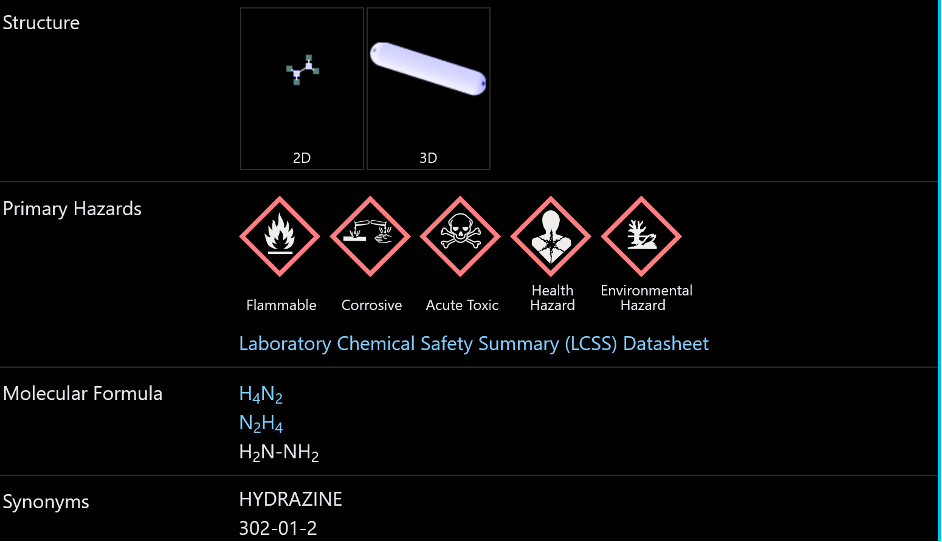
Figure 1. Properties of hydrazine anhydrous, PubChem. (Image credits: https://pubchem.ncbi.nlm.nih.gov/compound/Hydrazine)
Hierarchy of Controls to Reduce Hydrazine Exposure
Hydrazine anhydrous is a colorless, oily, fuming liquid with an ammonia-like odor. It evaporates into vapor at room temperature above 20 °C and at standard atmospheric pressure, when its spread widens. The risks that safety managers and industrial hygienists must handle are as follows:
Fire and explosion risk: Hydrazine anhydrous and its derivatives, monomethyl hydrazine and 1,1-dimethylhydrazine, are very flammable. Hydrazine decomposes into hydrogen, nitrogen, and ammonia in exothermic reactions that release heat and lead to fires and explosions. Moreover, the chemical can react with porous materials such as wood and paper, metals and metal oxides, and acids, causing auto-ignition without an external ignition source, even in the absence of oxygen. The ignition temperature depends on the substrate. Hydrazine vapors can travel back to the source of emission, causing flash back.
Poisonous gases such as ammonia and nitrogen oxides can be formed during a fire involving hydrazine.
Health risks: Hydrazines cause severe health problems with acute and chronic exposures. The usual routes of exposure are inhalation, dermal and eye contact, and ingestion. The effects are pulmonary, dermatological, neurological, hematological, and hepatic. Hydrazine is “Immediately Dangerous to Life or Health” (IDLH) at 50 ppm at acute exposures. Chronic exposures can be carcinogenic and mutagenic, so there is no truly safe level of exposure, even though the Occupational Safety and Health Administration (OSHA) allows a permitted emission level of 1 ppm averaged over an 8-hour shift.
Subscribe to receive our monthly round-up of articles.
The National Institute for Occupational Safety and Health (NIOSH) recommends using the hierarchy of controls to reduce the risk of hydrazine exposure in workplaces, especially in aerospace facilities and hazardous waste sites, where it is highest. The industries with hydrazine exposure risks include hydrazine producers; aerospace; agrichemical manufacturers; agricultural workers using chemical pesticides; pharmaceutical companies; facilities using hydrazine for corrosion control, such as water treatment; nuclear plants, thermal plants, and paper factories; plastic producers; clean energy biofuel and fuel cell producers; metal plating and producers; and chemical producers.
While hydrazine can decompose quickly within hours in the air, it remains intact in water for weeks and poses a health risk to aquatic life; therefore, care should be taken not to discharge hydrazine into water bodies.
The hierarchy of controls provides guidance and aims that safety managers and industrial hygienists in industry can follow to reduce occupational risks, as shown in Figure 1. Based on the risks and properties of hydrazine, the various measures advocated by prominent US agencies, mainly the New Jersey Department of Health, NIOSH, and CDC, are discussed below. The list of suggestions is not comprehensive, and given hydrazine’s dangerous and reactive nature, industries should consult experts before formulating the required safety measures and protocols.
The hierarchy of controls suggests five levels, as also shown in Figure 2:
- Elimination
- Substitution
- Engineering Controls
- Administrative controls
- Personal Protective Equipment
The effectiveness of the levels for controlling risks decreases from level 1 to level 5. In most cases, it will be necessary to implement multiple levels for maximum risk control. Hydrazine-specific suggestions for each control level are discussed in the following sections.
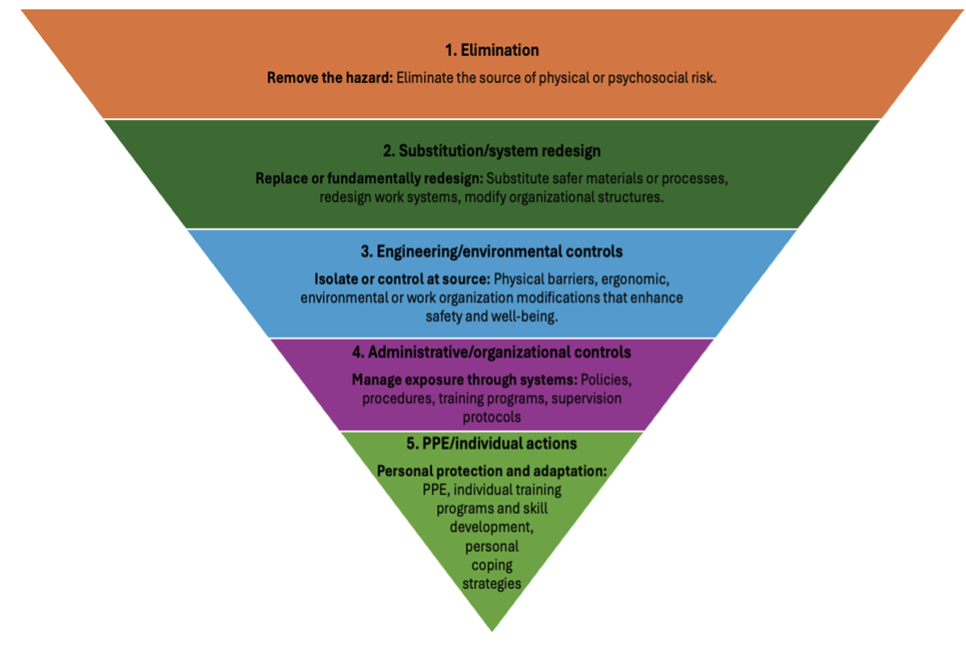
Figure 2: The common hierarchy of controls for reducing occupational risks, Winters and Howatt (2025). (Image credits: https://www.ohscanada.com/opinions/rethinking-the-hierarchy-of-controls-a-comprehensive-framework-for-modern-workplace-hazards/)
Elimination
The aim of the first level of control is to eliminate the source of risks. For hydrazine, a facility can end its use or redesign the process to eliminate the associated risks. While elimination is the most effective step, it can be hard to implement. Hydrazine was tested as an airplane fuel, but it caused an explosion. So, it was never used again as aviation fuel, making it the first and last time it was used as such, controlling any further risks to people.
Hydrazine is now used only for emergency landing in fighter planes.
Substitution
The next control is to substitute the hazardous material, in this case hydrazine, with a less dangerous one.
Some of its major applications include use as a corrosion inhibitor, a soldering flux, and a reducing agent. For these applications, substitutes for hydrazine are available. Japan has used alternative chemicals and technologies to manage boiler corrosion for several years.
However, substitutes may not always be successful. For example, the replacement chemicals used for corrosion control in power generation were less effective than hydrazine: 2-butanone oxime was very toxic, while other alternatives produced corrosive products.
In cases where successful substitution by alternatives is not possible, the next three controls should be considered to minimize risks to workers and facilities. These measures need input from experts because hydrazine is carcinogenic and a reproductive hazard.
Engineering Controls
Engineering controls are designed to reduce workers’ exposure to occupational hazards that cannot be eliminated in the workplace. When hydrazine cannot be eliminated or substituted from the process, the next best step is to ensure that people do not come in contact with it. Measures must also be taken to reduce the risk of accidental leaks and spills.
Some of the engineering controls useful for reducing hydrazine health, fire, and explosion risks
are listed below:
- Enclose the chemical processes so that hydrazine cannot spread unchecked through the facility, come into contact with people, or undergo autoignition. At temperatures above 40 °C, the vapor-air mixture can be explosive, so at high process or ambient temperatures, the vapors should be handled in a closed system.
- Ventilation can remove hydrazine vapors from the workplace. These can be general ventilation to reduce concentrations and subsequent effects of eye, skin, and pulmonary irritation. Local exhaust ventilation ensures that hydrazine levels near emission sources remain low, preventing acute hazardous effects from single exposures.
- Use dedicated dose-pumping systems to avoid direct exposure to hydrazine.
- Eliminate ignition risks by removing flares, flames, and sparks. Ground all equipment used to handle hydrazine. Use explosion-proof electrical equipment and fittings when hydrazine is used, handled, and stored.
- Install fixed gas sensors strategically to automatically and continuously monitor the air in both risky and stable areas of a facility. Many such fixed gas sensor systems can be connected to building management software, alarm systems, and control applications to shut down processes or machinery without human intervention. Fixed and portable gas sensors are crucial for detecting and identifying leak sources, including in confined spaces where hydrazine could have accumulated, creating an explosive environment.
- Reduce hydrazine levels in water before discharging effluents from the facility. While high temperatures in boilers break down hydrazine to less hazardous nitrogen, water, and ammonia, residual amounts can be removed to avoid environmental pollution of aquatic ecosystems. Some suggestions include using sodium hypochlorite to neutralize residual hydrazine and allowing time for hydrazine to degrade before discharge to the environment; using closed-loop water systems to achieve zero water discharge; and air injection into the water for aeration and faster hydrazine degradation.
The next two control levels can further reduce exposure to hydrazine.
Administrative Controls
Employers are responsible for developing administrative controls to change the flow of work or provide workers with information on occupational hazards and the safe work procedures to mitigate them.
For hydrazine, some of the administrative controls suggested are as follows:
- Conduct regular planned preventive maintenance of equipment.
- Educate workers on hydrazine risks through training, instructions, and easily accessible hazard and cautionary information.
- Develop emergency evacuation plans and train staff in readiness.
- Label containers with hydrazine. Store in a cool, dark, well-ventilated area away from any ignition source. Beware that containers can explode.
- Transfer hydrazine between containers in an enclosed area if possible.
- Reduce ignition risks. Forbid smoking and any other ignition source in areas where hydrazine is stored, handled, or used. Use non-sparking equipment to open and close hydrazine containers.
- Provide warnings of leaks or emergencies through signs, alarms (audio and visual), computer messages, etc.
- Enforce strict personal hygiene to prevent workers from carrying hydrazine home. Staff must wash at the end of the work shift. Work clothes cannot be taken home, not even for washing, especially if contaminated. Workers must be instructed to wash their hands before consuming any food or drink, applying cosmetics, or using the toilet.
- Do not allow eating and drinking in areas where hydrazine is handled.
- Provide eye washes and emergency showers.
- Before entering confined spaces, workers must check for hydrazine using a portable gas detector.
- Investigate reports of workers’ symptoms.
- Employees involved in firefighting must be trained and equipped in accordance with the US OSHA Fire Brigade Standard (29 CFR 1910.156).
- In case of an emergency, people should evacuate the area immediately. People in contact with hydrazine should flush their eyes for 30 minutes, remove contaminated clothing, shower, and seek medical help immediately. Artificial respiration and CPR are necessary if someone has stopped breathing.
Personal Protective Equipment
Personal protective equipment (PPE) is a last resort, but it is also widely used alongside other measures to control exposure to chemical and physical hazards. They include clothing and devices to protect workers, and must be accompanied by adequate training for proper use.
For hydrazine, the PPE for chemical exposure consists of a mask, safety glasses, impermeable gloves and clothing, and respirators.
- Eye protection is ensured by using goggles or a face shield to avoid contact with splashes or vapors. Use of contact lenses is not advised.
- Clothing and gloves protect the skin from contact with hydrazine and must be made of a material that is not degraded by hydrazine or is impermeable to it. Several standard recommended materials are used as protective materials for clothing, including headgear, footwear, suits, and gloves. Clothing should be maintained clean by employers and provided for daily use.
- Respiratory protection is necessary for people working in areas with potential exposure to hydrazine levels over 0.01 ppm. NIOSH-approved supplied-air respirator, including a full facepiece, is mandatory. It can be combined with a self-contained breathing apparatus for higher protection, since exposure to 50 ppm is IDLH.
Monitor Air with Intrinsically Safe Devices
The choice of the gas detectors for hydrazine can be vital. AccuSafe systems from Interscan are fixed systems that continuously monitor air and can be connected to building system software to control machines. Its data-logging capability is handy for identifying operational failures that cause leaks.
Given that hydrazine is explosive, intrinsically safe gas detectors, designed to prevent sparks or excessive heat, provide better protection, especially in confined spaces and high-risk workplace areas. Interscan is also introducing one of the very few intrinsically safe gas detectors for hydrazine on the market- the portable GASD IS®. Its design meets the IEC 60079-11 standards required by UL, which are the most stringent safety levels for monitoring explosive gases.
Contact us for more information and to place your order for the two gas detectors.
Sources
Cameo Chemicals NOAA. (n.d.). HYDRAZINE, ANHYDROUS. Retrieved from https://cameochemicals.noaa.gov/chemical/5019
Inchem. (n.d.). Hydrazine. Retrieved from https://www.inchem.org/documents/icsc/icsc/eics0281.htm
Ivanov I, Lee VR. Hydrazine Toxicology. [Updated 2023 Apr 23]. In: StatPearls [Internet]. Treasure Island (FL): StatPearls Publishing; 2026 Jan-. Available from: https://www.ncbi.nlm.nih.gov/books/NBK592403/
Kima, D., Mulyeb, H., & Jovanovicb, S. (2018). Reduction of Ecological Risk due to Hydrazine use at Nuclear Power Plants in Canada. Retrieved from
https://www.researchgate.net/publication/328964460_Reduction_of_Ecological_Risk_due_to_Hydrazine_use_at_Nuclear_Power_Plants_in_Canada
National Center for Biotechnology Information (2026). PubChem Compound Summary for CID 9321, Hydrazine. Retrieved from https://pubchem.ncbi.nlm.nih.gov/compound/Hydrazine.
New Jersey Department of Health. (2009). Hazardous Substance Fact Sheet- Hydrazine. Retrieved from https://nj.gov/health/eoh/rtkweb/documents/fs/1006.pdf
OSHA. 8n.d.). Identifying Hazard Control Options: The Hierarchy of Controls. Retrieved from https://www.osha.gov/sites/default/files/Hierarchy_of_Controls_02.01.23_form_508_2.pdf
STOP Carcinogens At work. (n.d.). The facts on Hydrazine. Retrieved from https://stopcarcinogensatwork.eu/fact/hydrazine/
UK Health Security Agency. (2025). Hydrazine- Incident management. Retrieved from https://assets.publishing.service.gov.uk/media/67cec269df94702964916068/UKHSA_Incident_Management_Hydrazine.pdf
Winters, T., & Howatt, B. (2025, July 2). Rethinking the hierarchy of controls: A comprehensive framework for modern workplace hazards. Retrieved from https://www.ohscanada.com/opinions/rethinking-the-hierarchy-of-controls-a-comprehensive-framework-for-modern-workplace-hazards/
—————————————————-