- Hydrazine is a fire and explosion risk because it is highly flammable at low temperatures, is very reactive, and is a strong reducing agent.
- Hydrazine is a serious health hazard that causes many acute and chronic diseases, because it is toxic, corrosive, and carcinogenic.
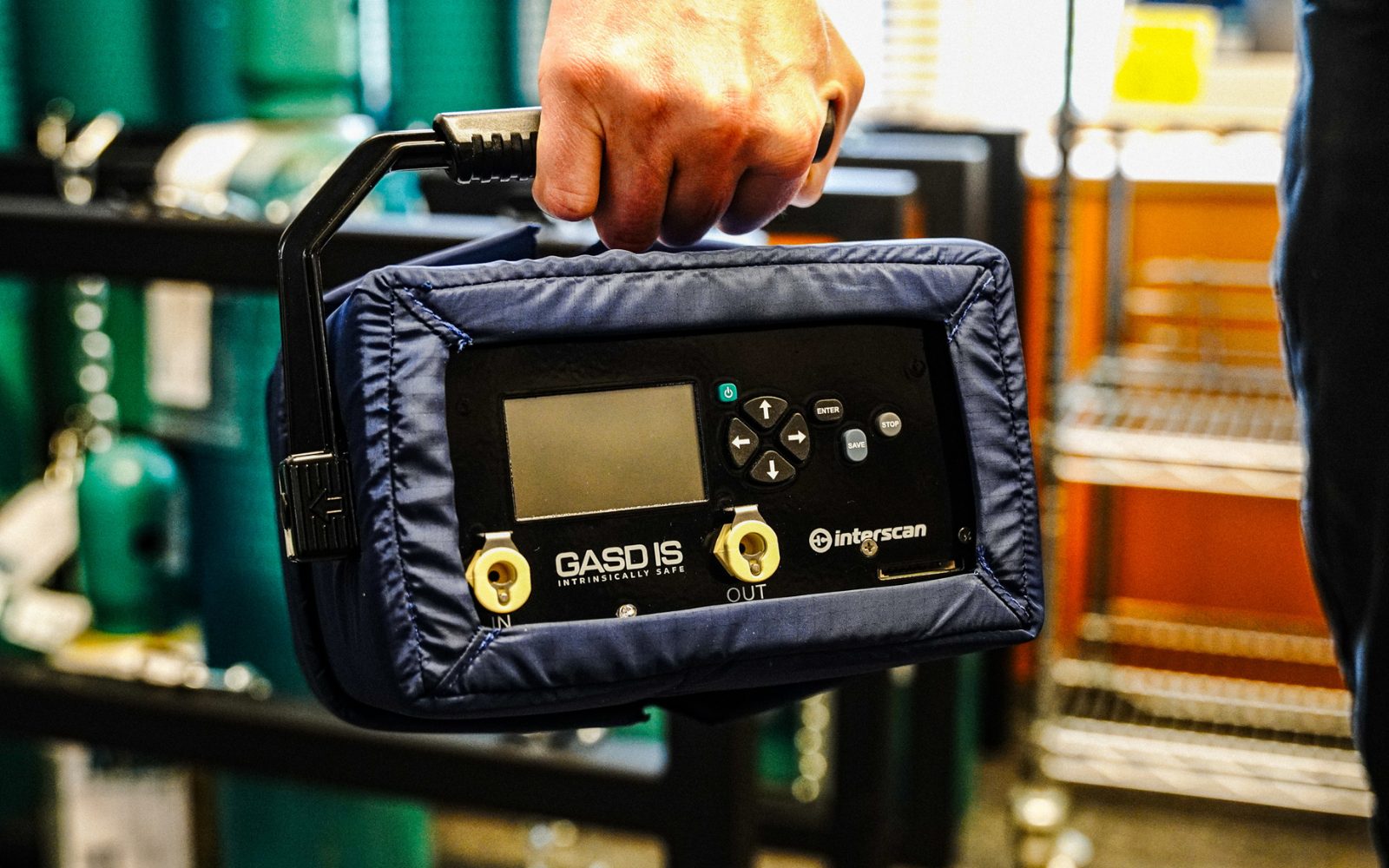
- Hydrazine requires an intrinsically safe gas detector, such as the GASD IS, designed for explosive environments to keep people and facilities safe.
Hydrazine has applications in many industries. Exposure to hydrazine mainly occurs in the workplace and is an occupational hazard, which is listed under the Right to Know Hazardous Substance List by several agencies. This article discusses its risks and the properties of the compound that make it dangerous for people.
Hydrazine Identity
Hydrazine is made of hydrogen and nitrogen and is the generic name for its dry and hydrated forms, and derivatives, which are as follows:
- Hydrazine anhydrous (N2H4) with a CAS (Chemical Abstracts Service) number 302-01-2, has a molecular weight of 32.05.
- Hydrazine monohydrate (N2H4 H2O) has a molecular weight of 50.06 and a CAS number of 7803-57-8.
- Other hydrazine compounds, such as monomethyl hydrazine and 1,1-dimethylhydrazine are also called hydrazines and are grouped with hydrazine anhydrous.
Various hydrazine products are commercially available and exhibit different physicochemical properties. This article is restricted to information on hydrazine anhydrous (or anhydride), which is also known as diamine and nitrogen hydride.
Hydrazine anhydrous (CAS number: 302-01-2)
Hydrazine is found only in small amounts in plants, and most of it is manufactured by variations of the Raschig process.\
According to ATSDR.CDC in the USA, in the 1950s and 1960s, 73% of hydrazine was used as rocket propellant. By 1982, other applications in the production of agricultural chemicals, pharmaceuticals, airbags for cars, and spandex fibers, for water treatment and nuclear fuel processing, and uses as a blowing agent for plastic production, boiler corrosion inhibitor, polymerization catalyst, reducing agent, and scavenger of other gases, had exceeded its use as rocket fuel, which had fallen to only 5%.
Hydrazine compounds, monomethyl hydrazine and 1,1-dimethylhydrazine, are used mainly as jet and rocket fuels today.
Physiochemical Properties of Hydrazine Anhydrous
Hydrazine anhydrous is a colorless, oily, fuming liquid with an odor similar to ammonia. The odor threshold is usually 3.7 ppm, but it can vary, and smell is not a reliable indicator of the chemical. Hydrazine is a liquid at 15°C and standard atmospheric pressure, but it evaporates at 20°C or ambient temperature. It has a vapor pressure of 14.4 mm Hg at 25°C (77°F).
Subscribe to receive our monthly round-up of articles.
Table 1. Physicochemical properties of hydrazine anhydrous (N2H4) and its derivatives according to Agency for Toxic Substances and Disease Registry (US). (Credits: https://www.ncbi.nlm.nih.gov/books/NBK595569/table/ch3.tab2/)
| Property | Hydrazine | 1,1-Dimethylhydrazine | 1,2-Dimethylhydrazine | Reference |
| Molecular weight | 32.05 | 60.10 | 60.10 | HSDB 1993 |
| Color | Colorless | Colorless | Colorless | HSDB 1993 |
| Physical state | Liquid | Liquid | Liquid | HSDB 1993 |
| Melting point | 2°C | −58°C | −9°C | HSDB 1993 |
| Boiling point | 113.5°C | 63.9°C | 81°C | WHO 1987 |
| Density | 1.0036 g/mL at 25°C | 0.7914 g/mL at 25°C | 0.8274 g/mL at 20°C | HSDB 1993; WHO 1987 |
| Odor | Ammoniacal, pungent, fishy | Ammoniacal, fishy | Ammoniacal | HSDB 1993; WHO 1987 |
| Odor threshold: | ||||
| Water | 160 mg/L | No data | No data | Amoore and Hautala 1983 |
| Air | 3-4 mg/m3 | 12-20 mg/m3 | No data | Ruth 1986 |
| Solubility: | ||||
| Water | Miscible | Miscible | Miscible | Budavari et al. 1989; HSDB 1993 |
| Organic solvent(s) | Miscible with alcohol, insoluble in chloroform and ether | Miscible with alcohol, ether, dimethyl formamide and hydrocarbons | Miscible with alcohol, ether, dimethyl formamide and hydrocarbons | ACGIH 1991a, 1991b; Budavari et al. 1989 |
| Partition coefficients: | ||||
| Log Kow | −3.08 | No data | No data | Radding et al. 1977; Poitrast et al. 1988 |
| −1.07 | ||||
| Log Koc | No data | No data | No data | |
| Vapor pressure | 10.4-16 mmHg at 20°C | 157 mmHg at 25°C | 68 mmHg at 24°C | HSDB 1993; Verschueren 1983; WHO 1987 |
| Henry’s law constant | No data | No data | No data | |
| Autoignition temperature | No data | 249°C | No data | |
| Flashpoint | 38°C (open cup) | −15°C (closed cup) | <23°C (closed cup) | HSDB 1993; WHO 1987 |
| Flammability limits | 1.8-100% | No data | No data | WHO 1987 |
| Conversion factors | 1 ppm = 1.31 mg/m3 | 1 ppm = 2.5 mg/m3 | 1 ppm = 2.5 ing/m3 | HSDB 1993; Verschueren 1983; WHO 1987 |
| 1 mg/m3 = 0.76 ppm | 1 mg/m3 = 0.407 ppm | 1 mg/m3 = 0.407 ppm | ||
| Explosive limits | 4.7-100% | 2-95% | No data | ACGIH 1991a, 1991b |
Flammability and explosive limits: Hydrazine is flammable between 1.8% and 100% and explosive between 4.7% and 100% by volume in air.
Unique heat exchanges: Hydrazine and its derivatives are highly endothermic and have high heats of combustion, and ignite when mixed with oxidizers such as ozone, dinitrogen tetroxide, and hydrogen peroxide.
- Heat of combustion: Substances with a high heat of combustion or that are exothermic are good, energy-efficient fuels because less fuel needs to be burnt to produce the required energy. It also makes hydrazine explosive.
- Endothermic heat: Materials with high endothermic capacity can absorb heat from the environment, thereby cooling it.
The unique combination of these two contrasting properties has enabled the use of hydrazine as a rocket fuel. When hydrazine and its derivatives are mixed with an oxidizing agent, such as dinitrogen tetroxide, ignition is not required to produce a fire. Once the fuel starts burning, hydrazine is broken down into simpler compounds, ammonia, nitrogen, and hydrogen, which release exothermic heat that can exceed 800°C within milliseconds, providing the required energy for the rocket. Ammonia breaks down further into hydrogen and nitrogen, providing thrust. Hydrazine can absorb excess heat generated by rockets traveling at hypersonic speeds of over Mach 5 (more than 6,100 km/hour). It acts as a heat sink, absorbing heat from parts that need cooling, thereby preventing explosions.
Therefore, hydrazine acts both as a rocket fuel and as a coolant. Hydrazine has been used primarily in missiles and space travel, for example, to land on Mars in 2012 and to propel the Juno spacecraft into Jupiter’s orbit in 2018.
Hydrazine is also used in fighter aircraft.
Due to its high heat of combustion, it is used as an environmentally friendly fuel in hydrogen fuel cells, producing energy as it breaks down into nitrogen and water, without the need for an expensive platinum catalyst. Hydrazine breaks down into oxygen, so it does not pollute the environment.
Alkaline and reducing agent: Hydrazine is a weak base, a strong alkaline and reducing agent, and is used to form many salts with acids. As a reducing agent, hydrazine is used to hydrogenate organic compounds and to prepare noble-metal catalysts. Its reducing properties make it an oxygen scavenger, helping control corrosion in boilers and water-heating systems and reducing metal oxides back to the metal.
Polymerization: Hydrazine, with its two nitrogen and four hydrogen atoms, is used to produce many derivatives such as agricultural chemicals- herbicides, fungicides, and plant growth regulators. This property is also useful to produce pharmaceuticals, polymers, chain extenders, cross-linkers, antioxidants, and foaming agents for plastics.
Ligand: Hydrazine is a good ligand. Ligands are neutral molecules or ions that bind to a central metal atom in a compound, acting as Lewis bases or electron donors. Hydrazine forms various complex heterocyclic compounds as a ligand.
Miscibility: Hydrazine dissolves in water and in alcohol or solvents such as methanol and ethanol. The compound is insoluble in ether and chloroform. Hydrazine anhydrous is highly hygroscopic and reacts with water in the air or in water bodies to form hydrazine monohydrate
Hydrazine auto-oxidizes in water, producing nitrogen and water.
Biodegradation in the environment: Hydrazine is classified as a “persistent substance” because its degradation rate was only 2% over four weeks, as measured by biochemical oxygen demand (BOD), and 0% by ion chromatography (IC). It can be degraded by nitrifying bacteria to nitrogen in aerobic conditions.
The properties of hydrazine explain not only its uses but also the risk it poses in workplaces.
Risks Posed by Hydrazine
Hydrazine is an occupational hazard due to its flammability, reactivity, corrosivity, toxicity, and carcinogenic properties; see Figure 1.
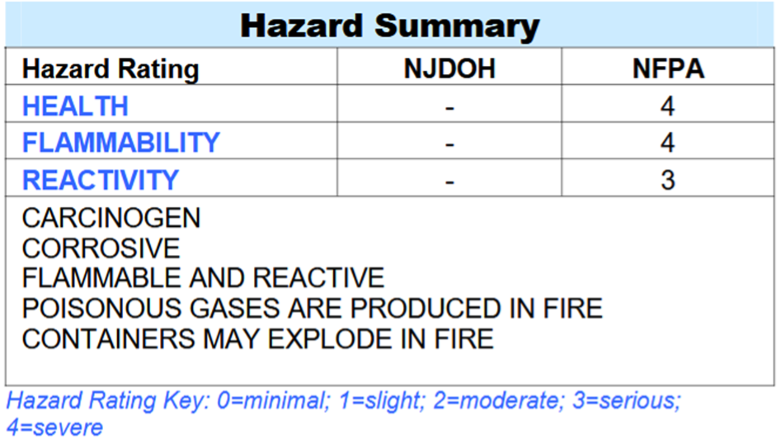
Figure 1: Hazard summary of hydrazine, New Jersey Department of Health. (Image credits: https://nj.gov/health/eoh/rtkweb/documents/fs/1006.pdf).
Fire and Explosion Risk
Hydrazine can decompose, producing ammonia, hydrogen, and nitrogen oxides that generate heat and can cause fires and explosions.
Hydrazine is highly flammable because it is highly reactive and a strong reducing agent, which can cause it to self-ignite. Air or oxygen is not necessary for the reaction in the following conditions:
- It reacts strongly when absorbed by porous materials such as asbestos, wood, cloth, and earth, unless cooled by ventilation.
- It can react strongly with oxidizing agents such as hydrogen peroxide, nitric acid, nitrous oxide, and metallic oxides, igniting spontaneously.
- Hydrazine can self-ignite at low temperatures (74°F) in air when in contact with a catalyst, such as rust on metals (metal oxides). Auto-ignition temperatures vary with substance- it is 74°F or 24°C for rusty iron and 270°C for a glass surface.
- Hydrazine reacts explosively with chemicals such as potassium and sodium dichromate, metals, and metal oxides, causing fires and explosions. Hydrazine reacts with alkali metals in the presence of ammonia to form explosive metal hydrazides.
Hydrazine also ignites from sparks, heat, and flames. At or above 40°C, mixtures with air can be explosive, so a closed system is necessary to handle the chemical. Vapor that ignites produces flashback when the fire travels back to the source. So, containers can explode in heat or fire.
The release of hydrazine into sewers can cause fires or explosions.
Health Effects
Hydrazine has negative health effects because it is corrosive to human tissues, carcinogenic, and toxic. Though hydrazine exposure mostly occurs in workplaces, it can be released into the environment through accidental discharges that pollute air, water, and soil during handling, storage, and waste disposal. However, it degrades rapidly in the environment, so it is rarely encountered by the general public. However, people can be exposed to hydrazine, which is found in tobacco smoke, in non-occupational situations.
Hydrazine enters the body by inhalation and through contact with the skin and eyes. People can suffer health problems due to acute and chronic effects and exposure. Hydrazine exposure’s toxic effects are seen in the neurological, hematological, pulmonary, dermatological, and hepatic systems.
Acute health hazards: Short-term health impacts from acute exposures result from its toxic and corrosive properties and affect the eyes, throat, and nose.
- Acute exposures can damage the kidneys, liver, and central nervous system. It causes dizziness, headaches, nausea, temporary blindness, seizures, shortness of breath, pulmonary edema, and coma.
- Hydrazine is highly corrosive and severely irritates and burns skin and eyes, where the eye damage can be permanent.
- The chemical is immediately Dangerous to Life or health (IDLH) at 50 ppm.
Chronic effects: Exposure can cause persistent effects over months or years.
- Hydrazine can damage the liver, kidneys, irritate the lungs, and cause bronchitis and skin allergy.
- The chemical could damage the developing fetus and the male reproductive system.
- Hydarzine is carcinogenic and causes cancers in the lungs, liver, and nasal cavity.
- Hydrazine is mutagenic and should be handled with care.
Permitted Levels
Given its various hazards and risks, the agencies that include hydrazine in the Right to Know Hazardous Substance List for workplaces are as follows:
- Occupational Safety and Health Administration (OSHA)
- The American Conference of Governmental Industrial Hygienists (ACGIH)
- National Institute for Occupational Safety and Health (NIOSH)
- S. Environmental Protection Agency (EPA)
- International Agency for Research on Cancer (IARC)
- Institutional Repository for Information Sharing (IRIS)
- National Fire Protection Association (NFPA)
According to the New Jersey Department of Health, the permitted levels of hydrazine in workplaces by various agencies are as follows:
- OSHA: The legal PEL (permissible exposure level) is 1 ppm averaged over an 8-hour shift.
- NIOSH: The REL (recommended airborne exposure limit) is 0.03 ppm in any 3-hour shift.
- ACGIH: The TLV (threshold limit value) is 0.01 ppm averaged over an 8-hour shift.
However, because hydrazine is carcinogenic, there is no safe level of exposure, so its concentration in the air should be kept as low as possible.
Controlling Hydrazine Levels
Since hydrazine is highly hazardous and its levels in the air should be minimal, continuous monitoring of the workplace air is essential to detect trace amounts. Strategically placed fixed gas analyzers can monitor the air around the clock. Interscan’s AccuSafe systems can monitor and record data to identify operational failures that cause leaks.
Interscan is also introducing the new GASD IS, a portable device designed for intrinsically safe use in highly hazardous, explosive conditions that hydrazine can create. The GASD IS® is one of the few detectors on the market that meet the highly specific requirements for intrinsically safe, trace-level detection using a hydrazine electrochemical sensor in a portable device.
GASD IS® is designed to meet the highest, most stringent safety standards required for monitoring explosive gases. In the USA, that is Class I, Zone 0 AEx ia IIC T4 Ga level.
- Instruments are “ia” suitable for Zone 0 or explosive gases.
- IS gas analyzers are designed for detecting IIC gases that need very little energy to explode, like hydrazine.
- The new device can handle T4 level temperatures, which is 135°C.
Interscan also offers its competitive quick-interchange sensor service for the new device.
Contact us for more information on our new, exciting intrinsically safe hydrazine gas detector.
Sources
(2025, March 19). The facts on Hydrazine. Retrieved from https://stopcarcinogensatwork.eu/fact/hydrazine/
American Chemical Society. (n.d.). CAS REGISTRY. Retrieved from https://www.cas.org/cas-data/cas-registry
ATSDR.CDC. (n.d.). Hydrazines-Production, Import, Use, and Disposal. Retrieved from
https://www.atsdr.cdc.gov/toxprofiles/tp100-c4.pdf
Cameo Chemicals NOAA. (1999). Hydrazine. Retrieved from https://cameochemicals.noaa.gov/chris/HDZ.pdf
Cameo Chemicals NOAA. (n.d.). HYDRAZINE, ANHYDROUS. Retrieved from https://cameochemicals.noaa.gov/chemical/5019
CDC. (n.d.). Hydrazine. Retrieved from https://www.cdc.gov/niosh/idlh/302012.html
Chemicals Evaluation and Research Institute (CERI), Japan. (2007, May). Hazard Assessment Report- Hydrazine. Retrieved from https://www.cerij.or.jp/ceri_en/hazard_assessment_report/pdf/en_302_01_2.pdf
EPA. (2016). Hydrazine. Retrieved from https://www.epa.gov/sites/default/files/2016-09/documents/hydrazine.pdf#
Fletcher-Wood, R. (2016, Aug 3). Hydrazine. Retrieved from https://edu.rsc.org/magnificent-molecules/hydrazine/2000023.article
Inchem. (n.d.). Hydrazine. Retrieved from https://www.inchem.org/documents/icsc/icsc/eics0281.htm
Jacoby, M. (2018, April 30). Cool fuel for hypersonic aircraft. Retrieved from https://cen.acs.org/energy/fossil-fuels/Cool-fuel-hypersonic-aircraft/96/i18
Ivanov I, Lee VR. (2023, Apr 23). Hydrazine Toxicology. In: StatPearls [Internet]. Treasure Island (FL): StatPearls Publishing; 2026 Jan-. Available from: https://www.ncbi.nlm.nih.gov/books/NBK592403/
Monas University. (n.d.). Exothermic and endothermic reactions. Retrieved from https://www.monash.edu/student-academic-success/chemistry/carbon-based-fuels/exothermic-and-endothermic-reactions
National Center for Biotechnology Information (2026). PubChem Compound Summary for CID 9321, Hydrazine. Retrieved from https://pubchem.ncbi.nlm.nih.gov/compound/Hydrazine.
New Jersey Department of Health. (2009, Nov). Right to Know Hazardous Substance Fact Sheet-Hydrazine. Retrieved from https://nj.gov/health/eoh/rtkweb/documents/fs/1006.pdf
Rothgery, E. F. (2000). Hydrazine and its derivatives. Kirk‐Othmer Encyclopedia of Chemical Technology.
Toxicological Profile for Hydrazines. Atlanta (GA): Agency for Toxic Substances and Disease Registry (US); 1997 Sep. TABLE 3-2, Physical and Chemical Properties of Hydrazines. Available from: https://www.ncbi.nlm.nih.gov/books/NBK595569/table/ch3.tab2