- Gases caused two-thirds of all industrial accidents between 2004 and 2019.
- The gases that caused most of the accidents were ammonia, followed by chlorine, chlorine dioxide, and hydrogen fluoride.
- The amount of gas released is not always related to the potential for accidents with the chemicals.
According to the International Council of Chemical Associations, 40,000 to 60,000 industrial chemicals are used or produced in amounts of over 1 metric ton per year. Of them, 6000 chemicals account for 99% of commercial use. Countries around the world are taking strict measures to limit chemical-related accidents, since many chemicals pose hazardous occupational risks and environmental pollutants. Despite these measures, four chemicals have been found to persistently cause industrial accidents over the past twenty years, up to 2023.
EPA’s Risk Management Program
The US Environmental Protection Agency (EPA) provides regulations and guidance to prevent chemical accidents in industries as stipulated by “Section 112(r) of the 1990 Clean Air Act Amendments.”
In 1996, the EPA launched the Risk Management Program (RMP), which requires industrial facilities that handle hazardous materials to conduct hazard assessments, identify accident-prevention measures, and develop emergency response plans. RMPs must be prepared by industries that use 140 hazardous chemicals at or above a threshold level every 5 years. RMPs are developed using existing industry codes and standards
The RMPs provide critical information for local emergency, fire, and police departments to prepare and respond to chemical emergencies. Sharing RMPs with the public can raise awareness, which is useful for accident prevention and local emergency response, as many chemical accidents can spread beyond industrial facilities.
The EPA maintains a record of all facilities that must be regulated in the USA. These regulated facilities must also identify and report accidents that have occurred in the previous five years, along with their impacts. The reportable impacts include onsite injuries and fatalities, as well as property damage. The report must also include the off-site impacts outside the facilities on local communities in the surrounding area, such as off-site hospitalizations, injuries, and fatalities; the number of people evacuated; and off-site property and environmental damage, such as destruction of trees and animals, and surface water contamination.
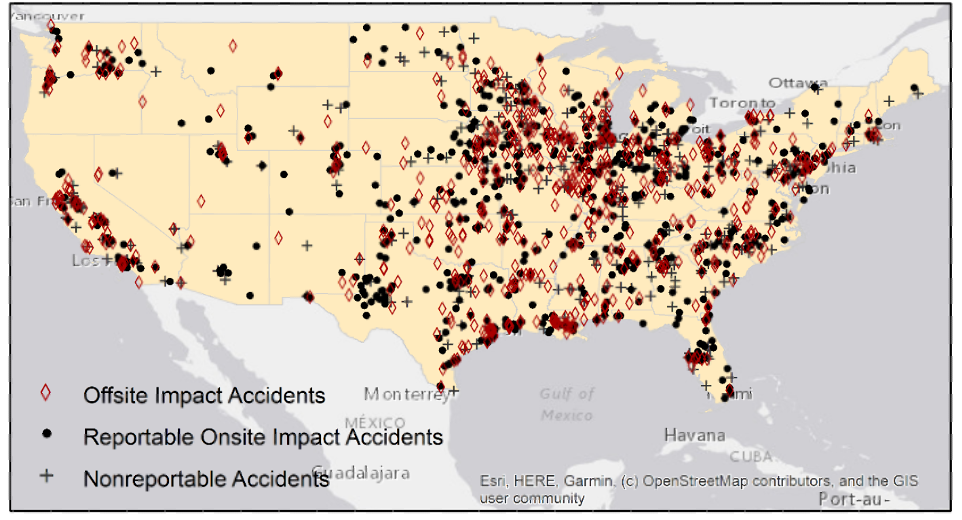
Figure 1: RMP accident sites in the USA between 2004 and 2019, Guignet et al. (2023). (Image credits: https://www.epa.gov/system/files/documents/2023-02/2023-01_0.pdf)
Subscribe to receive our monthly round-up of articles.
What RMPs Reveal About Accidents
The EPA’s RMP national database contains records of accidents, covering events that occurred up to five years prior to 1999, the date the program started. According to the 2023 EPA report, 1,822 facilities have reported at least one chemical accident during this period, as shown in Figure 1. Though the accidents have occurred across the country, concentrations are higher along the East Coast, in the Gulf of Mexico, in the Rust Belt, which has been a manufacturing hub, and in parts of California and the Northwest.
Between 2004 and 2019, 1822 regulated RMP facilities reported 3,236 chemical accidents; see Figure 1. Of these accidents
- 961 (29.7%) did not cause reportable injuries, deaths, or damage to staff or local communities (marked by a cross in Figure 1).
- 2275 (70.3%) accidents had reportable damage (marked by black dots),
- almost 25% (789 incidents) affected people outside the facilities (marked by red diamonds).
According to the 2023 EPA report, the most common industries reporting accidents are as follows:
- Farm suppliers – 13.1%
- Chemical manufacturers – 7.7%
- Refrigerated storage and warehousing – 6%
- Petroleum refineries – 5%
- Poultry processing – 5%
- Irrigation and water supply systems – 4.9%
Most facilities (68.5%) report only one accident, and 31.5% report multiple accidents. One facility has reported 30 accidents.
Table 1: “Chemical accident descriptive statistics,” EPA. (Credits: https://www.epa.gov/system/files/documents/2023-02/2023-01_0.pdf)
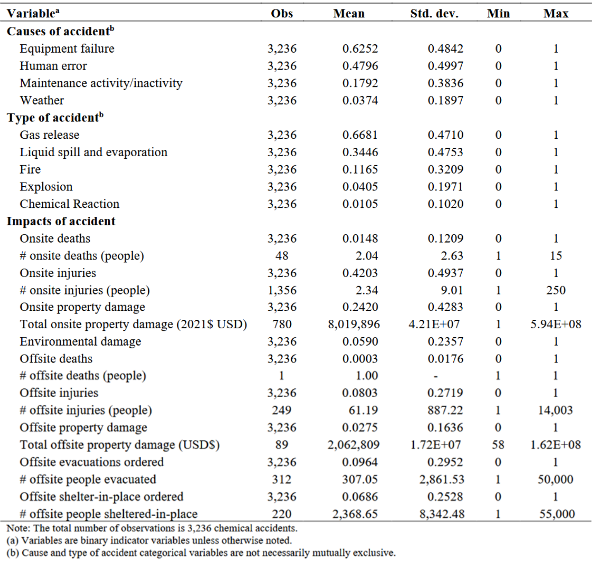
The 2023 EPA report found that the accidents were mainly due to equipment failure (62.5%), followed by human error (47.9%), maintenance activity (17.9%), and weather (3.7%), as shown in Table 1.
The risks from chemicals that were involved in the accidents were mainly gases, followed by liquid spills, as shown in Table 1:
- Hazardous gases caused 66.8% or two-thirds of the accidents
- Liquid spills and evaporation caused 34.5% of accidents
- Fires were responsible for 11.6% of accidents
- Explosions caused 4% of accidents
- Uncontrolled chemical reaction 1% accidents.
The Gases Causing Accidents
Axios identified the chemicals responsible for most of these accidents by analyzing RMP data accessed through the Data Liberation Project. The Data Liberation Project collects and reformats government datasets in obscure, difficult-to-use formats, often published without documentation for interpretation. The project reaches out to communities and newsrooms that can benefit from the data.
Axios found that the top chemicals responsible for these accidents were gases- ammonia, chlorine (and chlorine dioxide), and hydrofluoride.
-
Ammonia
The chemical that caused the most accidents among facilities that submitted RMPs to the EPA was ammonia (NH3).
Ammonia is a colorless gas with a distinct odor, which is hazardous because it is corrosive, flammable, and toxic. Ammonia is commonly associated with farm suppliers, chemical production, poultry processing, refrigerated warehousing and storage, and petroleum refineries.
Around 80% of ammonia is used as fertilizers or to make other fertilizers. In 2023, EPA found that ammonia accounted for the most air releases-around 24%, and 43% were from the nitrogen-based fertilizer manufacturing sector. The second-highest ammonia user is the refrigeration sector for food processing, storage, and ice production. Accidents are also common in facilities that manufacture ammonia and in industries that use it to make other chemicals.
Ammonia is also a major pollutant that contributes to particulate matter, which harms people’s environmental health. It can be deposited on vegetation, increasing pest and disease incidence and leading to local species loss and eutrophication of water bodies.
-
Chlorine and Chlorine Dioxide
Chlorine and chlorine dioxide together are the second-most-common chemical causes of accidents in industry. Chlorine is not among the ten most commonly released gases, yet it causes the second-highest number of accidents.
Chlorine (Cl2) is a yellowish-green gas that is hazardous because it is flammable, toxic, and corrosive. The industries that use the most chlorine are chemical manufacturers and water treatment facilities. It is used as a disinfectant for treating municipal drinking water and wastewater treatment.
Chlorine dioxide (ClO2) is a reddish-yellow gas that is dangerous because it is highly flammable and reactive. It is also toxic with acute and long-term impacts on the health of workers. Like chlorine, it is primarily used for disinfecting water and sanitizing food-processing facilities.
Both compounds are used for bleaching pulp, paper, and textiles.
-
Hydrogen Fluoride
Hydrogen fluoride gas (HF) causes the third-highest number of accidents in industries. It is a colorless, fuming gas that readily dissolves in water to form hydrofluoric acid. Unlike other acids, hydrofluoric acid is highly lipophilic and readily penetrates the skin into underlying tissues. It can also be inhaled and become life-threatening.
It is dangerous as it is very toxic and reactive. It can react with metal to produce flammable and explosive gases, and mixes with water to form toxic and corrosive gases. Around 60% of HF is used to make refrigerants. The rest is used to produce chemicals (herbicides, plastics, and pharmaceuticals) and in oil refineries.
The four gases are associated with one or more of the six industries that EPA has identified as having the most accidents.
Preventing Accidents
According to a 2024 EPA report, toxic chemical releases have decreased by 21% over the prior 10 years. One reason is a 6.5% increase in pollution-prevention activities. As part of the facilities’ efforts to prevent accidents as required under RMPs, safety managers should follow the hierarchy of controls. One of the engineering controls is monitoring the air for any leaks and increases in levels of hazardous gases, especially the four gases that cause the most. Fixed continuous gas monitors with audio and visual signals can alert staff to even the slightest increase above permitted levels. Similarly, portable gas detectors should be used by all personnel entering confined spaces. The stored data can be used to identify problems that lead to leaks and accidents.
Interscan offers both fixed AccuSafe and portable GASD 8000 and GASD IS detectors that measure gas concentrations in ppm (parts per million) and ppb (parts per billion), for over 20 gases, including ammonia, chlorine, and chlorine dioxide. These instruments can detect even the smallest leaks, allowing time for corrective action, staff evacuation from the premises, and contacting the relevant emergency response departments to reduce the risk of accidents or damage.
Contact us at Interscan to find out more about our precision gas detectors.
Sources
Anderson, A. R., & Centers for Disease Control and Prevention (CDC) (2015). Top five chemicals resulting in injuries from acute chemical incidents—Hazardous Substances Emergency Events Surveillance, nine states, 1999-2008. MMWR supplements, 64(2), 39–46. PMID: 25856537
CDC. (2024, Sept 6). Hydrogen Fluoride. Retrieved from https://www.cdc.gov/chemical-emergencies/chemical-fact-sheets/hydrogen-fluoride.html
EPA. TRI National Analysis- Air Releases. Retrieved from https://www.epa.gov/trinationalanalysis/air-releases
Guignet, D., Jenkins, R.R., Nolte, C., and Belke, J. (2023, Feb). The External Costs of Industrial
Chemical Accidents: A Nationwide Property Value Study. Retrieved from https://www.epa.gov/system/files/documents/2023-02/2023-01_0.pdf
ICCA. (n.d.). Debunking the Myths: Are there more than 100000 chemicals in commerce? Retrieved from https://icca-chem.org/focus/chemicals-management/chemicals-in-commerce
Lysik, T., & Reed, T. (2023, Sept 22). 3 chemicals account for most accidents. Retrieved from https://www.axios.com/2023/09/22/chemicals-accidents-epa-ammonia-chlorine
Michigan State University. (n.d.). Hydrofluoric acid. Retrieved from https://ehs.msu.edu/lab-clinic/chem/hydrofluoric-acid.html
New Jersey Department of Health and Senior Services. (2005). Hazardous substance fact sheet- Chlorine Dioxide. Retrieved from https://nj.gov/health/eoh/rtkweb/documents/fs/0368.pdf
New Jersey Department of Health and Senior Services. (2017). Hazardous substance fact sheet- Hydrogen fluoride. Retrieved from https://nj.gov/health/eoh/rtkweb/documents/fs/qr/3759qr.pdf
The Data Liberation Project. (2026, Jan 22). EPA Risk Management Program Database. Retrieved from https://www.data-liberation-project.org/datasets/epa-risk-management-program-database/