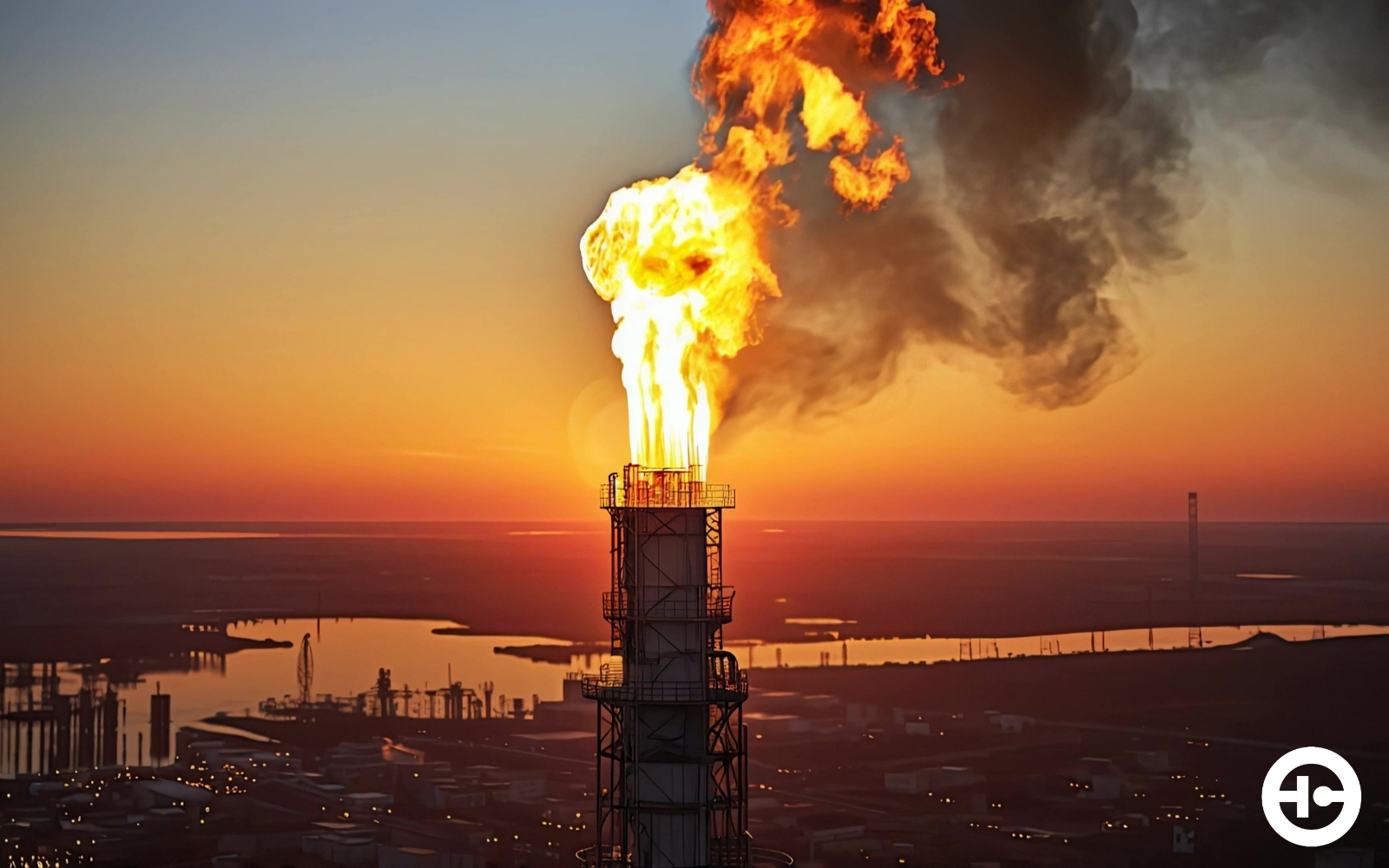
- Organic gases and vapors are primarily fire and explosion risks, but some can also be toxic.
- Risks from exposure to inorganic gases arise from their toxic, asphyxiant, and flammable properties.
- Common gas properties of density, concentrations, temperature, pressure, and ventilation can influence the risk posed by inorganic and organic gases.
Gases occur in most industrial sectors, as raw materials or products of processes. Accidental leaks can expose workers to hazardous gases. Understanding these gases and their properties can help safety managers and industrial hygienists in controlling them. In this article, we discuss inorganic and organic gases, the two major groups of chemicals that can threaten workers and the facilities.
Gas Properties
The atmosphere in industrial facilities can have gases and vapors that can harm people and property. Gases and vapors can be described and differentiated by their thermodynamic properties, in particular, critical temperature and pressure; see Table 1.
Table 1: The critical temperature and pressure of four gases based on Purdue.edu.
| Substance | Critical temperature (oC) | Critical pressure (atm) |
| Ammonia | 132 | 115 |
| Oxygen | -119 | 49.7 |
| Carbon dioxide | 31.2 | 73.0 |
| Water | 374 | 217.7 |
Gases: Chemicals that exist in only a gaseous state at atmospheric temperature and pressure are called gases. Gases cannot be liquified at the same temperature by increasing pressure, as they exist in the gaseous phase above their critical temperature. Gases are hard to convert to liquids, but it can be done by applying pressure at a suitable temperature.
Vapors: These are chemicals that are primarily liquids or solids at room temperature but are also present and coexist as gases at these temperatures. Vapors form when a substance is below its critical temperature. Vapors can be returned to their normal state (liquid or solid) easily by increasing pressure without lowering the temperature. For example, water is a liquid at room temperature and in the atmosphere, but can also exist as vapor.
Gases are ubiquitous in the air and necessary for our survival. The air has 78% nitrogen and 21% oxygen, with the remaining 1% consisting of hydrogen, helium, water vapor, carbon dioxide, ozone, methane, chlorofluorocarbons, etc. Oxygen is vital for the survival of most animals and plants, and carbon dioxide and nitrogen are essential for plant growth. A higher proportion of nitrogen helps in diluting oxygen, preventing fires from starting on Earth’s surface. However, even oxygen at concentrations above or below its normal levels can be harmful.
Gases are considered more dangerous than liquids and solids in workplaces because they are hard to detect, react more quickly, are compressible, spread in multiple ways, and undergo changes in density with temperature.
Organic vs Inorganic Chemicals
Hazardous gases found in industries can be classified into two broad groups based on their chemistry: inorganic and organic.
- Organic: Organic chemicals are compounds that have carbon along with other elements, excluding carbonates and oxides.
- Inorganic: The list of inorganic chemicals includes all chemicals that are not organic compounds and carbon compounds that lack carbon-hydrogen bonds.
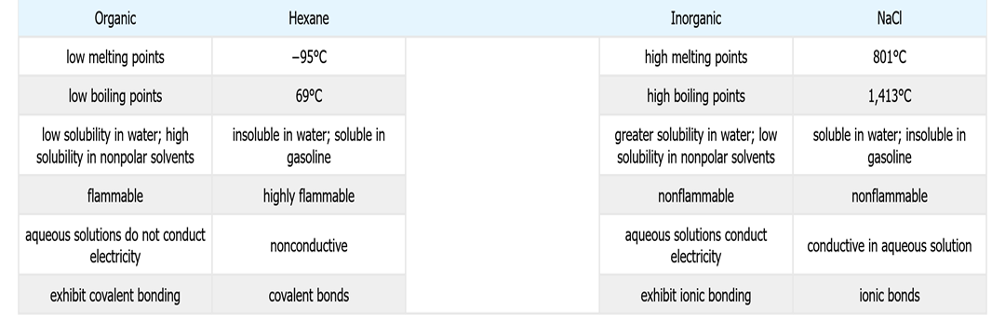
Some common differences between organic and inorganic compounds include melting and boiling points, solubility, flammability, bonding, and electrical conductivity; see Table 2. The classification is useful for understanding major uses across industries, as it describes some common properties and dangers, though exceptions exist.
Table 2: “General Contrasting Properties and Examples of Organic and Inorganic Compounds,” LibreTexts.
Organic Gases
All living beings are composed of organic compounds, and life on Earth is described as carbon-based. There are around twenty million organic compounds, outnumbering inorganic chemicals.
Carbon can form stable covalent bonds with other carbon atoms and with atoms of hydrogen, oxygen, and many other elements. It produces long chains or rings of carbon atoms attached to other elements. Organic chemicals can be simple, single-carbon compounds (for example, methane, CH4) to very complex compounds with thousands of carbon atoms. Organic compounds are divided into functional groups based on specific chemical properties, and homologous series are compounds with the same functional groups; for example, CnH2n are called alkenes, and CnH2n+2 are called alkanes. The first few members of a homologous series are gases or liquids, followed by solids.
Organic gases have low melting points, low boiling points, low solubility in water, but high solubility in nonpolar solvents; see Table 2. Aqueous solutions of organic gases do not conduct electricity. The organic gases are highly flammable, and this property poses the greatest hazard in industrial settings. Gases present in concentrations between the Lower Explosive Limits (LEL) and Upper Explosive Limits (UEL) can result in fires and explosions.
However, organic gases can also be toxic and pose an asphyxiation risk at concentrations lower than the LEL. Four out of five gases that can cause occupational cancer are organic compounds: 1,3-butadiene, benzene, ethylene oxide, and formaldehyde.
According to the European Agency for Safety and Health at Work, hydrocarbons produced in the petrochemical industry can be toxic, and the number of carbon atoms in them determines acute toxicity. However, the chronic effects of these gases could be very dangerous:
- Gaseous hydrocarbons with 1-4 carbons (C1-C4) have the least acute toxicity. However, aromatics can have more toxic effects at low concentrations during acute exposure. Moreover, chronic exposure to ethylene oxide (C2H40) can cause several cancers in workers and people in the area near industries using or producing ethylene oxide.
- Hydrocarbons with C5 to C9 have acute necrotic effects.
- Hydrocarbons above C12 are acutely toxic by inhalation at low exposures, with toxicity increasing with the number of carbon atoms, but this toxicity is offset by reduced volatility.
Common Organic Gases in Industries
Organic gases are used in industries, but are also produced as byproducts in the chemical and petrochemical industries.
- Chemical byproducts: During ethylene production, many hazardous organic gases are produced, for example, ethylene oxide, ethylene dichloride, butadiene, ethanol, vinyl acetate, styrene, and olefins. Ethylene oxide and butadiene are very toxic gases.
- Petrochemical byproducts: Solvents are byproducts of petrochemical processing but are also useful products that can cause health effects and fires at higher concentrations when improperly handled, as in the healthcare sector. Examples of solvents that produce vapors include formaldehyde, aliphatic heptane, toluene, methyl ethyl ketone, dichloromethane, triethylamine, and green solvents such as methanol and ethanol.
Several organic gases, such as methane, butane, acetylene, and propane, used as fuel sources, can pose fire and explosion risks due to mishandling of cylinders and accidental leaks.
- Methane is a common industrial fuel.
- Liquid petroleum gas (LPG) used as a domestic fuel is a mixture of propane and butane.
- Acetylene is used in welding and cutting.
Inorganic Gases
Inorganic chemicals include all 118 elements in the periodic table, and the compounds they form. Inorganic compounds are made of two or more elements and involve metal and ionic bonds and form oxides, halides, and chalcogenides. Inorganic compounds can have carbon, such as carbon monoxide, carbon dioxide, carbides, carbonates, cyanates, cyanides, and thiocyanates.
Many of the gases in the air are inorganic, such as oxygen, carbon dioxide, nitrogen, and ozone. Inorganic gases are also common as raw materials and byproducts in several industries. Although the number of organic compounds is higher, four inorganic gases account for the most chemical injuries, evacuations, and deaths across industries: ammonia, carbon monoxide, hydrogen sulfide, and chlorine.
The inorganic gases have high melting and boiling points, higher solubility in water than in nonpolar solvents, and can conduct electricity in aqueous solution. These inorganic gases are usually nonflammable, though some exceptions exist. The hazards posed by inorganic gases are primarily due to their toxic, asphyxiant, and corrosive properties:
Asphyxiation risk: The inorganic gases that pose asphyxiation risk are carbon dioxide (CO2), nitrogen, water vapor, helium, nitrous oxide, hydrogen sulfide (H2S), and argon. When the concentrations of these gases increase, they displace or reduce the concentrations of oxygen below normal, suffocating workers in these environments or confined spaces, ultimately causing death.
Toxic inorganic gases: Several inorganic gases are poisonous and can affect multiple organs, including the respiratory, cardiovascular, nervous, and circulatory systems, as well as the eyes and skin. Toxic gases can affect human health through several modes of action. Examples of toxic inorganic gases are arsine, ammonia, CO2, carbon monoxide, chlorine, fluorine, hydrogen chloride, hydrogen fluoride, H2S, ozone, nitrogen oxides, sulfur dioxide, phosgene, silane, and stibine.
Flammable inorganic gases: Many inorganic gases are also flammable, like ammonia, arsine, hydrogen sulfide, carbon monoxide, phosphine, silane, and stibine.
The general properties of inorganic and organic gases can serve as a guide, but because of overlapping properties, industrial hygienists and safety managers should research the individual gases found in their facilities to assess the risks they pose.
Preventing Occupational Hazards
Regardless of whether gases are organic or inorganic, common factors that can increase occupational risks include the gas’s relative density, temperature, and pressure, as well as ventilation and climatic conditions. Industrial hygienists and safety managers can use the hierarchy of controls to minimize risks. Gas analyzers are a must for continuous monitoring of the air, ensuring that gas levels remain below permissible levels to prevent ill health and below LEL to prevent fires and explosions. Portable gas detectors can be used before entering confined spaces to check for hazardous gases. Interscan offers both fixed gas detectors for continuous monitoring and portable detectors for spot checks for over 20 organic and inorganic gases.
Contact us to learn more about the portable gas detector GASD 8000, the GASD IS, and the AccuSafe for fixed gas detection to keep your staff and facilities safe.
Sources
Alharbi, B. H., Pasha, M. J., & Al-Shamsi, M. A. S. (2021). Firefighter exposures to organic and inorganic gas emissions in emergency residential and industrial fires. Science of the Total Environment, 770, 145332.
Bezverkhniy, V. (2019). The Amount of Organic Compounds. SSRN Electronic Journal 2(28).
http://dx.doi.org/10.2139/ssrn.3469654
Gardner, R., ‘Use of the reciprocal calculation procedure for setting workplace emergency action levels for hydrocarbon mixtures and their relationship to lower explosive limits, ”Annals of Occupational Hygiene”, Vol. 56, No 3, 2012, pp. 326-339.
Griffiths, S. D., Entwistle, J. A., Kelly, F. J., & Deary, M. E. (2022). Characterising the ground level concentrations of harmful organic and inorganic substances released during major industrial fires, and implications for human health. Environment international, 162, 107152.
OSH WIKI. (2016, Mar 1). Gases. Retrieved from https://oshwiki.osha.europa.eu/en/themes/gases
Purdue.Edu. (n.d.). Critical Temperature and Pressure. Retrieved from https://www.chem.purdue.edu/gchelp/liquids/critical.html