Choosing between single-point vs multi-point gas detection is ultimately a facility planning decision. The question is not simply how many detectors you can install. It is how many locations need continuous coverage, how operators need to receive information, and how the detection system should respond as the facility changes. A single monitoring point can be entirely appropriate for a localized, predictable hazard. Multi-point monitoring becomes more useful when several rooms, processes, or potential release locations need to be watched at the same time.
The distinction is also different from single-gas versus multi-gas detection. “Point” refers to the physical monitoring location. A facility can have several monitoring points dedicated to the same gas, or several points configured for different target gases.
What Is Single-Point Gas Detection?
A single-point system monitors one selected location. That point might be near chemical storage, a process vessel, a sterilization area, a gas cabinet, or another known potential release source.
Single-point monitoring makes sense when the risk is tightly defined. If a facility has one room where a particular toxic gas is stored and used, installing a detector specifically for that location can provide continuous monitoring without creating an unnecessarily complex system.
A single-point architecture can offer several practical benefits:
- Straightforward installation and configuration
- Local concentration readings and alarms
- Lower initial system complexity
- Easier troubleshooting when only one hazard location is involved
- A clear relationship between the detector and the hazard it monitors
Interscan’s AccuSafe platform can operate in this type of configuration. Optional local displays and alarms allow individual sensors to operate independently when centralized multi-point monitoring is not required.
The important question is whether one location actually represents the full risk. Facility layouts and operating procedures often become more complicated over time.
Subscribe to receive our monthly round-up of articles.
When Multi-Point Gas Detection Becomes Necessary
Multi-point gas detection uses sensors at several selected locations while bringing their measurements into a broader monitoring architecture.
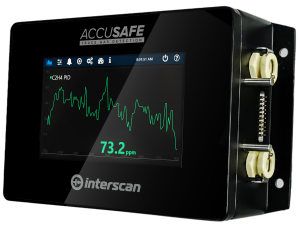
With the AccuSafe fixed-point gas detection system, a single controller can support up to ten smart sensor modules. Those sensors can be distributed among rooms, process areas, equipment locations, or other risk zones. The system can also be configured to monitor up to ten unique gases simultaneously.
Accusafe
This architecture is particularly useful when gas hazards are associated with multiple locations, such as:
- Several chemical storage or handling areas
- Multiple production lines
- Gas transfer and distribution systems
- Rooms with separate potential release sources
- Large processing environments
- Facilities where operators need centralized visibility
AccuSafe uses active, continuous sampling at each sensor module. Each module incorporates a sample draw pump and performs data acquisition and processing locally before sending information through the network.
That distributed approach means multi-point monitoring is not simply several basic detectors connected to one display. Each monitoring location acts as an intelligent measurement point within the larger system.
For a closer comparison of these architectures, see Interscan’s guide to AccuSafe multi-point monitoring versus standalone transmitters.
Start With the Hazard Map, Not the Detector Count
When evaluating single-point vs multi-point gas detection, avoid starting with a predetermined number of sensors.
Instead, map where gas could realistically appear.
Review potential release sources such as valves, fittings, cylinders, process equipment, storage locations, transfer points, and areas where hazardous gases are generated or consumed. Then consider how released gas could travel.
Air movement matters. So do equipment placement, ventilation, operating temperature, gas characteristics, worker locations, and physical obstructions.
A single detector positioned next to one obvious release source may work well when that source represents the dominant risk. In a facility with multiple sources or several occupied zones, relying on one monitoring point can create coverage gaps.
Sensor placement therefore matters just as much as sensor quantity. Interscan’s article on how to place gas detectors for optimal safety and accuracy covers the main placement considerations in more detail.
Consider How Operators Need to See the Data
The difference between single-point and multi-point architectures also appears at the operator level.
With one independent monitoring point, local readings and alarms may be enough. The employee responsible for the area can see the concentration and respond when the detector enters an alarm condition.
As the number of points grows, centralized visibility becomes more valuable.
AccuSafe Connect provides a 5-inch touch display and supports access through a remote web browser, desktop application, and MQTT API. Communication options include Modbus TCP and RTU. The system can also provide sound, email, and SMS notifications.
For a multi-point facility, this means personnel do not have to walk to every individual detector to understand facility conditions. Several monitoring locations can feed information into one connected environment.
That becomes especially valuable during an alarm. Knowing that one detector has activated is useful. Seeing how readings compare across several locations can give operators additional context for evaluating where a release may be occurring and how conditions are changing.
Think About Future Expansion
Facility planning should account for tomorrow’s monitoring requirements as well as today’s.
A site might currently have one high-risk area but already be planning another production line, additional chemical storage, or a process expansion.
This is where the single-point vs multi-point gas detection decision becomes an architecture question.
Installing one completely independent detector may address the immediate requirement. Choosing a scalable platform can provide the same single-point coverage while leaving a clearer path to additional monitoring points later.
AccuSafe supports both configurations. A facility can begin with a limited deployment and build toward a connected monitoring network as requirements grow.
This approach can reduce the need to reconsider the entire monitoring architecture every time another location needs protection.
Do Not Ignore Portable Monitoring
Fixed monitoring does not eliminate the need for portable gas detection.
A multi-point fixed system continuously watches the locations where its sensors are installed. A portable analyzer can investigate other areas, verify conditions during maintenance, conduct surveys, or help personnel evaluate unusual readings.
For example, the Interscan GASD 8000 provides active sampling, real-time concentration readings, graphical data, alarms, and onboard data logging in a portable format.
In many facilities, fixed and portable systems therefore perform complementary jobs. The fixed system watches established risks continuously, while portable equipment gives industrial hygiene and safety teams flexibility outside the permanent sensor network.
Interscan covers this relationship further in its comparison of GASD 8000 and AccuSafe for industrial gas monitoring.
A Practical Planning Framework
When evaluating single-point vs multi-point gas detection, work through these questions:
- How many credible gas release locations exist?
- Are those locations permanent or temporary?
- Could one sensor realistically represent conditions across the entire risk area?
- Do operators need to see several monitoring points from one interface?
- Should alarms or measurements be available remotely?
- Will gas detection need to integrate with compatible controls or actuators?
- Is the facility likely to add processes, rooms, or monitoring points later?
- Where will portable monitoring still be required?
If the answers point toward one localized and stable hazard, single-point detection may be sufficient. When risks extend across several locations, multi-point monitoring usually provides a more practical foundation for continuous facility-wide visibility.
The advantage of AccuSafe is that the facility does not have to choose between two completely separate platforms. The system supports single and multi-point configurations, allowing the detection architecture to match current risks while leaving room to expand. Explore the Interscan AccuSafe fixed-point gas detection system to see how connected sensor modules, active continuous sampling, alarms, data logging, and centralized access can fit into your facility monitoring plan.
Frequently Asked Questions
What is the difference between single-point and multi-point gas detection?
Single-point detection monitors one selected physical location. Multi-point gas detection uses sensors at several locations, often with centralized monitoring so operators can view conditions across multiple rooms, processes, or risk zones.
How many monitoring points can an AccuSafe system support?
A single AccuSafe controller can support up to ten smart sensor modules. The system can also be configured to detect up to ten unique gases simultaneously, depending on the facility’s monitoring requirements.
Is multi-point gas detection always better than single-point detection?
No. A single monitoring point can be appropriate when one clearly defined location contains the primary gas hazard. Multi-point monitoring becomes more valuable when several potential release locations, occupied areas, or process zones require continuous coverage and centralized visibility.