- Occupational cancer incidences are still on the rise and must be controlled.
- Biological, physical, chemical, and work organization can cause cancer in workplaces.
- The five gases found in workplaces that are associated with occupational cancer are radon, benzene, ethylene oxide, formaldehyde, and 1,3-butadiene
- Cancers are preventable if proper control measures, protective equipment use, and regulations are followed correctly.
According to the CDC, 2-8% of cancers occurring globally are caused by occupational exposures in the workplace. Regrettably, these cancers are preventable if industrial facilities take adequate and proper precautions and protective measures. In this article, industrial hygienists can learn which gases and workplace conditions increase cancer risk among their staff.
Occupational Cancers
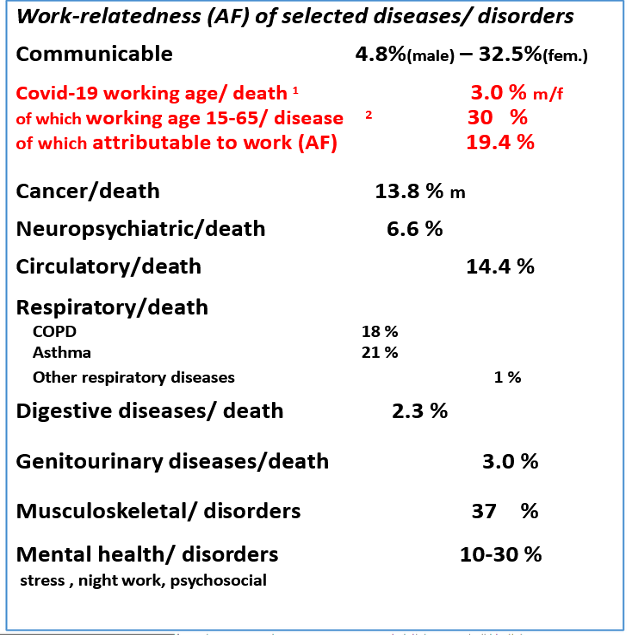
Figure 1: Work-relatedness of diseases, Hämäläinen et al. (2022). (Image credits: DOI:10.1016/j.shaw.2021.12.1158)
Cancer is a life-threatening illness that is the leading cause of mortality on global and national scales, especially among working-age people, which is an economic and social problem for society and affected families. Cells multiply and grow out of control, spreading to affect other tissues and organs, ultimately causing death.
People can be exposed to carcinogens and mutagens in workplaces that trigger the uncontrolled growth leading to occupational cancer, or cancer due to occupations. According to the International Congress on Occupational Health, deaths due to occupational cancers have risen from 666,000 in 2011 to 880,000 in 2021, showing that not enough has been done to control this problem. Moreover, among occupational diseases, cancer accounts for 13.8% of deaths, as shown in Table 1.
Since occupational cancer has a latency period of 10 to 40-50 years, it is sometimes challenging to determine the cause.
The cancers associated with occupation include lung, pharyngeal, oropharyngeal, mesothelioma, leukemia, nasal and sinus, liver, bladder, central nervous system, bone, breast, colon, rectal, stomach, and brain cancers.
The symptoms of cancer will vary based on the type of cancer and severity. Still, common complaints can include fever, fatigue, body pain, weight loss, loss of appetite, shortness of breath, altered bowel movements, lumps or scaly red skin, and abnormal bleeding.
Factors Increasing Cancer Risk
The presence of carcinogens alone does not cause cancer. The cancer risk from workplace exposure to carcinogens depends on various factors. According to the Canadian Centre for Occupational Health and Safety, some factors that influence the risk of cancer are as follows:
- Toxicity: Concentration and dose of the carcinogen are vital in determining the risk.
- Exposure type: The frequency (how often the person is exposed to the carcinogen) and the duration of exposure can affect cancer formation. The duration is calculated in weeks to years of exposure.
- Route of exposure: The carcinogen can enter the body through various routes- through breathing, contact through skin or eyes, swallowing by eating, or injection through skin penetration. Breathing is the main route of entry, followed by contact. Chemicals may be ingested if workers do not wash their hands after handling them before eating or smoking cigarettes.
- Job details: The type of work, place of work, and time will also influence risk. Disturbing the circadian rhythm is considered a risk factor.
- Management: Despite the presence of carcinogens, the types of measures used or absent can determine exposure concentrations, doses, frequencies, and durations. The higher the duration or amount of exposure, the greater the risk of cancer occurrence. So, workplace safety protocols and interventions are crucial in determining cancer incidence.
- Individual characteristics: The person’s genetics, habits such as smoking or drinking, lifestyle, gender, ethnicity, age, and ongoing medical treatments are also risk factors.
The risk is also determined by the ability of hazardous substances to cause cancer.
Carcinogenicity
The carcinogenic potential of substances is called carcinogenicity, which is determined through
animal (in vivo) studies, epidemiological studies, in vitro experiments, and silica calculations.
The International Agency for Research on Cancer (IARC), a part of the World Health Organization, a global entity, classifies carcinogens into five groups based on their carcinogenicity. These groups are as follows:
Group 1: The agents in this group are known to be carcinogenic to humans.
Group 2A: These factors are probably carcinogenic to humans.
Group 2B: These causal agents are possibly carcinogenic to humans.
Group 3: These are “not classifiable as to their carcinogenicity to humans.”
Group 4: “Probably not carcinogenic to humans.”
The American Conference of Governmental Industrial Hygienists (ACGIH) classifies carcinogens as follows:
A1: These are confirmed human carcinogens.
A2: The causal factors are suspected human carcinogens.
A3: This group contains confirmed animal carcinogens, but relevance to humans is unknown.
A4: These are “not classifiable as a human carcinogen.”
A5: This group is not suspected of being a human carcinogen.
Other regions and countries have their own classification.
Types of Occupational Carcinogens
The identified occupational carcinogens are of four types: biological, chemical, physical, and work organization.
Biological carcinogens
Several types of microorganisms, such as viruses and fungi, cause cancer through disease or by producing toxic substances, such as aflatoxins and mycotoxins. People working in the agriculture, food, and beverage industries that handle bulk food products, horticulture, waste management, and composting can be exposed to microbes.
- Viruses that cause cancer include the Hepatitis B virus, Kaposi sarcoma-associated herpesvirus, HIV, etc.
- Fungi that cause cancer are Aspergillus ochraceus, Aspergillus carbonarius, and Penicillium verrucosum.
Physical carcinogens
Included in this category are ultraviolet rays and ionizing radiation, such as X-rays and alpha, beta, and gamma radiation, which also cause cancer. Industrial and medical exposure to ionizing radiation can cause occupational skin cancer and possibly brain cancer. Heat exposure damages the DNA and results in a shock response that increases the risk of breast cancer.
Work organization
According to a Nordic Occupational Cancer Study (NOCCA), night shift and shift work that disrupts the sleep-wake rhythm, a lack of melatonin, and insomnia can cause breast cancer. Sedentary work could increase the risk of colon and rectal cancers.
Chemical carcinogens
Several chemicals used in industry or emitted as process byproducts cause cancer. The chemicals can be gases, vapors, dust, mist, fumes, liquids, and nanomaterials. The chemical carcinogens are asbestos, polycyclic aromatic hydrocarbons, arsenic, beryllium, cadmium, nickel, benzene, and formaldehyde. Nanomaterials or micro-sized solids such as carbon black, aluminum silicate, aluminum oxide, titanium dioxide, and amorphous silicon dioxide also cause tumors. Substances that act as endocrine disruptors (EDs) change hormonal functioning to cause breast and prostate cancers. EDs include phthalates, plasticizers (bisphenol A), polybrominated flame retardants, and specific pesticides, herbicides, and plant growth regulators, such as DDT and chlordecone.
Certain cancer types are associated with specific carcinogens and occupations. So, industrial hygienists can consult Table 2 to identify the cancers commonly related to their industries. For more information, check this resource. According to the CDC, professions with the highest risk of occupational cancer include rubber manufacturing, painting, roofing, paving, chimney cleaning, and firefighting.
Table 2: “The carcinogens, the cancers they cause, and the occupations in which workers are most commonly exposed,”
https://www.worksafebc.com/en/health-safety/injuries-diseases/occupational-cancer
| Occupation | Hazardous material or agent | Cancer types |
| Agriculture workers | Diesel engine exhaust | Lung |
| Pesticides | Lung | |
| Other organ | ||
| Solar radiation | Skin | |
| Building maintenance workers | Asbestos | Lung |
| Mesothelioma | ||
| Silica | Lung | |
| Construction workers (residential, industrial, commercial) |
Asbestos | Lung |
| Mesothelioma | ||
| Ionizing radiation | Lung | |
| Skin | ||
| Silica | Lung | |
| Wood dust | Nasal | |
| Electricians | Asbestos | Lung |
| Mesothelioma | ||
| PCBs | Liver | |
| Other organ | ||
| Firefighters | Combustion products from fires and diesel exhaust | Cancer types, including those identified in the Firefighters’ Occupational Disease Regulation |
| Furniture and cabinet makers | Formaldehyde | Pharynx & nasopharynx |
| Wood dust | Nasal | |
| Healthcare workers | Formaldehyde | Pharynx & nasopharynx |
| Hepatitis C | Liver | |
| Mechanics | Asbestos | Lung |
| Mesothelioma | ||
| Diesel engine exhaust | Lung | |
| Metalworkers | Asbestos | Lung |
| Mesothelioma | ||
| Oil & gas workers | Diesel engine exhaust | Lung |
| Silica | Lung | |
| Painters | Lead, solvents | Lung |
| Other organ | ||
| Pest control workers | Arsenic | Liver |
| Skin | ||
| Other organ | ||
| Pesticides | Lung | |
| Other organ | ||
| Plumbers | Asbestos | Lung |
| Mesothelioma | ||
| Pulp & paper mill and wood products manufacturing workers |
Asbestos | Lung |
| Mesothelioma | ||
| Formaldehyde | Pharynx & nasopharynx | |
| Road construction workers | Diesel engine exhaust | Lung |
| Silica | Lung | |
| Solar radiation | Skin | |
| Roofers | Asbestos | Lung |
| Mesothelioma | ||
| Silica | Lung | |
| Solar radiation | Skin |
5 Occupational Gases Causing Cancer
Among the hazardous occupational chemicals are a few carcinogenic gases. These are radon, benzene, ethylene oxide, formaldehyde, and 1,3-butadiene. Exposures to these gases can occur over years. Gases enter the body through inhalation and contact with the skin and eyes.
Radon: It is a radioactive gas present in underground uranium and coal mines. It causes lung cancer.
Benzene: The gas is found in petroleum, oil refining, and rubber manufacturing industries. It causes lung and bladder cancers.
Formaldehyde: Used in rubber and industrial resin manufacturing, embalming (funeral industry), and the textiles industry. Formaldehyde causes nasopharyngeal and other head and neck cancers.
1,3-Butadiene: The gas is produced as a byproduct of petroleum processing and used for synthetic rubber manufacturing. Exposure to the gas increases the risk of stomach, blood, and lymphatic system cancers.
Ethylene Oxide (EtO): The EtO gas is used for sterilizing medical equipment and to produce solvents and pharmaceuticals. It causes lymphatic and stomach cancer and leukemia.
However, it is worth noting that gaps exist in our knowledge of cancer-causing gases. For example, the carcinogenicity of the common occupational gas hazard, hydrogen sulfide, has not yet been established due to insufficient data.
Preventing Occupational Cancers
Management can limit exposure by applying the Hierarchy of Controls and taking sufficient measures to lower cancer risk. These involve administrative and engineering controls and the use of protective gear equipment (PPE). In new facilities, they can eliminate or reduce the use of carcinogenic gases. As part of engineering controls, industries can use fixed units for continuous monitoring and portable gas analyzers for spot checks to keep hazardous gas levels in the facility below permitted levels. Interscan offers fixed and portable systems for formaldehyde and ethylene oxide. For known carcinogens, any exposure is harmful, so PPE is essential to protect workers and reduce cancer risk.
Contact us at Interscan to learn more about the gas analyzers that could protect your workers’ health and lives.
Sources
ATSDR. (n.d.). ToxFAQs™ for 1,3-Butadiene. Retrieved from https://wwwn.cdc.gov/tsp/ToxFAQs/ToxFAQsDetails.aspx?faqid=458&toxid=81
CCOHS. (n.d.). Occupational Cancer. Retrieved from https://www.ccohs.ca/oshanswers/diseases/cancer/occupational_cancer.html#section-3-hdr
CDC. (2024, Aug 1). Occupational Cancer. Retrieved from https://www.cdc.gov/niosh/cancer/about/?CDC_AAref_Val=https://www.cdc.gov/niosh/topics/cancer/
Ekpanyaskul C. (2024). Update on Occupational Cancer for Better Cancer Prevention and Control. Asian Pacific Journal of Cancer Prevention: APJCP, 25(12), 4465–4476. https://doi.org/10.31557/APJCP.2024.25.12.4465
European Agency for Safety and Health at Work. (2022, Sep 13). Work-related cancer. Retrieved from https://oshwiki.osha.europa.eu/en/themes/work-related-cancer#:~:text=Table_content:%20header:%20%7C%20Occupation%20or%20industry%20%7C,chemicals%20used%20in%20%E2%80%9Cspotting%22%20%7C%20Sites:%20%7C
Hämäläinen, P., Neupane, S., Nygård, C. H., Sauni, R., & Takala, J. (2022). Comparative global estimates on the work-related burden of accidents and diseases. Safety and Health at Work, 13, S130.
HSENI. (n.d.). Occupational cancers. Retrieved from https://www.hseni.gov.uk/topics/occupational-cancers#toc-0
James Lind Institute. (2019, Jan 11). Occupational Cancers. Retrieved from https://jliedu.ch/occupational-cancers/