When safety teams compare Interscan gas detectors vs Gas Chromatography, they are usually comparing two different jobs rather than two interchangeable instruments. Interscan detectors are designed to monitor a known target gas continuously and provide concentration data and alarms where people are working. Gas chromatography, or GC, is designed to separate components in a sample so analysts can characterize a gas mixture with a high degree of chemical specificity. In practice, one approach prioritizes immediate operational awareness, while the other prioritizes detailed analytical separation.
Understanding that distinction makes it much easier to decide which technology belongs in a safety program.
What Interscan Gas Detectors Are Designed to Do
Interscan systems use gas specific sensor technology to measure hazardous gases at the point where exposure can occur. Electrochemical sensors work by reacting with a target gas and generating an electrical current related to its concentration. This makes the technology well suited to continuous industrial monitoring, particularly when the gas of concern is already known.
The portable GASD 8000 illustrates this approach. It uses active, continuous sampling through an integral pump and provides a digital concentration readout, real time graphics, data logging, and audible and visual alarms. The instrument can be configured for 21 gases and is designed for trace level detection, with sensitivity depending on the selected gas. Its rechargeable battery supports up to eight hours of continuous operation.
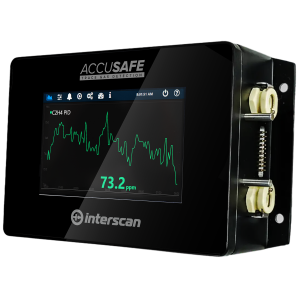
AccuSafe fixed-point gas detection system for continuous monitoring of gas hazards in industrial facilities.
For fixed monitoring, AccuSafe applies the same general philosophy across a facility. The system continuously draws samples and can connect multiple sensor locations to a central monitoring interface. The AccuSafe brochure describes configurations with up to 10 sensors connected to one display module, allowing users to monitor several rooms, zones, or process areas from one location.
That gives Interscan gas detection a practical advantage when the question is, “Is the target gas reaching a hazardous concentration right now?”
What Gas Chromatography Does Differently
Gas chromatography starts with a different analytical objective. Instead of continuously watching one location for a target gas, GC separates compounds in a collected sample. Components move through a chromatography column at different rates based on their interactions with the stationary phase. A detector then measures the separated compounds.
This separation is why GC is valuable when analysts need to distinguish individual chemicals in a complex mixture. GC can also be coupled with techniques such as mass spectrometry when more definitive compound identification is required.
Portable GC systems exist, so gas chromatography is not limited exclusively to centralized laboratories. Still, many industrial hygiene and environmental workflows use GC as a confirmatory or reference laboratory technique. Sample collection, handling, transportation, preparation, and analysis can add time between an exposure event and the final result.
Gas Chromatography
That difference in workflow matters when evaluating Interscan gas detectors vs Gas Chromatography.
Immediate Alarm Response vs Analytical Specificity
For workplace gas safety, speed is often part of the measurement requirement. Knowing that an exposure exceeded a threshold several hours after the event is useful for investigation, but it cannot provide an immediate warning to the worker standing in the affected area.
Interscan systems are designed around that operational need. Depending on the configuration, users can obtain:
- Continuous active air sampling
- Trace level monitoring of a selected gas
- Real time concentration readings
- Audible and visual alarms
- Exposure data logging
- Portable monitoring with the GASD 8000
- Fixed, multi location monitoring with AccuSafe
- On site sensor replacement through Interscan’s Interchange Sensor System
These capabilities make the detector part of the safety response itself, rather than simply an analytical tool used after sampling. The Interscan gas detection product line includes portable and fixed solutions for this type of continuous monitoring.
GC has the advantage when the analytical question is more complicated. If investigators have an unknown sample containing several compounds, separating those compounds can provide information that a target gas sensor is not intended to deliver.
Selectivity Still Matters in Electrochemical Detection
The comparison should not imply that electrochemical gas detection automatically identifies every chemical present. These sensors are designed around particular target gases, and cross sensitivity can occur when other reactive gases produce a response.
Sensor design, electrode materials, electrolytes, filters, operating conditions, temperature, and humidity can all influence performance. That is why appropriate sensor selection and calibration remain important. Interscan discusses these factors in its guide to how electrochemical gas sensors work.
GC approaches the selectivity problem differently by physically separating components before detection. Its value becomes particularly clear when a laboratory needs to determine what compounds are present rather than simply determine whether a known target gas has reached a concerning concentration.
When Should You Use Each Technology?
The best choice depends on the decision that the measurement needs to support.
Choose continuous Interscan gas detection when personnel need to know immediately that a known hazardous gas is present or increasing. Applications can include process monitoring, leak detection, industrial hygiene, worker exposure assessment, and fixed area surveillance.
Choose GC when the primary objective is detailed sample characterization, compound separation, confirmation, or investigation of a complex or unknown mixture.
For many organizations, these are complementary functions. A real time detector can identify an excursion and trigger an immediate response. Samples associated with the event can then be sent for GC analysis when additional chemical identification or documentation is required. Interscan’s overview of gas detection and analysis technologies describes this broader distinction between sensing technologies and laboratory analytical methods.
The practical question in Interscan gas detectors vs Gas Chromatography is therefore not which technology is universally better. It is whether your operation needs to act on a known gas concentration now, characterize a complex sample later, or do both.
When immediate warnings and continuous exposure visibility are central to the application, explore Interscan’s portable and fixed gas detection systems to find a configuration suited to your target gas and monitoring environment.
Frequently Asked Questions
Can an Interscan gas detector replace gas chromatography?
Not for every analytical task. An Interscan detector is intended for continuous measurement of a selected target gas, while GC is designed to separate components in a sample. For workplace alarms and real time monitoring, Interscan can provide information much closer to the point of exposure. For detailed characterization of complex mixtures, GC may still be appropriate.
Can Interscan gas detection and GC be used together?
Yes. A detector can provide continuous monitoring and alert personnel when concentrations change, while GC can be used later for confirmatory analysis or more detailed characterization. This combination can give a facility both rapid operational information and laboratory analytical depth.
Which option is better for continuous workplace exposure monitoring?
For a known target gas that must be monitored continuously, a purpose built gas detector is generally the more direct approach. Systems such as the GASD 8000 and AccuSafe provide active sampling, concentration readings, data logging, and alarm capabilities designed specifically for ongoing industrial gas monitoring.