Choosing between Interscan gas detection platforms is less about finding a single “best” detector and more about matching the instrument to the monitoring job. In a GASD 8000 vs GASD IS vs AccuSafe comparison, the biggest differences are mobility, hazardous-location requirements, and whether monitoring needs to follow a technician or remain active at fixed points around a facility. All three systems are designed around low-level gas detection and continuous sampling, but they solve different operational problems.
The GASD 8000 is a portable analyzer for general industrial monitoring. The GASD IS brings portable trace-level detection to applications where intrinsic safety is a core requirement. AccuSafe takes a different approach as a fixed-point, connected system intended for continuous monitoring across designated locations.
GASD 8000 vs GASD IS vs AccuSafe at a glance
| Consideration | GASD 8000 | GASD IS | AccuSafe |
|---|---|---|---|
| Primary format | Portable | Portable | Fixed point |
| Best fit | Surveys, inspections, troubleshooting | Portable work in hazardous classified environments | Continuous facility monitoring |
| Sampling | Active and continuous | Active and continuous | Active and continuous |
| Trace-level detection | Yes | Yes | Yes |
| Data logging | Yes | Yes | Yes |
| Hazardous-area focus | No intrinsic-safety positioning | Designed around intrinsic safety, certification pending | Fixed industrial monitoring |
| Networking | Portable edge device | Portable edge-enabled device | Distributed IIoT architecture |
| Multi-point capability | Operator moves instrument | Operator moves instrument | Up to 10 smart sensor modules per controller |
The practical decision usually starts with three questions: Does the detector need to move? Is the monitoring location classified? And does the facility require unattended, continuous coverage?
Choose GASD 8000 for flexible portable monitoring
The GASD 8000 is the most straightforward choice when technicians need to move between sampling points.
It uses an integral sample pump for active, continuous sampling and combines the concentration reading with a real-time graphical display, data logging, and audible and visual alarms. Interscan specifies detection capability across 21 gases, depending on the installed sensor. The instrument also provides 4-20 mA and 0-2.5 V analog outputs.
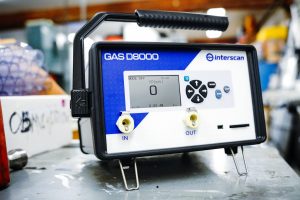
GASD 8000
Typical applications include:
Subscribe to receive our monthly round-up of articles.
- Industrial hygiene surveys
- Maintenance inspections
- Leak investigations
- Process troubleshooting
- Temporary monitoring
- Checking multiple locations during a shift
The GASD 8000 is especially useful when a facility does not know in advance exactly where measurements will be needed. Instead of installing instrumentation at every possible sampling point, a technician can take the analyzer directly to the area of interest.
It is also designed for practical field use. The instrument has a sunlight-visible transflective display, an anodized aluminum enclosure, a 32 GB integral SD card, and up to eight hours of continuous battery operation.
For a closer look at the portable-versus-fixed decision, Interscan also compares the GASD 8000 and AccuSafe for industrial monitoring.
Choose GASD IS when classified-area requirements drive the decision
The GASD IS occupies a similar portable role, but its design is focused on potentially explosive atmospheres.
Like the GASD 8000, it uses continuous active air sampling and is designed for extremely low trace-level detection. It also provides a portable form factor, field-readable interface, data logging, alarms, and Interscan’s replaceable sensor approach. The key difference is that the GASD IS is engineered around intrinsic safety requirements.
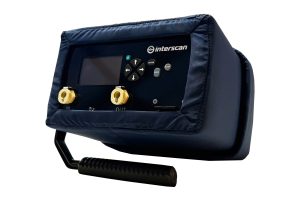
GASD IS
That distinction matters in environments such as:
- Refineries
- Chemical processing facilities
- Fuel handling areas
- Tank farms
- Certain confined spaces
- Locations where flammable gases or vapors may be present
Intrinsic safety is intended to prevent electrical or thermal energy in an instrument from becoming an ignition source. Interscan currently describes the GASD IS as undergoing intrinsic safety certification for hazardous classified locations, so facilities should verify the current certification status against their specific site requirements before deployment.
This is why the GASD 8000 vs GASD IS vs AccuSafe question can sometimes be answered before comparing any other specification. If technicians must carry a portable analyzer into a classified location, hazardous-area suitability becomes a primary selection criterion.
Interscan covers this distinction in more detail in its article on GASD IS vs GASD 8000 and classified-area use.
For applications where this requirement is central, review the GASD IS portable gas detector as the starting point for system selection.
Choose AccuSafe when the monitoring point cannot be left unattended
AccuSafe changes the GASD 8000 vs GASD IS vs AccuSafe comparison because it is not primarily a portable survey instrument.
It is a fixed-point monitoring platform intended to watch selected areas continuously. Each smart sensor module incorporates an active sampling pump and local data acquisition and processing. Up to ten sensor modules can report to a single controller using Modbus TCP/IP, giving facilities the ability to distribute monitoring across multiple locations.
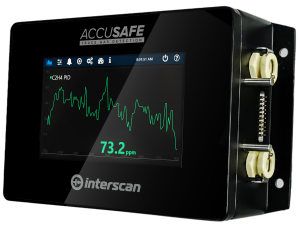
Accusafe
That makes AccuSafe better suited to locations where a gas hazard may develop whether or not a technician happens to be present.
Examples include:
- Permanent process areas
- Known release points
- Gas storage locations
- Manufacturing lines
- Rooms requiring continuous toxic-gas monitoring
- Facilities that need centralized alarm and data visibility
AccuSafe can detect up to 10 unique gases simultaneously in a multi-point configuration and supports a wider connected architecture through Modbus TCP and RTU, remote browser access, a desktop application, and an MQTT API. The system also supports sound, email, and SMS notifications.
For facilities moving toward connected operations, this architecture is significant. Monitoring does not depend on somebody walking through the area with an instrument. The sensors remain at the measurement points and continuously pass information into the facility’s monitoring infrastructure.
Portable and fixed detection can work together
These products do not always have to be treated as mutually exclusive choices.
A facility may use AccuSafe to continuously monitor its highest-risk fixed locations while keeping a GASD 8000 available for investigations and mobile surveys. In classified areas, a GASD IS may fill that portable role where the applicable hazardous-location requirements are met.
That combination addresses one of the inherent limitations of any fixed system. A fixed sensor can continuously monitor its installed location, but it cannot physically follow technicians into new work areas or investigate a reading elsewhere in the plant.
Portable equipment fills that gap.
Conversely, relying only on a portable detector means readings generally depend on somebody being present and sampling the area. AccuSafe adds an always-on monitoring layer for locations where continuous visibility matters.
How to make the final choice
When evaluating GASD 8000 vs GASD IS vs AccuSafe, start with the operating scenario rather than a feature checklist.
Choose the GASD 8000 when you need portable trace-level measurements across changing locations and classified-area approval is not a requirement.
Choose the GASD IS when you need the flexibility of a portable Interscan analyzer and the work takes place in environments where intrinsic-safety requirements apply. Confirm the instrument’s current certification status for your specific area classification before use.
Choose AccuSafe when critical locations require continuous, unattended fixed-point monitoring, centralized data access, and scalable network connectivity.
In many larger facilities, the strongest answer is a combination of fixed and portable monitoring. That gives safety teams continuous coverage where hazards are predictable and a portable instrument for everything that is not.
InterScan can help determine the appropriate sensor, measurement range, sampling setup, and instrument architecture for a specific gas and operating environment. If classified-area portable monitoring is driving your decision, start by reviewing the GASD IS and contact InterScan to discuss the requirements of your application.
Frequently Asked Questions
What is the biggest difference between GASD 8000, GASD IS, and AccuSafe?
The main difference is how and where they are deployed. GASD 8000 is a general-purpose portable analyzer, GASD IS is designed around portable monitoring in hazardous classified environments, and AccuSafe is a fixed-point system for continuous facility monitoring.
Should I choose GASD IS instead of GASD 8000 for every portable application?
Not necessarily. If the monitoring area does not require intrinsically safe equipment, the GASD 8000 provides portable active sampling, trace-level sensitivity, data logging, alarms, and up to eight hours of continuous operation. GASD IS becomes particularly relevant when hazardous-location requirements affect instrument selection.
Can AccuSafe replace a portable gas detector?
It can replace the need for manual measurements at certain permanently monitored points, but it does not provide the same mobility as GASD 8000 or GASD IS. Many facilities benefit from using AccuSafe for continuous fixed monitoring while retaining a portable analyzer for surveys, investigations, maintenance work, and measurements outside the installed sensor network.