When safety teams compare Interscan gas detectors vs FTIR Analysis, they are usually comparing two different approaches to gas measurement rather than two interchangeable instruments. Interscan gas detectors are designed around rapid, target-gas monitoring at the point where a safety decision needs to be made. FTIR spectroscopy is built around infrared spectral analysis and can identify or quantify multiple compounds in a gas mixture. The better choice depends on whether the priority is immediate operational response or broader chemical characterization.
For industrial hygiene, leak investigation, process safety, and facility monitoring, that workflow difference matters as much as analytical sensitivity.
How Interscan Gas Detection Works in the Field
Interscan’s approach focuses on detecting specific gases with sensors selected for the application. Instead of collecting a broad spectrum and determining which compounds are present afterward, the detector is configured to monitor a known hazard and provide a concentration reading directly.
The portable GASD 8000 is a good example. It supports sensor options for 21 gases and provides active, continuous sampling through an integral pump. Concentrations appear on a digital display with real-time graphics, while audible and visual alarms provide immediate notification when hazardous conditions develop.
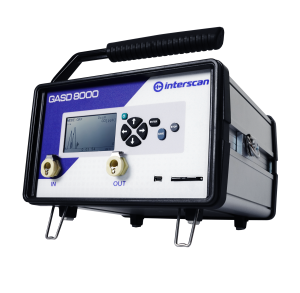
The Interscan GASD 8000 provides portable, continuous gas monitoring for field surveys, maintenance, and task-based applications.
The instrument also includes:
- Up to eight hours of continuous operation
- Integral 32 GB SD card data logging
- Analog outputs for integration with other systems
- A sunlight-visible display
- A rechargeable lithium-ion battery
- Trace-level sensitivity that varies by target gas
- A 6.5 lb portable enclosure
These features make the GASD 8000 practical when personnel need to move through a facility, evaluate suspected releases, perform industrial hygiene measurements, or verify gas concentrations without sending samples elsewhere.
For permanent monitoring, the AccuSafe fixed-point gas detection system extends the same operational idea across a facility. AccuSafe can connect up to ten smart sensor modules to one controller through Modbus TCP/IP. Each sensor module incorporates sample draw capability and local data processing, supporting continuous monitoring across multiple rooms or process areas.
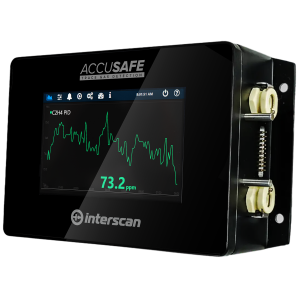
AccuSafe provides continuous fixed-point gas monitoring with connected smart sensors, centralized data access, alarms, and logging.
This is where the Interscan gas detectors vs FTIR Analysis comparison becomes especially important. A fixed gas monitoring system is meant to watch the hazard continuously, not wait for someone to initiate an analytical test.
Where FTIR Analysis Has the Advantage
Fourier Transform Infrared spectroscopy takes a broader analytical approach. Gas molecules absorb infrared radiation at characteristic frequencies, producing spectra that can be compared with reference information to identify and quantify compounds.
EPA Method 320 describes FTIR for compound-specific measurements in multi-component vapor-phase samples. The method applies to organic and inorganic compounds that absorb in the mid-infrared region, with software used to analyze spectra and report concentrations.
That gives FTIR an important advantage when the question is not simply “How much chlorine is present?” but rather “What compounds are actually present in this mixture?”
For example, FTIR can be useful for:
- Characterizing complex process emissions
- Identifying unknown IR-active compounds
- Measuring several compounds from the same spectrum
- Investigating combustion or decomposition products
- Conducting detailed emissions or research studies
FTIR also should not be described as strictly laboratory-only. Modern systems can perform field analysis and even real-time measurements. Thermo Fisher, for example, describes an FTIR system integrated into an emergency response vehicle for on-site identification of unknown gases. That configuration uses a spectrometer, gas cell, sampling equipment, software, and spectral libraries to bring laboratory-style analytical capability into the field.
The tradeoff is that this broader information comes with a more analytical workflow.
Real-Time Safety Response vs Spectral Interpretation
The practical difference between Interscan gas detectors vs FTIR Analysis becomes clearest during a gas release.
If a facility already knows that ethylene oxide, hydrogen chloride, chlorine, ammonia, or another specific hazardous gas is the primary concern, a dedicated detector can continuously watch that gas and provide an immediately understandable concentration reading. Alarm functions can turn the measurement directly into an operational response.
FTIR generates much richer chemical information, but the system must acquire and interpret an infrared spectrum. Depending on the application, sampling lines, gas cells, spectral libraries, software, interference evaluation, and trained operators may be involved. EPA Method 320 specifically notes that users should be familiar with FTIR spectroscopy and describes factors such as spectral resolution, absorption path length, sample composition, moisture, and interfering species as relevant to measurement performance.
That distinction does not make one technology universally more accurate than the other. It means each is optimized for a different question.
Interscan asks: Is my target gas present, at what concentration, and do I need to act?
FTIR asks: What infrared-active compounds are in this sample, and what does the overall spectrum tell me?
When Interscan Is the More Practical Choice
For many routine industrial safety programs, focused gas detection has a straightforward advantage. Safety personnel typically know which chemicals are stored, used, generated, or transported at the facility. Monitoring can therefore be designed around those hazards.
Interscan is particularly well suited when operators need:
- Continuous fixed monitoring around known gas hazards
- Portable measurements at different points in a facility
- Trace-level target-gas measurements
- Immediate local alarms
- Real-time concentration trends
- Simple field data collection and logging
- Integration with connected industrial safety systems
For a deeper look at sensor-based measurement, see Interscan’s guide to how electrochemical gas sensors work. Teams deciding between permanent infrastructure and mobile measurements can also review fixed or portable gas detectors. For facilities building long-term monitoring records, the article on the role of data logging in gas detection explains why continuous measurement history matters.
FTIR remains valuable when the chemical composition is unknown, when several compounds must be characterized at once, or when detailed analytical information is the primary objective. In many facilities, the technologies can complement one another. FTIR can help characterize a complex problem, while dedicated gas detectors provide the ongoing operational monitoring needed after the relevant hazards are understood. Even manufacturers of field FTIR systems describe the technology as a complement to traditional gas monitors rather than a universal replacement.
For safety teams that already know which hazardous gases matter, Interscan provides a direct route from detection to action. Portable GASD 8000 analyzers support field measurements, while AccuSafe provides continuous fixed-point coverage for connected facilities. Explore the full range of Interscan gas detection systems to select a configuration built around the gases, locations, and response requirements in your operation.
Frequently Asked Questions
Can FTIR detect multiple gases at the same time?
Yes. FTIR can analyze multi-component gas samples by evaluating infrared absorption features associated with different compounds. Its usefulness depends on whether the compounds absorb in the relevant infrared range, the instrument configuration, sample conditions, and potential spectral interference.
Are Interscan detectors only suitable for portable measurements?
No. Interscan offers both portable and fixed-point approaches. The GASD 8000 is designed for portable gas analysis, while AccuSafe provides continuous fixed monitoring and can connect multiple smart sensor modules through a centralized system.
Which is better for an immediate gas leak response, Interscan or FTIR?
For a known target gas, a dedicated Interscan detector generally provides the more direct operational workflow because it continuously displays the target-gas concentration and can provide immediate audible and visual alarms. FTIR is especially useful when responders need broader chemical identification or analysis of an unknown or complex gas mixture.