Formaldehyde monitoring looks straightforward until you have to choose an instrument for a specific facility. Healthcare sterile processing departments, pathology labs, research facilities, and manufacturing plants use formaldehyde differently, so the monitoring strategy needs to match the actual exposure scenario. Good formaldehyde monitor selection starts with the concentration range you need to measure, then considers where measurements are required, whether monitoring must be continuous, and how the resulting data will be used. In healthcare environments, these decisions are especially important because formaldehyde can be present alongside other sterilization gases and chemical hazards. Interscan provides additional guidance for these applications in its healthcare and sterile processing gas detection resources.
Start with the concentration range
A formaldehyde monitor should be selected around the concentrations that matter to the application, not simply the widest range available.
OSHA’s formaldehyde limits include a permissible exposure limit of 0.75 ppm as an 8-hour time-weighted average, an action level of 0.5 ppm, and a 2 ppm short-term exposure limit. That makes low-level measurement capability particularly relevant when the objective is occupational exposure monitoring rather than identifying a major release.
Interscan offers formaldehyde detection ranges including:
- 0 to 10.0 ppm
- 0 to 5.0 ppm
- 0 to 2000 ppb
These options allow a facility to match the sensor range more closely to the expected environment. A lower range can be useful when the main concern is identifying small changes around an occupational exposure threshold. A broader range may make more sense around processes where higher concentrations are possible.
This is one reason formaldehyde monitor selection should begin with the monitoring objective. A detector intended to investigate low-level background concentrations has a different job from one positioned near a process where an accidental release could occur. More information on available ranges is available on Interscan’s formaldehyde detection page.
Decide whether you need portable or fixed monitoring
The next question is where the measurement needs to happen.
Subscribe to receive our monthly round-up of articles.
A portable analyzer works well when industrial hygienists, safety teams, or laboratory personnel need to move from one sampling point to another. Interscan’s GASD 8000 portable gas analyzer supports formaldehyde and uses active sampling for real-time continuous monitoring. Its manual specifies automatic data logging, SD card storage, adjustable alarm settings, a sample probe, and approximately five to eight hours of battery operation depending on use.
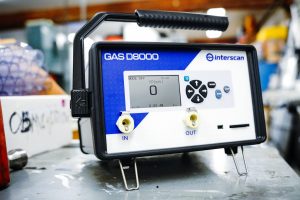
GASD 8000
That configuration can fit applications such as:
- Checking multiple laboratory workstations
- Evaluating pathology or specimen-processing areas
- Investigating complaints or suspected exposure locations
- Testing around storage cabinets or process equipment
- Comparing conditions before and after ventilation changes
- Conducting scheduled industrial hygiene surveys
Fixed monitoring addresses a different problem. If formaldehyde may be released repeatedly from the same process or workers occupy the area routinely, waiting for someone to arrive with a portable instrument leaves a monitoring gap.
The AccuSafe fixed-point gas detection system provides continuous monitoring through smart sensor modules with integrated sample draw pumps. Up to ten sensor modules can report to a single controller, and the system supports data logging and connected alarm functions.
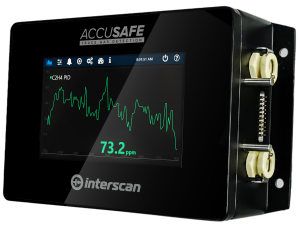
Accusafe
In many facilities, the best answer is not choosing one format exclusively. Interscan discusses this directly in its guide to GASD 8000 vs. AccuSafe monitoring. A fixed system can watch known risk areas continuously while a portable analyzer handles investigations, verification, and measurements outside the permanent sensor network.
Match the monitor to the work environment
The right formaldehyde monitor selection also changes by industry.
Healthcare facilities
Formaldehyde can appear in healthcare and sterile processing environments alongside ethylene oxide, hydrogen peroxide, and other chemical hazards. Hospitals may need continuous monitoring around predictable risk locations while still requiring a portable analyzer for troubleshooting or exposure surveys.
A connected fixed system is particularly useful when a department wants alerts without relying on someone to perform every measurement manually.
Laboratories and pathology
Laboratories often have more localized and changing sampling needs. Formaldehyde and formalin may be used around specimen preparation, preservation, storage, and waste handling.
A portable monitor gives an industrial hygienist more flexibility to compare locations. Measurements can be taken near a workstation, ventilation hood, storage location, doorway, or other point of concern without installing a permanent sensor at every position.
Where the same formaldehyde process operates routinely, fixed monitoring can complement these surveys.
Manufacturing
Manufacturing introduces another set of variables. Formaldehyde is used in applications involving resins, adhesives, wood products, textiles, coatings, and other chemical processes.
Here, formaldehyde monitor selection often has to account for multiple release points, larger work areas, changing airflow, and integration with facility safety systems. A networked fixed solution can provide continuous coverage at selected locations, while a portable analyzer helps teams investigate equipment, verify engineering controls, and identify areas where additional fixed sensors may be justified.
Do not overlook sampling and sensor placement
Instrument specifications are only part of the measurement system. The gas still has to reach the sensor.
Active sample draw can be useful because the monitor pulls the sample to the sensing element rather than depending entirely on passive gas movement. Both the GASD 8000 and AccuSafe use active sampling approaches.
For fixed installations, placement should consider likely leak points, worker breathing zones, process equipment, ventilation patterns, doors, obstructions, and environmental conditions. A detector installed in the wrong location can produce a technically accurate measurement that does not represent the exposure you actually need to understand.
Interscan’s guide to gas detector placement for safety and accuracy provides a useful starting point for evaluating these factors.
Consider data, alarms, and maintenance
A monitor should also fit the way your safety program operates after the measurement is taken.
Useful formaldehyde monitor selection questions include:
- Do you need a historical record of readings?
- Will several people need access to monitoring data?
- Does the application require local alarms?
- Should alarms or data be available remotely?
- How often will the sensor require service or replacement?
- How much downtime is acceptable during sensor maintenance?
- Does the instrument need to move between departments or remain installed continuously?
The GASD 8000 provides onboard data storage and downloadable data, making it useful for surveys and documenting measurements. AccuSafe is designed for connected, continuous monitoring and can provide centralized access to measurements from multiple installed sensor points.
Interscan also uses replaceable sensor cartridges and offers SensorExpress for sensor replacement and calibration support, which can reduce the operational disruption associated with maintaining gas detection equipment.
The most effective formaldehyde monitor selection process is therefore based on the monitoring task rather than a single specification. Define the concentration range, determine whether measurements need to move with personnel or remain at fixed locations, assess sampling conditions, and decide how alarms and data need to fit into the facility’s safety procedures. For more background, Interscan’s formaldehyde detection Q&A covers additional monitoring considerations.
Frequently Asked Questions
What range should I choose for a formaldehyde monitor?
Choose the range around the concentrations you actually need to evaluate. Low-level workplace exposure monitoring may benefit from a lower measurement range, while areas where higher concentrations are possible may require broader coverage. Interscan offers formaldehyde sensor ranges from ppb-level monitoring through higher ppm ranges.
Is a portable or fixed formaldehyde monitor better for healthcare facilities?
They serve different purposes. Portable monitors such as the GASD 8000 are useful for surveys, investigations, and changing sampling locations. Fixed systems such as AccuSafe are better suited to continuously monitoring known risk points. Some healthcare facilities can benefit from using both.
Can one formaldehyde monitor cover an entire manufacturing facility?
A portable analyzer can be moved throughout a facility, but it only monitors wherever it is currently sampling. A fixed system continuously watches installed monitoring points, but sensor placement determines its coverage. Large or complex facilities may therefore use multiple fixed sensors along with portable monitoring for investigations and verification.
If you are evaluating formaldehyde monitoring for healthcare, laboratory, or manufacturing operations, InterScan can help match the sensor range and monitoring format to the actual exposure scenario. Explore the GASD 8000 for portable measurements or AccuSafe for continuous fixed-point monitoring, and contact InterScan to configure a formaldehyde detection system around your facility’s sampling, alarm, and data requirements.